Sourcing Authentic Oaxacan Zapotec Huipils: 2026 Collector's Guide
The Enduring Legacy of the Oaxacan Huipil in 2026
The huipil, derived from the Nahuatl word huipilli, is far more than a traditional garment; it is a woven codex of indigenous identity, cosmology, and regional pride. Across the Americas, few textile traditions command the reverence and intricate mastery of the Oaxacan huipil. As we navigate the global textile market in 2026, the intersection of high fashion, cultural appreciation, and indigenous intellectual property rights has made the authentication and ethical sourcing of these garments more critical than ever. For collectors, curators, and enthusiasts of Latin American traditional garments, understanding the nuances of Oaxacan weaving is essential to preserving this living heritage.
Oaxaca remains the beating heart of Mexico's textile arts, home to over 16 distinct indigenous groups, each with its own sartorial language. While the state is famous for its diversity, the Zapotec, Mixtec, and Amuzgo weaving traditions of the Valles Centrales and the Costa Chica regions produce some of the most highly sought-after huipils in the world. According to the Museo Textil de Oaxaca, a premier institution dedicated to the preservation of these arts, the contemporary huipil continues to evolve while maintaining strict adherence to pre-Columbian structural techniques. In 2026, a genuine, hand-woven huipil represents hundreds of hours of labor, deep botanical knowledge, and an unbroken lineage of matriarchal craftsmanship.
Decoding the Backstrap Loom: Techniques and Tensions
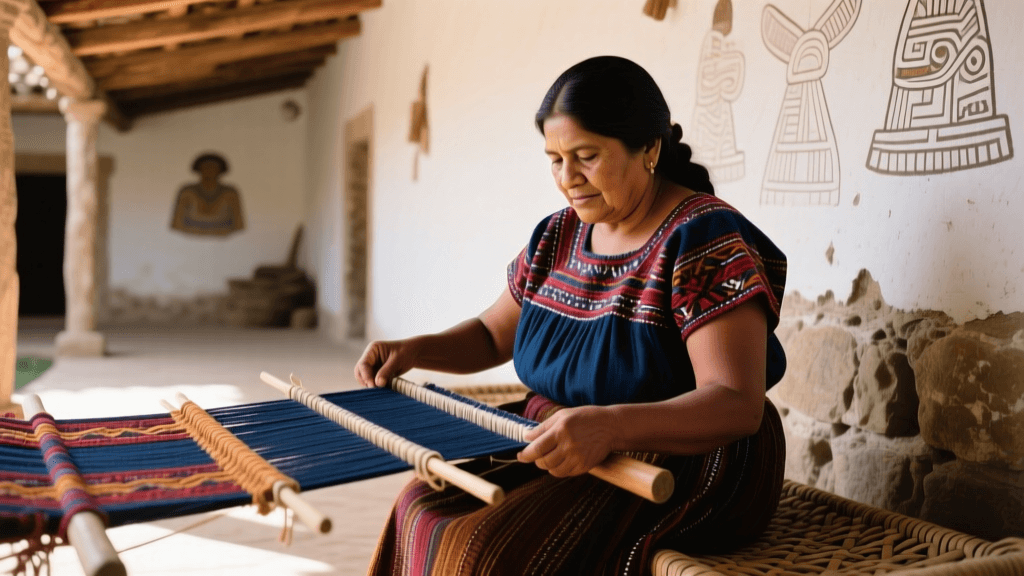
To authenticate an Oaxacan huipil, one must first understand the technology used to create it. The vast majority of traditional, high-grade huipils are woven on a telar de cintura, or backstrap loom. This ancient device consists of a series of wooden rods, a heddle, and a shuttle. One end of the warp is tied to a sturdy post or tree, while the other is attached to a belt that wraps around the weaver's lower back. The weaver's own body provides the tension; by leaning forward or backward, she adjusts the warp threads to create the shed through which the weft is passed.
This intimate connection between the weaver and the loom results in a fabric that is uniquely structured. Authentic backstrap-woven textiles typically feature finished selvedges on all four sides, meaning the fabric is woven to its exact final dimensions and never cut with scissors. A standard Oaxacan huipil is constructed from two or three separate panels of cloth, woven to a width of roughly 24 to 30 inches each. These panels are then joined vertically using a highly decorative, hand-embroidered seam known as a randa. In 2026, the complexity of the randa—often featuring intricate lace-like cross-stitching or zigzag patterns—is a primary indicator of a garment's ceremonial importance and the weaver's technical mastery.
Furthermore, the choice of fiber is a major authentication marker. While commercial cotton is widely used for everyday garments, elite collectors in 2026 seek out huipils woven from coyuche cotton. Coyuche is a rare, naturally pigmented indigenous cotton variety that grows in shades of warm brown, rust, and soft green. Because the fiber is naturally colored, it requires no dyeing, and its cultivation is heavily protected by local agricultural cooperatives to prevent cross-pollination with commercial white cotton strains.
The Alchemy of Natural Dyes: Cochineal, Indigo, and Caracol Púrpura
The color palette of an authentic Oaxacan huipil is derived from the region's rich biodiversity. Master dyers utilize complex, multi-step fermentation and mordanting processes that have been refined over centuries. The most famous of these is cochineal (Dactylopius coccus), a parasitic scale insect that lives on the native nopal cactus. When dried and crushed, cochineal yields a potent carminic acid that, depending on the mordant used (such as alum, iron, or acidic lime juice), can produce brilliant crimsons, deep purples, and soft pinks.
Indigo (Indigofera suffruticosa), or añil, is another cornerstone of the Oaxacan dye palette. The extraction of indigo requires a meticulous alkaline fermentation process. Genuine natural indigo possesses a distinct, slightly earthy scent and a visual depth that synthetic equivalents cannot replicate. When examining a blue textile in 2026, look for subtle variations in the hue and a slight powdery residue on the surface of the fibers, which are hallmarks of organic vat dyeing.
Perhaps the most precious and heavily regulated dye in 2026 is Caracol Púrpura (Plicopurpura pansa), a marine snail found along the rocky shores of the Pacific coast. The Mixtec weavers of San Juan Colorado and Pinotepa de Don Luis harvest the snail's milky secretion, which oxidizes in the sunlight to become a vibrant, colorfast purple. Due to severe overharvesting in the late 20th century, the Mexican government and indigenous councils have implemented strict seasonal harvesting limits. Today, a huipil dyed with genuine Caracol Púrpura is an exceptionally rare, museum-grade artifact, often commanding prices well over $2,500 USD on the international collector's market.
2026 Authentication Guide: Spotting Genuine Artisanal Textiles
As global demand for 'boho-chic' and indigenous-inspired fashion has surged, the market has been flooded with machine-made imitations. Distinguishing a genuine, hand-woven Oaxacan huipil from a commercial factory reproduction requires a trained eye. Below is a comparative guide to help buyers and collectors authenticate pieces in the current market.
| Feature | Authentic Artisanal Huipil (2026) | Commercial / Machine Imitation |
|---|---|---|
| Material | Hand-spun or locally milled cotton, Coyuche, or wild silk | Synthetic blends, polyester-cotton, rayon |
| Dyes | Cochineal, Indigo, Marigold (slight hue variations) | Uniform synthetic azo dyes, harsh chemical smell |
| Selvedge | Finished naturally on the loom, no cut edges | Raw edges, serged, or machine-hemmed |
| Joinery | Hand-embroidered 'randa' stitch connecting panels | Machine straight-stitch or glued seams |
| Pattern Integration | Supplementary weft brocade (pattern is woven in) | Embroidered on top of finished cloth or printed |
| Price Range | $250 - $1,500+ USD (up to $3,000 for ceremonial) | $25 - $85 USD |
Note: The Smithsonian National Museum of the American Indian maintains extensive digital archives of historical Mesoamerican textiles, which serve as an invaluable visual reference for collectors studying traditional brocade motifs and structural joinery.
Market Pricing and Ethical Sourcing in 2026
The pricing of Oaxacan huipils in 2026 reflects a growing awareness of fair trade and the true cost of artisanal labor. A standard, everyday huipil woven with commercial cotton thread and synthetic dyes from a village like Santo Tomás Jalieza typically ranges from $120 to $250 USD. However, a ceremonial huipil from San Antonino Castillo Velasco, featuring intricate silk-thread embroidery and natural cochineal dyes, will easily command between $600 and $1,200 USD.
Ethical sourcing is paramount. The exploitation of indigenous weavers by middlemen—often referred to locally as coyotes—remains a challenge, though the rise of digital cooperatives has empowered many artisans. Collectors in 2026 are strongly encouraged to purchase directly from recognized, women-led weaving cooperatives in the Valles Centrales or via verified fair-trade partnerships that guarantee the weaver receives the majority of the sale price. When buying from galleries or online boutiques, always demand transparency regarding the specific village of origin, the name of the weaver, and the cooperative affiliation. Authentic documentation not only increases the garment's provenance value but ensures your investment directly supports the continuation of the craft.
Archival Care and Preservation for Collectors
Once you have acquired an authentic Oaxacan huipil, proper preservation is essential to maintain its structural integrity and color vibrancy. Textile conservation requires a careful balance of environmental control and gentle handling. According to guidelines published by the American Institute for Conservation, organic fibers like cotton and silk are highly susceptible to light damage, pest infestation, and acidic degradation.
Washing: Never machine wash or dry clean a hand-woven, natural-dyed huipil. Dry cleaning chemicals can strip natural oils from the cotton and alter the pH of natural dyes, causing cochineal to shift from red to a dull brown. If cleaning is absolutely necessary, gently hand-wash the garment in cold water using a pH-neutral, conservation-grade detergent. Do not wring or twist the fabric; instead, press it between clean towels to absorb excess moisture and lay it flat to dry in the shade.
Storage: Never hang a heavy, hand-woven huipil on a wire or wooden hanger, as the weight of the wet or dry fabric will distort the warp threads and stress the shoulder seams. For long-term archival storage, fold the garment loosely with acid-free, unbuffered tissue paper to prevent sharp creases. Place it in an acid-free archival box or a clean, undyed cotton pillowcase. Store the box in a climate-controlled environment with a relative humidity of around 50% to prevent mold growth and fiber embrittlement. By treating these garments with the respect afforded to fine art, collectors ensure that the vibrant legacy of Oaxacan textile arts endures for generations to come.