Authenticating Oaxacan Backstrap Woven Huipiles: 2026 Buyer Guide
The Cultural Heart of the Oaxacan Huipil in 2026
The traditional huipil of Oaxaca, Mexico, is far more than a simple garment; it is a wearable codex, a mathematical triumph, and a profound expression of Indigenous identity. As we navigate the global textile market in 2026, the demand for authentic Latin American traditional garments has surged. Unfortunately, this heightened interest has also led to an influx of mass-produced, machine-embroidered imitations that appropriate Indigenous designs without supporting the artisan communities. For collectors, cultural enthusiasts, and ethical fashion advocates, understanding how to authenticate a genuine backstrap-woven huipil is an essential skill.
Oaxaca remains the epicenter of Mexico's textile heritage, home to diverse Indigenous groups including the Zapotec, Mixe, Chinantec, and Mixtec peoples. Each community utilizes the ancient telar de cintura (backstrap loom) to create garments that reflect their specific cosmology, local flora, and historical lineage. This comprehensive guide will equip you with the technical knowledge, market insights, and ethical sourcing strategies required to identify and acquire authentic Oaxacan huipiles in the current 2026 market.
Regional Variations: Decoding the Geography of Weave
Before examining the physical structure of the textile, it is crucial to understand that an authentic huipil is deeply tied to its geography. The motifs, color palettes, and weaving densities vary drastically from village to village.
- San Bartolo Yautepec (Zapotec): Renowned for their ethereal white-on-white brocade work. The weavers use exceptionally fine, hand-spun cotton to create subtle, tonal geometric patterns that rely on light and shadow rather than contrasting colors. These are among the most time-intensive huipiles to produce.
- Santa María Tlahuitoltepec (Mixe): Garments from this highland region are characterized by heavy, durable cotton and striking red and black geometric brocades. The diamond motif is prevalent, representing the four cardinal directions and the cyclical nature of the agricultural seasons.
- San Juan Cotzocón (Mixe): Famous for intricate, multi-colored supplementary weft patterns that depict local fauna, such as birds, iguanas, and insects, interwoven with complex zigzag borders representing the local mountain ranges and rivers.
- San Andrés Chicahuaxtla (Triqui): While technically outside the central valley, Triqui huipiles are highly prized in Oaxacan markets. They are distinguished by their vibrant red base color and horizontal bands of intricate, multi-colored geometric embroidery and weaving.
The Mechanics of the Backstrap Loom (Telar de Cintura)
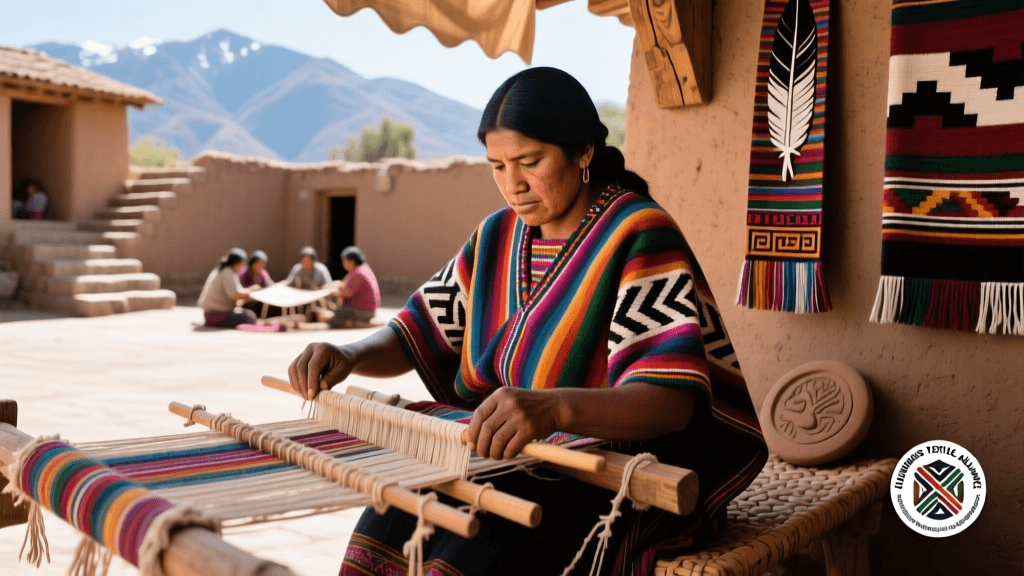
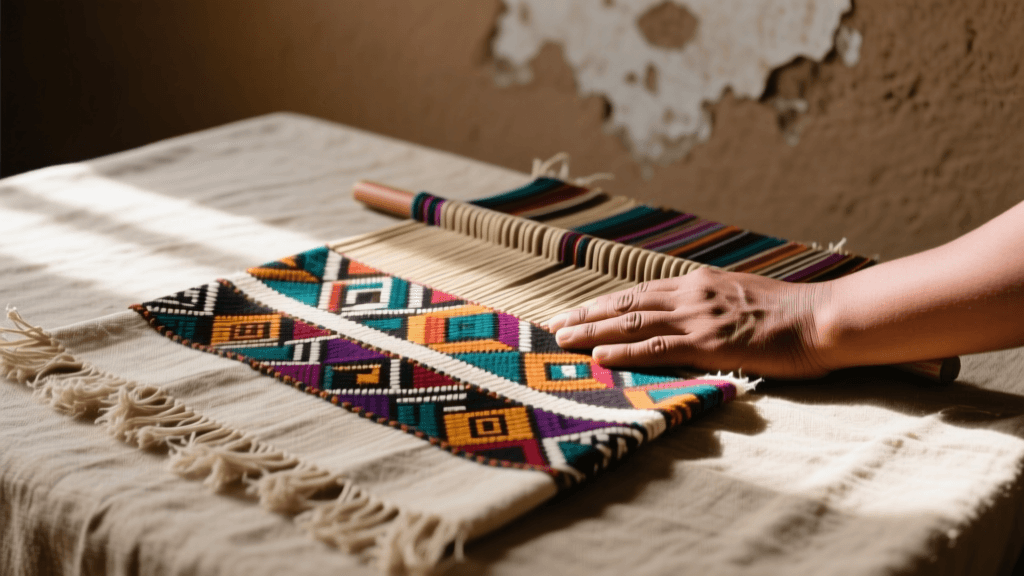
To authenticate a garment, you must understand the tool that created it. The backstrap loom is a deceptively simple apparatus consisting of wooden rods, a shuttle, and a batten (machete), where one end is tied to a fixed post or tree, and the other is secured around the weaver's lower back via a leather or woven strap. The weaver's body provides the tension for the warp threads.
Because the loom is limited by the length of the weaver's arms and body, the resulting fabric panels are inherently narrow—typically measuring between 15 and 18 inches (38 to 45 cm) in width. Consequently, a full-sized huipil cannot be woven as a single piece. It must be constructed by weaving two or three separate panels and joining them together. This structural limitation is the first and most vital clue in authenticating a traditional garment.
Authentication Checklist: Handwoven vs. Machine-Made
In 2026, industrial textile manufacturers have become adept at mimicking the visual aesthetic of Indigenous brocade. However, they cannot replicate the structural physics of hand-weaving. Use the following comparison chart to evaluate potential purchases.
| Feature | Authentic Backstrap Woven (2026) | Machine-Made / Industrial Imitation |
|---|---|---|
| Panel Width | Narrow (15-18 inches); requires joining seams. | Wide (45-60 inches); cut from continuous yardage. |
| Selvedge (Orillos) | Finished, tightly bound edges directly off the loom; no raw cut edges. | Raw edges cut by shears, often serged or hemmed to prevent fraying. |
| Reverse Side | Supplementary weft threads 'float' loosely across the back of the pattern. | Pattern is embroidered on top; backing shows dense, tight machine stitching. |
| Joining Seams (Randa) | Panels joined by complex, decorative hand-stitching (randa). | Panels are absent, or faux 'seams' are simply printed or machine-stitched. |
| Thread Tension | Slight, organic variations in tension reflecting human movement. | Mathematically perfect, uniform tension across the entire textile. |
The 'Touch and Look' Field Test
When examining a huipil in a market or online, request high-resolution macro photography of the reverse side and the seams. Look for the randa, the intricate joining stitch used to connect the woven panels. In authentic pieces, the randa is not merely functional; it is a secondary canvas for the weaver's artistry, often featuring complex lace-like structures or vibrant contrasting colors. Machine-made garments will either lack panels entirely or feature a flat, utilitarian lockstitch seam.
Furthermore, examine the trama suplementaria (supplementary weft) technique. In true hand-brocade, the decorative threads are woven directly into the structural warp and weft of the fabric as it is being created. On the reverse side, you will see long 'floats' of colored thread spanning the back of the design. Machine embroidery, conversely, is applied to a pre-woven base cloth; the reverse side will show dense, tight, and often messy bobbin threads.
Decoding Natural Dyes in the Modern Market
While synthetic aniline dyes have been present in Oaxaca since the late 19th century, the 2026 market has seen a massive renaissance in natural dyeing techniques, driven by both ecological awareness and collector demand. Authenticating natural dyes requires a nuanced eye.
'The color of cochineal is never flat. It holds the memory of the sun, the acidity of the lime, and the iron of the clay. A machine can copy the hex code, but it cannot copy the soul of the insect.' — Master Dyer, Teotitlán del Valle.
Cochineal (Dactylopius coccus): Yields vibrant reds, deep purples, and soft pinks. Authentic cochineal exhibits subtle variations in hue across the garment due to natural shifts in pH during the dye bath. Synthetic reds will appear uniformly flat and may fluoresce under UV light.
Indigo (Añil): Produces rich, deep blues. Hand-dyed indigo cotton often features a slightly mottled, organic depth and may emit a faint, earthy scent when dampened. Synthetic indigo or chemical blue dyes often have a harsh, metallic sheen and will bleed uniformly in water.
Marigold (Cempasúchil) and Cedar Bark: Used for yellows, golds, and warm browns. These natural dyes are inherently light-sensitive. If you are examining a vintage or well-used authentic huipil, the yellow tones will show graceful, uneven fading, whereas synthetic yellows will either remain aggressively bright or fade to a sickly green.
2026 Pricing Guide for Authentic Garments
Understanding the true cost of labor is vital for ethical purchasing. A master weaver may spend anywhere from two to eight months working four to six hours a day on a single ceremonial huipil. In 2026, fair-trade pricing reflects this immense dedication.
- Everyday Cotton Huipil (Single Panel or Simple Brocade): $150 – $300 USD. These feature simpler geometric patterns and are woven with commercially spun (but naturally dyed) cotton threads.
- Ceremonial / Fiesta Huipil (Multi-Panel, Complex Brocade): $450 – $1,200 USD. These are museum-quality garments featuring dense supplementary weft work, natural dyes, and intricate randa joinery.
- White-on-White (San Bartolo Yautepec): $800 – $1,800 USD. The extreme difficulty of weaving fine, hand-spun white cotton with white brocade commands a premium due to the physical strain on the weaver's eyesight and the rarity of the skill.
- Vintage / Antique (Pre-1990): $2,000 – $6,000+ USD. Sourced through specialized textile dealers and auctions, valued for their historical motifs and discontinued natural dye recipes.
Ethical Sourcing: Where and How to Buy
The most critical aspect of collecting Latin American traditional garments in 2026 is ensuring your capital directly supports the Indigenous women who preserve these heritage techniques. Avoid middlemen in tourist-heavy zones who cannot verify the origin of the textile. Instead, seek out established cooperatives and cultural institutions.
The Museo Textil de Oaxaca remains an invaluable resource for buyers. While primarily an educational and exhibition space, their affiliated networks and recommended artisan directories provide a vetted pathway to connect directly with weaving cooperatives. Furthermore, consulting the registry of the Fondo Nacional para el Fomento de las Artesanías (FONART) can help you identify certified workshops that adhere to fair-trade practices and authentic material sourcing.
When buying online, prioritize platforms that provide the weaver's full name, community of origin, and a breakdown of the materials used. Transparency is the hallmark of ethical textile commerce in the modern era.
Preservation and Care for the Modern Collector
Once you have authenticated and acquired a genuine backstrap-woven huipil, proper preservation is essential to maintain its structural integrity and color vibrancy.
- Washing: Never machine wash or dry clean an authentic huipil, as the harsh chemicals and agitation will destroy the natural dyes and warp the hand-spun fibers. Hand wash gently in cold water using a pH-neutral, artisan-approved textile soap.
- Drying: Roll the garment in a clean, white cotton towel to press out excess moisture. Lay it flat to dry in a shaded, well-ventilated area. Direct sunlight will rapidly degrade natural cochineal and indigo dyes.
- Storage: Do not hang huipiles on wire or wooden hangers, as the weight of the heavy brocade will distort the warp threads over time. Store them flat, folded with acid-free tissue paper to cushion the randa seams, in a climate-controlled environment away from direct light.
By mastering these authentication techniques and embracing ethical sourcing, collectors and enthusiasts play a vital role in ensuring that the magnificent textile traditions of Oaxaca continue to thrive for generations to come. The huipil is not merely a relic of the past; it is a living, breathing art form that deserves our utmost respect and protection in 2026 and beyond.