Master Nishijin-Ori Weaving & Jibata Looms: 2026 Guide
Introduction to Nishijin-Ori and the Jibata Loom
Nishijin-ori represents the absolute pinnacle of Japanese textile artistry. Originating in the Nishijin district of Kyoto, this intricate, multi-colored silk weaving method has been the standard for imperial garments, Noh theater costumes, and luxury obi sashes for centuries. As we navigate the cultural landscape of 2026, the intersection of ancient hand-weaving techniques and contemporary preservation efforts offers a fascinating glimpse into Japan's living heritage. While modern manufacturing has automated much of the global textile industry, the traditional Jibata (handloom) remains the beating heart of authentic Nishijin-ori production. This comprehensive guide explores the mechanics of the Jibata loom, the meticulous hand-weaving process, and how artisans are sustaining this craft in 2026.
The Legacy and 2026 Preservation Landscape
Historically, Nishijin-ori was defined by its complex brocade patterns and the use of precious metals woven directly into the silk. Today, the craft faces the dual challenges of an aging artisan population and shifting consumer habits. However, 2026 has brought a renewed wave of interest, fueled by Kyoto's Traditional Craft Preservation Grants and a global resurgence in appreciation for slow fashion and heritage textiles. According to the Japanese Ministry of Economy, Trade and Industry (METI), government and private subsidies in 2026 have successfully stabilized the number of registered Nishijin weaving studios, encouraging young apprentices to take up the shuttle. Furthermore, luxury fashion houses and high-end architectural firms are increasingly commissioning Nishijin-ori for interior textiles, expanding its use far beyond the traditional kimono.
The Anatomy of a Traditional Jibata (Handloom)
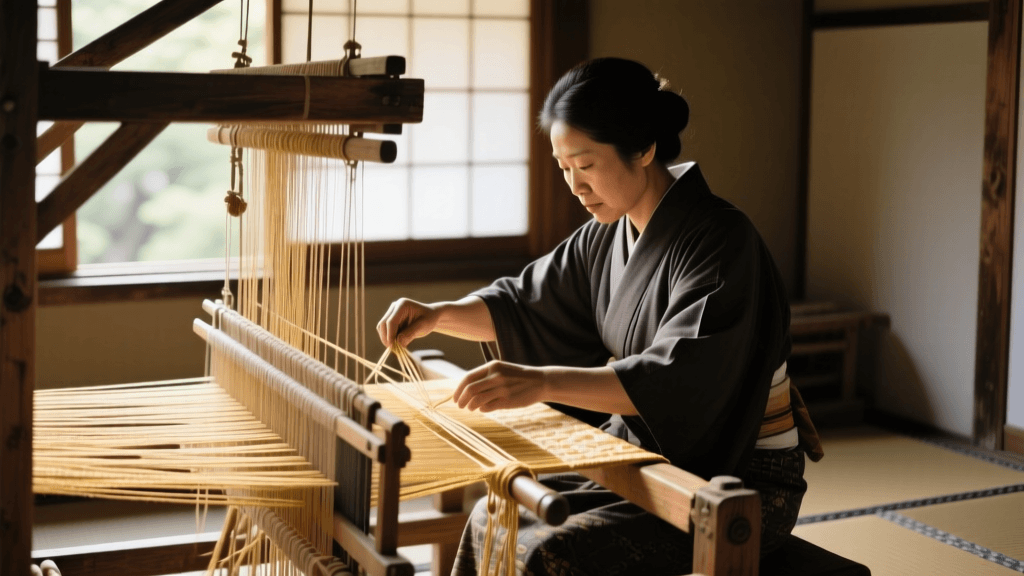
The Jibata is a traditional Japanese handloom, distinct from the foot-powered treadle looms common in Western weaving. It is a masterpiece of functional wooden engineering, designed to give the weaver ultimate control over thread tension and pattern complexity. A standard Jibata used for obi weaving in 2026 measures approximately 2.5 meters in length and 1.2 meters in width, constructed primarily from aged Japanese cypress (hinoki) or oak for stability.
Key Components of the Loom
- Osa (Reed): A comb-like structure used to beat the weft yarn tightly into the warp. In high-end Nishijin-ori, the reed is meticulously calibrated to handle metallic threads without snagging.
- Hizome (Treadles/Harnesses): Unlike Western looms where feet operate the treadles, the Jibata often requires the weaver to use a combination of hand-pulled harness cords and subtle foot braces to lift specific warp threads, creating the shed.
- Hi (Shuttle): The boat-shaped tool that carries the weft thread through the shed. Nishijin weavers use specialized, polished wooden shuttles that glide effortlessly across the warp.
- Makimono (Cloth Beam): The roller that collects the finished fabric. Tension on the makimono is adjusted manually by the weaver, requiring an intuitive sense of touch developed over decades of practice.
In 2026, while the core mechanics of the Jibata remain unchanged, many studios have introduced subtle ergonomic modifications, such as adjustable seating and specialized lighting, to accommodate the physical demands placed on aging master weavers.
Step-by-Step: The Hand-Weaving Process
Creating a single Nishijin-ori obi on a Jibata is a monumental task that involves over twenty distinct specialized steps, often distributed among different artisans. However, the weaving itself is a solitary, deeply focused endeavor.
Thread Preparation (Seikei) and Dyeing
Before the loom is even threaded, the raw silk must be prepared. Artisans use Omi silk, prized for its tensile strength and brilliant luster. The threads are dyed using both traditional natural dyes (like indigo and madder) and advanced, color-fast synthetic dyes developed for the 2026 luxury market. The warp threads are stretched and aligned in a process called seikei, which dictates the final width and density of the fabric.
Pattern Design and Jacquard Integration
Nishijin-ori is famous for its elaborate patterns. While the Jibata is a handloom, it is frequently fitted with a Jacquard attachment for complex brocades. In 2026, studios utilize AI-assisted design software to translate digital artwork into physical Jacquard punch cards or electronic solenoid triggers. This technology ensures mathematical precision in the pattern draft, but the actual interlacing of the threads on the Jibata remains entirely manual.
The Rhythm of the Weave
The weaver sits at the Jibata, orchestrating a complex dance of hands and feet. They pull the harness cords to open the shed, throw the shuttle carrying the weft thread through the opening, and then pull the reed forward to beat the thread into place. When working with metallic threads (such as gold-leaf wrapped silk), the weaver must adjust their beating force to prevent the delicate metal from cracking. A master weaver produces only 10 to 15 centimeters of complex brocade per day on a Jibata.
Comparison: Traditional Jibata vs. Modern Power Looms
While modern power looms dominate the mass-market kimono industry, the Jibata remains essential for heritage pieces. Below is a comparison of the two methods as of 2026.
| Feature | Traditional Jibata (Handloom) | Modern Jacquard Power Loom |
|---|---|---|
| Production Speed | 10 - 20 cm per day | 5 - 10 meters per day |
| Artisan Skill Required | Master level (10+ years training) | Technician level (Machine operation) |
| Thread Tension Control | Dynamic, intuitive human touch | Automated, uniform mechanical tension |
| Texture and Drape | Rich, three-dimensional, supple | Flatter, tighter, more rigid |
| 2026 Market Price (Obi) | $3,000 - $15,000+ | $150 - $800 |
| Primary Use Case | Heirloom garments, luxury interiors | Everyday kimono, commercial apparel |
The stark contrast in pricing reflects the immense human capital invested in Jibata-woven textiles. Collectors in 2026 view hand-woven Nishijin-ori not merely as clothing, but as investable fine art.
Identifying Authentic Hand-Woven Nishijin-Ori
With the rise of high-quality digital printing and automated weaving, identifying authentic Jibata-woven Nishijin-ori requires a trained eye. First, look for the official Nishijin Ori certification mark, a gold seal issued by the Nishijin Textile Industrial Association, which guarantees the fabric was woven in the Nishijin district using approved methods. Second, examine the reverse side of the textile. Hand-woven brocade will show floating threads and a slightly irregular, organic texture on the back, whereas printed or machine-woven imitations will appear flat or show a synthetic backing. Finally, feel the weight and drape; authentic hand-loomed silk possesses a distinct, heavy suppleness that machines struggle to replicate.
Where to Experience the Craft in Kyoto (2026)
For textile enthusiasts and cultural travelers visiting Kyoto in 2026, witnessing the Jibata in action is an unforgettable experience.
Nishijin Textile Center
The Nishijin Textile Center remains the premier destination for understanding this craft. The center offers daily live demonstrations of Jibata weaving, allowing visitors to hear the rhythmic clacking of the wooden reed and observe the intricate hand movements of the weavers. In 2026, the center also features interactive digital exhibits that map the historical evolution of Nishijin patterns.
Hosoo Flagship Store and Atelier
For a look at the cutting-edge application of traditional techniques, a visit to Hosoo is essential. Founded in 1688, Hosoo has pioneered the use of Nishijin-ori in contemporary luxury fashion and three-dimensional architectural textiles. Their flagship store in Kyoto showcases how ancient Jibata techniques are being adapted to weave ultra-wide fabrics for global luxury brands, proving that tradition and innovation can seamlessly coexist.
Conclusion
The survival of the Jibata loom and Nishijin-ori hand-weaving methods in 2026 is a testament to the resilience of Kyoto's artisans. While the physical demands of the craft are immense, the resulting textiles possess a soul, depth, and beauty that no machine can replicate. By understanding the anatomy of the loom, the painstaking weaving process, and the modern efforts to preserve these techniques, we gain a profound appreciation for the threads that bind Japan's past to its future. Whether you are a collector, a weaver, or a cultural traveler, the world of Nishijin-ori offers an endless tapestry of discovery.