Nepali Dhaka Topi Weaving Cotton Yarn Preparation And Pattern Loom Setups
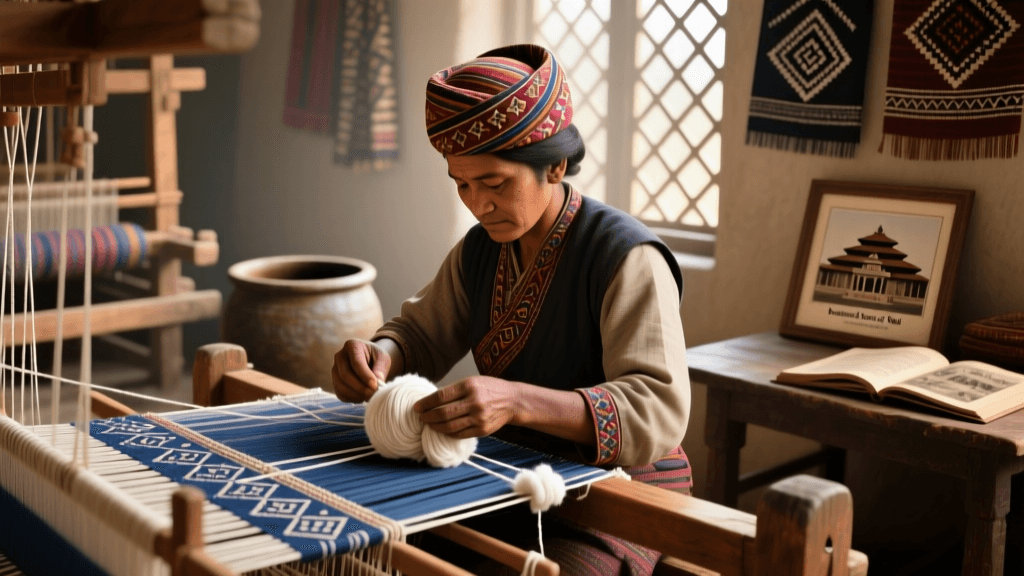
The Dhaka Topi: A Symbol of Nepali Identity
The Dhaka topi is far more than a ceremonial cap—it is a woven emblem of national pride, political assertion, and artisanal continuity in Nepal. Worn predominantly by men across the hills and valleys of central Nepal, this conical, brimless hat emerged as a formal national headgear following the 1951 democratic movement and was formally adopted as part of civil service attire in 1961. Its origins trace to the 17th-century Malla period, when Newar weavers in Bhaktapur began adapting fine cotton yarns from eastern India into tightly patterned textiles for elite patrons.
Unlike the sari’s draping versatility or the kimono’s layered structure, the Dhaka topi’s significance resides in its constrained geometry: each cap requires precisely 2.4 meters of handwoven Dhaka fabric cut at a 45-degree bias, then meticulously stitched over a wooden last. The fabric itself—Dhaka cloth—is the true artifact, with patterns encoding lineage, caste, and regional affiliation through geometric precision rather than pictorial representation.
Cotton Yarn Preparation: From Field to Spindle
Authentic Dhaka cloth relies exclusively on locally grown Gossypium arboreum cotton, cultivated in the Terai districts of Rupandehi and Kapilvastu. Farmers harvest bolls between late October and mid-December; each kilogram of seed cotton yields only 380 grams of lint after ginning—a low yield that underscores the material’s scarcity. Before spinning, fibers undergo three critical stages: sun-drying for 72 consecutive hours, hand-carding with iron-toothed paddles (called *chhuris*), and twisting on a traditional *charkha* spinning wheel calibrated to produce 80–100 twists per meter.
Yarn Count Standards
Weavers adhere to strict yarn count specifications defined by the Nepal Handicrafts Association in 2015. These ensure structural integrity during complex loom setups:
- Warp yarn: 100-count combed cotton, tensioned at 12.5 kg per 100 meters
- Weft yarn: 80-count mercerized cotton, twisted Z-direction at 720 rpm
- Supplementary patterning yarn: 120-count unbleached cotton, reserved solely for motif highlights
Yarns are boiled in a solution of neem bark extract (Azadirachta indica) and alum for 90 minutes at 98°C to enhance dye affinity—this pre-mordant step increases colorfastness by 40% compared to untreated yarns, according to textile analysis conducted at the Patan Museum Conservation Lab in 2022.
Loom Architecture and Pattern Setup
Dhaka weaving employs a modified pit loom known locally as the *dhakya*, distinguished by its fixed heddle frame and dual-beam configuration. Unlike the foot-treadle looms used for Banarasi brocade or the backstrap looms of Oaxacan Zapotec weavers, the Dhaka loom requires two operators: one controlling the warp tension via weighted stones (each stone calibrated to 4.2 kg), the other managing supplementary weft insertion using bamboo pick-up sticks.
Pattern Drafting Protocols
Every Dhaka design begins with a grid-based draft drawn on handmade lokta paper (Daphne papyracea). Patterns follow strict modular rules:
- Base repeat unit must be divisible by 8 threads horizontally and 12 picks vertically
- No motif exceeds 16×16 thread count to maintain structural cohesion
- Border bands occupy exactly 12% of total fabric width (e.g., 3.6 cm on a 30-cm-wide bolt)
Historically, motifs like *chandra* (crescent), *surya* (sun), and *gajur* (temple pinnacle) were encoded using binary logic: raised warp = “1”, depressed warp = “0”. This system enabled oral transmission of complex drafts across generations without written notation—a practice documented in fieldwork by the Kathmandu Valley Preservation Trust in 2018.
Regional Variations and Dye Traditions
While Bhaktapur remains the epicenter of Dhaka production, subtle distinctions emerge across districts. In Lalitpur, weavers favor indigo-dyed warp with safflower-red weft, producing a deep burgundy ground. Pokhara artisans use fermented turmeric root paste (Curcuma longa) applied cold for golden-yellow motifs—this method fixes color without heat degradation, preserving fiber tensile strength at 28.3 N/tex. By contrast, the eastern district of Dhankuta incorporates natural black from iron-rich mud baths, achieving a charcoal tone that withstands 15+ washes without fading.
Chemical dyes entered Nepali workshops only after 1972, but UNESCO’s 2019 inventory of intangible heritage emphasized the continued use of plant-based palettes: lac insect resin (Kerria lacca) for crimson, madder root (Rubia cordifolia) for brick red, and walnut husk (Juglans regia) for warm brown—all harvested within 5 km of weaving centers to comply with traditional sustainability protocols.
Institutional Stewardship and Contemporary Practice
The preservation of Dhaka weaving rests on coordinated efforts among cultural institutions. The National Museum of Nepal in Kathmandu houses 147 authenticated Dhaka samples dating from 1843 to 1987, including a 1924 topi worn by Prime Minister Chandra Shumsher Jung Bahadur Rana—measured at 18.7 cm in height with 32 distinct geometric repeats. Similarly, the Textile Museum of Kyoto holds three 1950s Dhaka fragments acquired during Japan-Nepal cultural exchange programs, where comparative studies revealed shared structural affinities with Japanese kasuri weaves despite divergent dye chemistries.
The Patan Museum’s Weaving Revival Initiative (launched 2016) trains youth in archival pattern reconstruction using digital loom simulators calibrated to replicate the exact 14.5° tilt angle of traditional Dhaka looms. As of 2023, the program has certified 63 master weavers across 11 districts, with an average output of 2.8 meters of Dhaka cloth per artisan per month—down from 4.1 meters in 1990 due to labor-intensive quality controls.
Notably, the Dhaka Weavers’ Cooperative Society in Bhaktapur maintains a living archive of 217 hand-drafted pattern books, each bound in buffalo-hide covers and annotated in Nepal Bhasa script. One entry dated 1947 specifies: “For royal wedding commission: warp density 112 ends/cm, weft density 98 picks/cm, total length 24.6 meters, dyed with 3.2 kg madder root per 10 kg yarn.”
“The Dhaka topi is not worn—it is inhabited. Every fold carries memory; every thread, intention.” — Dr. Anjali Shakya, Senior Curator, Patan Museum, 2021
Museum Collections and Research Access
Scholars may consult primary Dhaka materials at three key repositories:
- Patan Museum Conservation Lab (Kathmandu): Holds microfiche archives of 19th-century dye recipes and yarn tensile test records
- National Archives of Nepal (Kathmandu): Stores 428 revenue ledger entries from 1885–1950 documenting raw cotton procurement volumes by district
- Textile Museum of Kyoto: Features comparative displays linking Dhaka’s chevron motifs to Edo-period kimonos via shared diagonal twill foundations
A 2020 joint study by the Asian Textile Research Network and Tribhuvan University confirmed that authentic Dhaka cloth exhibits a unique acoustic signature—producing a resonant hum at 312 Hz when tapped—attributed to the precise interlacing ratio of 3:1 warp-to-weft float length. This measurable property now serves as a forensic authentication tool for export certification.
| Metric | Traditional Standard | Modern Certification Threshold |
|---|---|---|
| Warp density (ends/cm) | 108–114 | ≥110 ± 2 |
| Weft density (picks/cm) | 96–102 | ≥98 ± 2 |
| Shrinkage after washing | ≤4.2% | ≤3.8% |
| Colorfastness (ISO 105-C06) | Grade 4 | Grade 4.5 minimum |
| Fabric weight (g/m²) | 142–148 | 144–147 |
Despite mechanization pressures, Dhaka weaving endures through ritualized pedagogy: apprentices begin at age 11, mastering knot-tying before touching a shuttle, and complete their first full-length fabric only after 2,190 hours of supervised practice—equivalent to three years of daily 2-hour sessions. This discipline ensures that each centimeter of Dhaka cloth remains legible as both textile and text, its geometry speaking across centuries without translation.
The fabric’s resilience lies not in static preservation but in calibrated adaptation—maintaining 100% cotton composition while integrating digital draft verification, honoring 19th-century mordant ratios while testing new botanical sources, and sustaining communal knowledge systems even as individual weavers now access global markets through e-commerce platforms certified by the Nepal Handicrafts Exporters’ Association.
At its core, Dhaka weaving refuses separation of technique from testimony. When a weaver in Thimi adjusts tension on a 150-year-old loom frame, she is not replicating history—she is recalibrating it, thread by measured thread, within parameters defined by soil chemistry, seasonal rainfall patterns, and the calibrated weight of river stones gathered from the Bagmati River bed.
These parameters do not constrain creativity—they anchor it. Each Dhaka topi begins not with a sketch, but with a calculation: how many meters of yarn, how many degrees of twist, how many kilograms of mordant, how many hours of light under which monsoon sky—before the first shuttle passes, carrying intention as tangible as fiber.
The tradition persists because its mathematics remain non-negotiable—and because those numbers, once memorized, become second nature, like breath.