Reviving the Chinese Drawloom: Yunjin Brocade Techniques 2026
The Resurgence of the Chinese Drawloom in 2026
The Chinese drawloom, known traditionally as the Hua Lou Ji (花楼机), represents the absolute zenith of ancient textile engineering. For over 1,600 years, this towering wooden apparatus has been the sole instrument capable of producing Yunjin (Cloud Brocade), a fabric so luxurious and complex that it was historically reserved exclusively for the imperial family. As we navigate the fashion landscape of 2026, the drawloom is experiencing an unprecedented renaissance. Driven by the explosive global popularity of the Xin Zhongshi (New Chinese Style) movement, contemporary artisans and high-fashion houses are returning to these ancient weaving techniques to create textiles that bridge millennia of heritage with modern sartorial elegance.
According to the UNESCO Intangible Cultural Heritage registry, the craftsmanship of Nanjing Yunjin is a masterclass in human ingenuity. Unlike standard treadle looms, the drawloom requires a level of mechanical complexity and human synchronization that modern automated machinery still struggles to replicate authentically, particularly when working with delicate metallic threads and peacock feather yarns. In 2026, mastering the drawloom is not just an act of historical preservation; it is a highly lucrative and deeply respected artisanal discipline.
Anatomy of the Traditional Nanjing Drawloom
To understand the sheer scale of this ancient technology, one must look at its physical dimensions. A traditional Nanjing drawloom is a massive structure, typically measuring 5.6 meters in length, 1.4 meters in width, and an imposing 4 meters in height. The loom is divided into two primary operational zones: the lower section where the weaver sits, and the upper elevated platform (the 'flower tower') where the pattern puller operates.
While the fundamental mechanics remain unchanged since the Ming Dynasty, the materials used in 2026 have seen subtle, specialized upgrades to improve longevity and precision without compromising the traditional hand-woven feel.
| Component | Traditional Material | 2026 Artisan Adaptation | Function |
|---|---|---|---|
| Main Frame | Aged Elm Wood | Steel-Reinforced Elm | Provides structural stability for high-tension silk warps |
| Heddles | Bamboo and Silk | Laser-Cut Bamboo & Synthetic | Separates warp threads to create the shed |
| Pattern Cords | Hemp and Cotton | Kevlar-Blended Cord | Ensures durability for complex Tiaohua knotting |
| Shuttles | Solid Rosewood | Weighted Rosewood with Teflon Tips | Allows smooth passage through dense, metallic warps |
The Human Element: The Weaver and the Pattern Puller
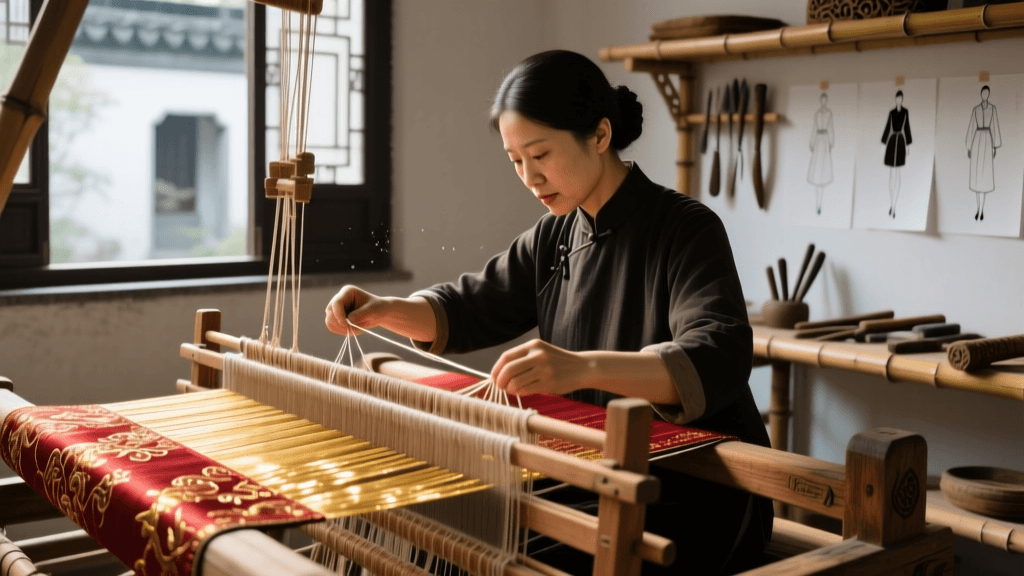
Operating a Hua Lou Ji is inherently a collaborative endeavor. It requires two highly trained individuals working in perfect tandem. The weaver sits at the base of the loom, managing the shuttles, beating the weft threads into place with a heavy wooden reed, and operating the foot treadles that control the ground weave. Meanwhile, the pattern puller (historically known as the 'drawboy') sits atop the 4-meter-high flower tower.
The pattern puller's job is to manipulate the intricate web of pattern cords that control the individual warp threads. When the weaver below shouts a specific cue, the puller yanks the exact sequence of cords required to raise the specific warp threads, creating the 'shed' through which the weaver passes the shuttle containing the gold or colored silk thread. In 2026, while some commercial operations have introduced mechanized assist-pulleys to reduce the physical strain on the upper operator, the most prestigious Yunjin ateliers in Nanjing strictly maintain the two-person manual operation to ensure the precise tension control required for imperial-grade brocade.
Tiaohua: The Ancient Binary Code of Silk
Long before the invention of the Jacquard loom in 19th-century France or the advent of modern computing, Chinese weavers developed Tiaohua (挑花), a method of pattern programming that functions remarkably like binary code. As detailed in The Metropolitan Museum of Art's Heilbrunn Timeline of Art History, the complexity of Chinese silk weaving relies on the precise mathematical mapping of motifs.
In the Tiaohua process, a master designer maps a motif (such as a five-clawed dragon or a sprawling peony) onto a specialized grid. Every single intersection on this grid corresponds to a specific warp thread out of the 12,000 to 14,000 threads loaded onto the loom. The pattern cords are then tied in a specific sequence based on this grid. A raised knot signifies a '1' (thread is lifted), and the absence of a knot signifies a '0' (thread remains down). This physical 'code' is stored in the rigging of the loom itself. For a complex, repeating Yunjin pattern, the Tiaohua rigging can contain hundreds of thousands of individual knots, taking weeks to program before a single inch of fabric is woven.
Integrating Yunjin into the 2026 Xin Zhongshi Movement
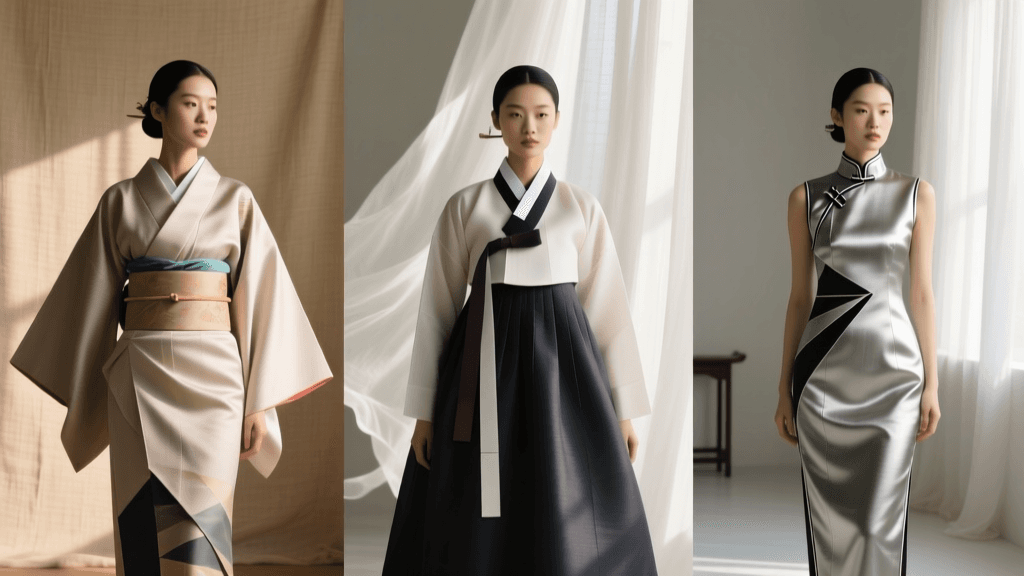
The year 2026 has seen the Xin Zhongshi (New Chinese Style) movement mature from a niche aesthetic into a dominant force in global luxury fashion. However, modern designers are moving away from using Yunjin as an overwhelming, head-to-toe fabric. Instead, the 2026 design philosophy focuses on strategic integration. High-end ateliers are utilizing the drawloom to weave narrow, hyper-dense panels of Yunjin that are then inset into modern silhouettes—such as the collars of structured wool blazers, the cuffs of silk organza blouses, or as structural corsetry elements.
This approach serves two purposes: it makes the astronomical cost of hand-woven Yunjin more accessible to the luxury consumer, and it highlights the textile as a piece of wearable art. The juxtaposition of the ancient, heavy, metallic brocade against ultra-modern, minimalist fabrics like matte crepe and technical nylon is the defining textile trend of the 2026 Asian fashion weeks.
Commissioning Authentic Yunjin: A 2026 Buyer's Guide
For collectors, fashion houses, and cultural preservationists looking to commission authentic, hand-drawn loom Yunjin in 2026, the process requires patience, capital, and a deep understanding of the craft. Here is what you need to know before approaching a Nanjing atelier:
- Pricing Realities: As of early 2026, authentic hand-woven Yunjin brocade commands between ¥18,000 and ¥45,000 RMB (approx. $2,500 to $6,200 USD) per meter. The price fluctuates heavily based on the density of the gold leaf threads and the inclusion of rare materials like peacock feather yarn.
- Production Timelines: A master weaver can produce a maximum of 5 to 6 centimeters of Yunjin per day. Commissioning a standard 3-meter garment length will take a minimum of 4 to 6 months, excluding the Tiaohua programming time.
- Authentication Markers: True drawloom Yunjin features a distinct 'float' on the reverse side of the fabric. Because the metallic threads are laid in using a tapestry-like technique (brocading) rather than woven through the entire structure, the back of the fabric will show loose, unbound floats of the pattern threads. If the back of the fabric looks identical to the front, it is a modern Jacquard machine reproduction.
- Climate Considerations: In 2026, top-tier ateliers utilize strict climate-controlled weaving rooms. Silk and gold-leaf threads are highly sensitive to humidity. Ensure your commissioned contract specifies that the weaving will occur in an environment maintained at 60-65% relative humidity to prevent thread snapping and tension irregularities.
Preservation and Storage of Hand-Woven Brocade
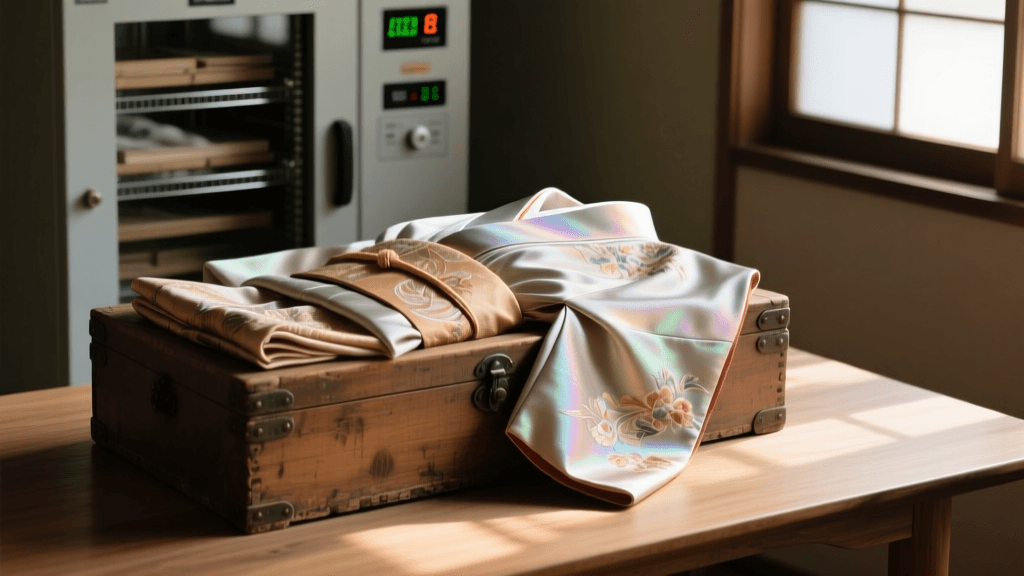
Investing in ancient-technique textiles requires meticulous care. The Victoria and Albert Museum's Asian Collections conservation guidelines emphasize that heavy brocades are highly susceptible to gravitational stress and metallic oxidation. When storing Yunjin garments or fabric bolts in 2026, never hang them on standard hangers; the weight of the gold threads will warp the silk warp over time, causing irreversible tearing.
Instead, garments should be padded with acid-free, unbuffered tissue paper and stored flat in archival-grade textile boxes. The storage environment must be kept away from direct UV light, which degrades the natural dyes used in traditional Yunjin, and maintained at a stable temperature of around 18°C (64°F). For pieces featuring real gold leaf wrapped around a silk core, avoid storing in environments with high sulfur or pollutant levels, as this can cause the metallic elements to tarnish or become brittle.
Conclusion
The Chinese drawloom is far more than a relic of antiquity; it is a living, breathing engine of cultural expression. As the 2026 fashion world continues to seek authenticity, depth, and unparalleled craftsmanship, the Hua Lou Ji stands ready to deliver. By understanding the immense technical skill, the binary-like programming of Tiaohua, and the collaborative human effort required to operate it, we can better appreciate the true value of Yunjin brocade. Supporting these ancient weaving techniques ensures that the clouds of Nanjing will continue to be woven into the fabric of the future.