Mythology-Inspired Hanfu: Recreating Feitian & Deity Garments
The Allure of Chinese Mythological Fashion
Chinese mythology is a boundless wellspring of artistic inspiration, populated by celestial beings, elemental deities, and mythical creatures that have shaped the cultural consciousness of East Asia for millennia. In recent years, the Hanfu movement has transcended historical reenactment, venturing into the realm of the divine. As noted in BBC Travel's feature on the Hanfu revival movement, modern enthusiasts are not merely replicating ancient daily wear; they are actively resurrecting the fantastical garments depicted in murals, operas, and classical literature. Dressing as a deity requires a distinct approach to fabric manipulation, structural styling, and ethereal aesthetics that differ vastly from standard historical Hanfu.
Recreating mythological garments—such as the flowing ribbons of the Feitian (Flying Apsaras) or the structured, imposing robes of the Dragon King—demands a blend of historical textile knowledge and modern cosplay engineering. This guide provides actionable, practical advice for sourcing, styling, and photographing mythology-inspired Hanfu, ensuring your celestial wardrobe is both authentic to the legends and visually breathtaking.
Recreating the Feitian (Flying Apsara) Look
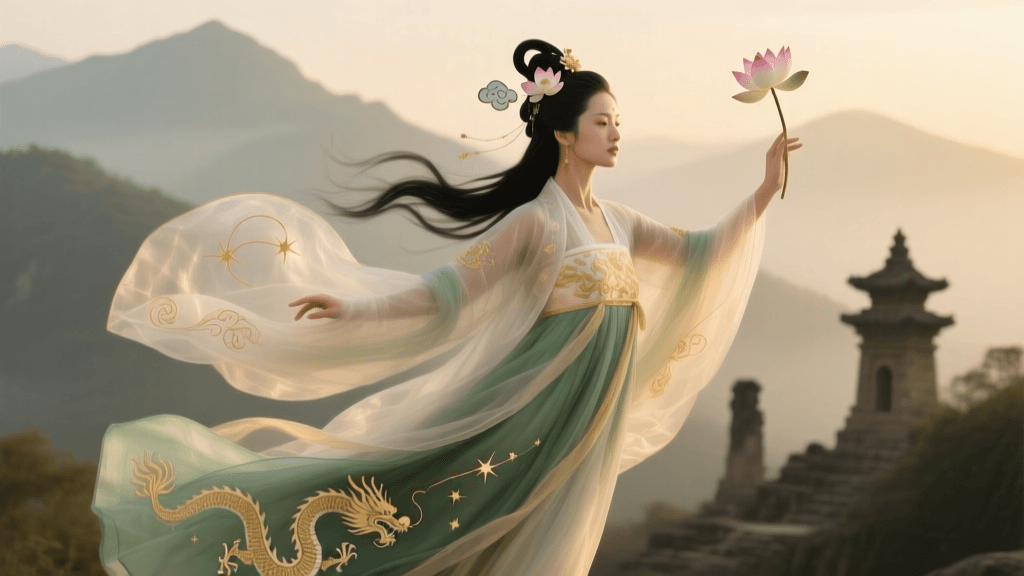
The Feitian, or Flying Apsaras, are perhaps the most iconic mythological figures in Chinese textile art, immortalized in the breathtaking murals of the Mogao Caves. According to the Metropolitan Museum of Art's overview of Dunhuang Cave Temples, these celestial musicians and dancers are characterized by their gravity-defying postures and elaborate, wind-swept garments. To recreate this look, you must focus on two primary elements: the Qixiong Ruqun (chest-high pleated skirt) and the Pibo (silk ribbon stole).
Fabric Selection and Measurements
The illusion of flight relies entirely on fabric weight and drape. Avoid heavy cottons or stiff linens. Instead, opt for 30D polyester chiffon or 16mm silk charmeuse. These materials catch the wind beautifully while remaining lightweight enough to hover around the body.
- The Pibo (Silk Ribbon): To achieve the dramatic, sweeping arcs seen in Dunhuang murals, your Pibo must be exceptionally long. The ideal measurement is 300cm in length and 25cm in width. A shorter ribbon will not loop correctly around the arms and back to create the 'halo' effect.
- The Qixiong Skirt: A standard historical skirt might use 3 meters of fabric, but a mythological Feitian skirt requires a minimum of 4.5 to 5 meters of fabric to accommodate over 120 knife pleats. This massive circumference creates the 'cloud-like' volume at the base of the garment. The length should be measured from the underarm to the floor, plus 5cm for hemming.
Styling and Draping Technique
Wrapping the Pibo is an art form. Start by draping the center of the ribbon across your back, just below the shoulder blades. Bring both ends over the shoulders, cross them over the chest, and loop them around the inner elbows. Secure the ribbon at the inner elbow with a discreet safety pin or a hidden elastic band to prevent it from slipping during movement or photography.
Styling the Dragon Deity & Celestial Officials
While the Feitian represents ethereal grace, the Dragon Deity and Celestial Officials represent cosmic authority and elemental power. The foundational garment for these figures is the Yuanlingpao (round-collar robe), heavily adorned with mythological motifs. The Victoria and Albert Museum's guide on Chinese Dragon Robes highlights the strict sumptuary laws and symbolic weight of dragon and beast motifs in traditional Chinese textiles, a symbolism that translates directly into mythological deity styling.
Structural Fabrics and Rank Badges
Unlike the flowing Feitian garments, deity robes require structure to project authority. You should source heavy silk brocade or woven jacquard with a weight of at least 150gsm to 200gsm. These fabrics hold their shape, allowing the robe to stand away from the body and create a commanding silhouette.
- The Buzi (Rank Badge): To elevate a standard Yuanlingpao to a deity-level garment, attach a Buzi (a square embroidered badge) to the chest and back. For a Dragon King, source a badge featuring a five-clawed dragon amidst crashing waves and clouds. These can be purchased as separate embroidered patches on platforms like Taobao or Etsy for $20 to $45 and hand-stitched onto the robe.
- Waist Structuring: Use a stiffened leather or heavy brocade Geda (waist belt) with jade or metallic plaques. The belt should sit firmly at the natural waist, pulling the heavy robe into a structured, hourglass-like column that mimics ancient statuary.
Chang'e and the Moon Goddess Aesthetic
Chang'e, the Goddess of the Moon, requires a garment that balances the volume of a deity with the melancholy grace of a lunar immortal. The core garment is the Daxiushan (large-sleeved robe), characterized by sleeves that can measure up to 120cm in width. To mimic the pale glow of the moon, utilize fabrics in pearlescent white, ice blue, or pale silver. Incorporating subtle silver-thread embroidery of osmanthus flowers or crescent moons along the collar and cuffs adds a layer of mythological accuracy without overwhelming the ethereal aesthetic.
Comparison Chart: Mythological Hanfu Styles
When planning your mythological wardrobe, it is crucial to understand the varying requirements for fabric, budget, and preparation time. The table below breaks down the core specifications for the three most popular deity archetypes.
| Deity / Mythical Figure | Core Garment | Primary Fabric Requirements | Estimated Budget (USD) | Styling & Draping Time |
|---|---|---|---|---|
| Feitian (Apsara) | Qixiong Ruqun & 3m Pibo | 30D Chiffon, Silk Organza (Lightweight) | $60 - $140 | 45 minutes |
| Dragon Deity | Yuanlingpao with Buzi | Heavy Brocade, Jacquard (150gsm+) | $150 - $350 | 30 minutes |
| Chang'e (Moon Goddess) | Daxiushan (Large Sleeves) | 16mm Silk Charmeuse, Pearlescent Satin | $180 - $400 | 50 minutes |
Practical Guide: Sourcing, Budgeting, and Photography
Acquiring mythology-inspired Hanfu often requires navigating specialized markets. While standard historical Hanfu is widely available, deity garments often fall into the 'performance' or ' haute couture Hanfu' categories.
Sourcing and Keywords
If you are sourcing from international marketplaces like Taobao or AliExpress, using the correct Mandarin keywords is essential for finding high-quality, mythologically accurate pieces:
- Feitian / Dunhuang: Search '敦煌飞天汉服' (Dunhuang Feitian Hanfu) or '仙女风汉服' (Fairy-style Hanfu).
- Dragon / Deity Robes: Search '神明汉服' (Deity Hanfu) or '龙纹圆领袍' (Dragon-pattern round-collar robe).
- Custom Makers: For high-end silk brocades and authentic hand-embroidered Buzi badges, expect to pay a premium. Custom deity robes from established Hanfu studios (such as Ming Hua Tang or Shiyue) can range from $400 to over $1,200, with a production lead time of 45 to 90 days.
Photography and Wind Engineering
'The soul of the Feitian is not in the silk, but in the wind that carries it.' — Traditional Dunhuang Dance Proverb
To capture the mythological essence of these garments, static photography is rarely enough. You must engineer the environment. Invest in a 12-inch portable rechargeable fan (capable of outputting at least 15mph wind speed). Position the fan at a 45-degree angle from the ground, pointing upward toward the model's arms and back. This specific angle lifts the Pibo and the wide sleeves of the Daxiushan, creating the illusion of levitation. Set your camera's shutter speed to a minimum of 1/250s to freeze the rapid movement of the lightweight chiffon without introducing motion blur.
Hair and Makeup: The Divine Details
A mythological garment is incomplete without the corresponding celestial styling. Deity makeup and hair require an investment in specialized accessories and techniques that differ from everyday historical looks.
The Lotus Crown and Hair Architecture
Celestial officials and high-ranking goddesses are frequently depicted wearing elaborate crowns. The Lianhua Guan (Lotus Crown) is a staple for deity styling. These crowns are typically constructed from brass, copper, or resin, and can weigh between 150g and 300g. To support this weight without causing headaches or slippage, you must build a structural base. Braid the model's hair into a tight, flat bun at the crown of the head, and use two crossed, heavy-duty U-shaped hairpins (at least 15cm in length) to anchor the crown directly to the hair base. Supplement with pearl hairpins (Buyao) that feature dangling elements to mimic the swaying ornaments seen in temple statues.
Huadian and Celestial Makeup
The Huadian (forehead marking) is non-negotiable for mythological styling. While historical Huadian were often simple floral shapes, deity Huadian should be intricate, utilizing gold leaf, crushed mica powder, or rhinestones to catch the light. Apply the Huadian using a skin-safe adhesive, and extend the eye makeup upward toward the temples using deep reds or golds to create an otherworldly, elongated eye shape. Allow at least 45 to 60 minutes for full celestial makeup application, as the precision required for the Huadian and facial contouring is highly detailed.
Conclusion
Recreating traditional clothing from Chinese mythology and legends is a profound way to engage with the spiritual and artistic heritage of East Asia. Whether you are engineering the gravity-defying ribbons of a Dunhuang Feitian or tailoring the imposing brocades of a Dragon Deity, success lies in the meticulous attention to fabric weight, structural measurements, and dynamic styling. By understanding the specific requirements of these mythical garments, you can transcend simple costume wear and step fully into the realm of the divine, bringing ancient legends to vivid, breathtaking life.