Mythological Hanfu: Recreating Chinese Deity Garments
Dressing the Divine: The Intersection of Myth and Silk
For centuries, Chinese mythology has provided a rich tapestry of inspiration for art, literature, and fashion. Today, the modern Hanfu movement has transcended strict historical reenactment, venturing boldly into the realm of the divine. Enthusiasts and designers are no longer just recreating the daily wear of the Ming or Song dynasties; they are embodying the celestial beings, nature spirits, and mythical rulers of ancient folklore. At The Garment Atlas, we explore how traditional clothing in Chinese mythology is being reimagined for contemporary wearers, blending ancient symbolism with actionable, modern styling techniques.
The translation of mythological concepts into wearable garments requires a deep understanding of both historical textile practices and the symbolic language of Chinese legends. As noted by the Metropolitan Museum of Art's Heilbrunn Timeline of Art History, silk has long been associated with the divine and the elite in Chinese culture, serving as the perfect medium for expressing otherworldly elegance. Furthermore, the intricate techniques used to create these textiles are so culturally significant that sericulture and silk craftsmanship are officially recognized by UNESCO as Intangible Cultural Heritage. When we dress as deities, we are participating in a lineage of craftsmanship that spans millennia.
Deity Archetypes and Their Signature Garments
To successfully recreate mythological Hanfu, one must first understand the core archetypes and their corresponding sartorial elements. The following table outlines the foundational garments, motifs, and material requirements for three of the most popular mythological figures in the Hanfu community.
| Deity Archetype | Core Garment Style | Key Motifs | Recommended Fabric | Estimated Cost (USD) |
|---|---|---|---|---|
| Moon Goddess (Chang'e) | Daxiushan (Wide-Sleeve Robe) + Pibo | Jade Rabbit, Moon, Clouds | Mulberry Silk Organza | $120 - $250 |
| Fox Spirit (Huli Jing) | Mamianqun (Horse-Face Skirt) + Beizi | Peony, Fox Fire, Flora | Jacquard Brocade & Chiffon | $90 - $180 |
| Dragon King (Long Wang) | Yuanlingpao (Round Collar Robe) | Waves, Dragon Scales, Thunder | Heavy Silk Damask | $150 - $350 |
Chang'e (The Moon Goddess): Ethereal Elegance
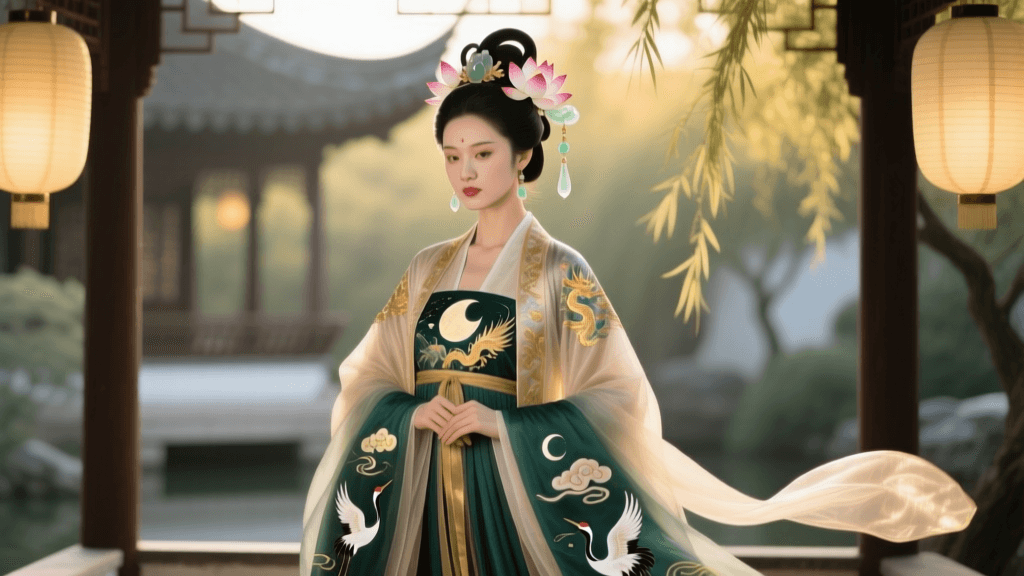
Chang'e, the goddess who resides on the moon, is the epitome of ethereal beauty and sorrowful elegance. Recreating her look requires mastering the physics of drape and movement. The centerpiece of this ensemble is the Daxiushan (wide-sleeve robe) paired with a Pibo (a long, flowing ribbon shawl).
Actionable Sizing and Fabric Advice:
- Pibo Dimensions: To achieve the dramatic, floating effect seen in classical paintings of Chang'e, your Pibo must be between 3.5 and 4 meters in length, with a width of 40 to 50 centimeters. Anything shorter will not allow for the traditional double-loop draping over the arms.
- Sleeve Drop: The sleeves of the Daxiushan should extend at least 20 to 30 centimeters past the fingertips. This elongates the silhouette and mimics the sweeping motion of celestial winds.
- Fabric Weight: Opt for 100% mulberry silk chiffon or organza. For the inner layers, use an 8 to 10 momme weight silk chiffon to ensure the fabric catches the wind. For the outer structural robe, a 16 momme silk organza provides enough stiffness to hold the wide sleeve shape without collapsing.
- Color Palette: Pale celadon, icy silver, and pearlescent white. Avoid harsh, saturated colors; the goal is to mimic moonlight.
Huli Jing (The Fox Spirit): Enchantment and Layers
The Huli Jing, or fox spirit, is a complex figure in Chinese mythology, representing both enchantment and danger. In modern Hanfu styling, the fox spirit aesthetic leans heavily into the late Ming dynasty silhouette, utilizing the Mamianqun (horse-face skirt) and the Beizi (a long, open-front overcoat).
Construction and Styling Details:
- Mamianqun Pleating: A standard, high-quality modern Mamianqun features 12 to 16 knife pleats per side panel. For a fox spirit look, the movement of the skirt is paramount. Ensure the pleats are heat-set and weighted at the hem. The skirt length should be ankle-grazing (approximately 105 to 110 cm, depending on your height) to allow for fluid, predatory movements.
- Gradient Dyeing (Jianse): Fox spirits are often associated with transformation and illusion. Commission or dye your Mamianqun using the jianse (gradient) technique, transitioning from a deep, blood crimson at the waist to a pale, shimmering gold at the hem. This mimics the visual of fox fire (huli jing fire) in the dark.
- Accessories: Incorporate faux fur stoles or heavily embroidered cloud shoulders (yunjian) featuring peony and nine-tail motifs. Hair should be adorned with dangling buyao (step-shake) hairpins featuring fox-fire pearls or red agate.
Long Wang (The Dragon King): Regal Authority
The Dragon Kings of the Four Seas command water, weather, and storms. Dressing as a dragon deity requires garments that project immense authority, structure, and weight. The Yuanlingpao (round-collar robe) is the quintessential garment for this archetype, historically worn by officials and royalty.
Tailoring and Embroidery Guidelines:
- Collar and Structure: The round collar of the Yuanlingpao must sit flush against the base of the neck. The collar diameter should be precisely 15 to 18 cm. Unlike the flowing silks of the Moon Goddess, the Dragon King's robe requires heavy silk damask or brocade (22 to 30 momme weight) to give the garment a rigid, architectural drape.
- Motif Placement: According to traditional cosmological design, water and wave motifs should dominate the lower hem (the lishui or standing water hem), while dragon scales and cloud motifs should adorn the chest, shoulders, and sleeves.
- The Yunjian (Cloud Shoulder): To elevate the Yuanlingpao to divine status, add a detachable, multi-layered Yunjian. A four-tiered cloud shoulder with gold-thread couching embroidery will broaden the shoulders, giving the wearer an imposing, supernatural silhouette.
Sourcing, Commissioning, and Practical Timelines
While mass-produced Hanfu is readily available on e-commerce platforms, true mythological garments often require custom commissioning from specialized indie makers and Taobao ateliers. The Victoria and Albert Museum's extensive Asian collections demonstrate the level of intricate detail historically required for ceremonial and mythological dress, a standard that modern bespoke Hanfu makers strive to emulate.
“When you wear the garments of the gods, you are not merely putting on cloth; you are donning the cosmos. Every stitch represents a star, every pleat a mountain range.” — Modern Hanfu Design Philosophy
How to Commission a Mythological Hanfu:
- Provide Exact Measurements: Indie makers require precise data. You must provide your Bust, Waist, Hips, Shoulder Width, Arm Length (from shoulder bone to wrist), and total Height. For the Mamianqun, also provide your natural waist-to-ankle measurement.
- Understand the Timeline: Custom embroidered mythological pieces are not fast fashion. Expect a wait time of 45 to 90 days for hand-embroidered Yunjian or custom-woven brocade. Plan your convention or photoshoot dates accordingly.
- Budgeting: Allocate between $150 and $400 for a complete, high-quality mythological ensemble. This includes the base garments, specialized outer layers, and essential accessories like the Pibo or Yunjian. Do not compromise on the skirt pleating or the silk momme weight, as cheaper synthetic fabrics will ruin the ethereal or regal illusion.
Conclusion
Recreating traditional clothing from Chinese mythology is a profound way to engage with Asian traditions. It requires a synthesis of historical knowledge, textile science, and artistic vision. Whether you are chasing the moonlit elegance of Chang'e, the enchanting mystery of the Huli Jing, or the storm-bringing authority of the Dragon King, the key lies in respecting the materials and the measurements. By investing in proper silk weights, precise pleating, and culturally resonant motifs, modern Hanfu enthusiasts can successfully bridge the gap between ancient legend and contemporary fashion, keeping the divine threads of mythology alive for future generations.