Exploring China's Premier Hanfu And Silk Museums
The Living Archives of Chinese Sartorial History
The modern Hanfu movement has transformed from a niche internet subculture into a sweeping cultural renaissance across China and the global diaspora. However, to truly understand the structural layering, seasonal fabric choices, and historical context of traditional Chinese garments, enthusiasts must look beyond social media and step into the physical archives. Hanfu museums and silk heritage sites serve as the vital bridge between ancient weaving techniques and contemporary revivalism.
For scholars, designers, and passionate hobbyists, visiting these institutions offers an unparalleled education in the drape of a Ming dynasty mamianqun (horse-face skirt), the intricate weave of Song brocade, and the delicate embroidery of Tang dynasty banbi (half-sleeve jackets). This comprehensive guide explores China’s premier Hanfu and textile heritage sites, providing actionable advice, costs, and travel tips for your next sartorial pilgrimage.
Why Physical Archives Matter in the Hanfu Revival
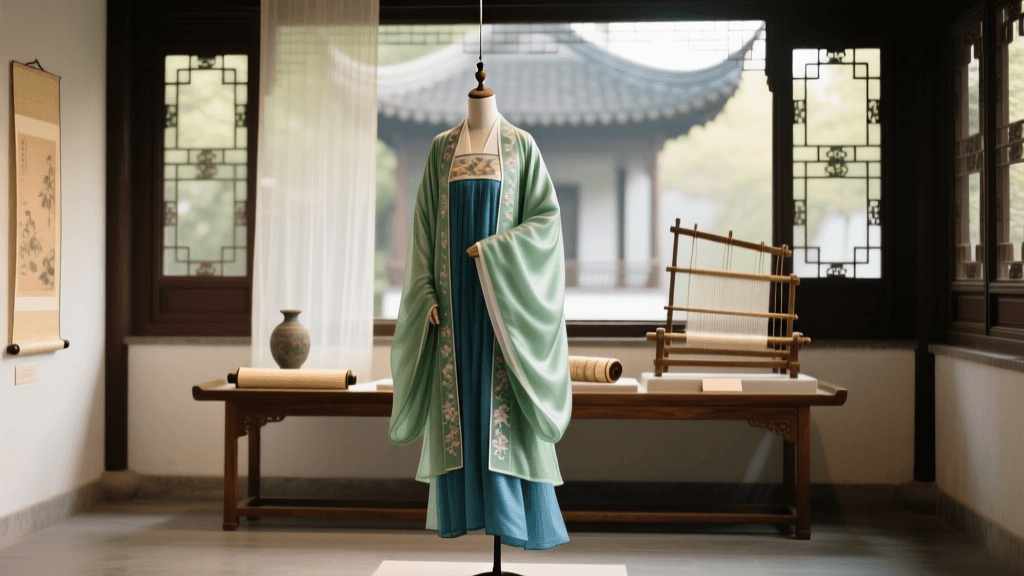
While digital replicas and modern e-commerce have made Hanfu accessible, physical museums preserve the intangible heritage of Chinese sericulture and tailoring. According to the UNESCO Intangible Cultural Heritage registry, traditional sericulture and silk craftsmanship encompass everything from mulberry cultivation to the complex operation of wooden drawlooms. Seeing these massive, room-sized looms in person provides crucial context for the astronomical cost and time required to produce historical brocades.
Furthermore, museums employ strict conservation protocols. Ancient silks are highly susceptible to photodegradation. By observing how museums limit lighting to 50 lux and maintain relative humidity at exactly 50-55%, modern Hanfu collectors can learn how to properly store and care for their own high-end silk garments at home.
Top 3 Must-Visit Hanfu and Silk Museums
1. China National Silk Museum (Hangzhou)
Located near the picturesque West Lake, the China National Silk Museum (CNSM) is the largest silk-focused museum in the world and a mandatory stop for any Hanfu enthusiast. The museum’s "Silk Road" and "Chinese Textile History" pavilions house actual excavated garments dating back to the Han and Tang dynasties.
- Key Exhibits: The Mawangdui Han dynasty silk artifacts and the intricate Tang dynasty floral motifs that inspire modern Hanfu designers.
- Practical Advice: Admission is entirely free, but you must reserve a ticket in advance. Download WeChat, search for the "中国丝绸博物馆" (China National Silk Museum) mini-program, and book your slot up to 3 days in advance.
- Best Time to Visit: Tuesday through Thursday mornings to avoid the heavy weekend tourist crowds. Allocate at least 3 to 4 hours for a thorough viewing.
2. Chengdu Shu Brocade Museum (Chengdu)
Shu brocade, originating from Sichuan province, is one of China's four famous brocades and was a staple for aristocratic Hanfu during the Tang and Ming dynasties. This museum is uniquely focused on the living craft of weaving.
- Key Exhibits: The museum features live demonstrations on traditional wooden drawlooms. Watching a master weaver operate the loom reveals the physical toll and mathematical precision required to create the complex geometric patterns seen in Ming dynasty aoqun (jacket and skirt sets).
- Practical Advice: Tickets cost approximately 50 RMB (around $7 USD). The museum shop sells authentic, hand-woven Shu brocade scarves and fabric offcuts, which are excellent for creating bespoke Hanfu accessories like hair ribbons or small pouches.
- Best Time to Visit: Early afternoon, which is when the master weavers typically begin their live demonstration shifts.
3. Suzhou Silk Museum (Suzhou)
Suzhou is historically the epicenter of China's silk trade, particularly famous for Song brocade and Zhangzhou velvet—fabrics that define the luxurious, understated elegance of Song dynasty Hanfu.
- Key Exhibits: The museum excels in displaying the evolution of weaving tools and the delicate, water-inspired color palettes of Jiangnan (south of the Yangtze) textiles. It provides a masterclass in the seasonal fabric choices of ancient scholars, who favored lightweight, breathable gauzes for the humid southern summers.
- Practical Advice: Entry is free, but requires a passport for international visitors at the front desk. Combine your visit with a trip to the nearby Humble Administrator’s Garden to see how these flowing garments interact with traditional Chinese landscape architecture.
- Best Time to Visit: Spring (April-May) or Autumn (September-October) when the weather is mild, allowing you to comfortably wear your own Hanfu while exploring the city.
Museum Comparison & Visitor Guide
To help you plan your itinerary, here is a structured comparison of these premier heritage sites:
| Museum Name | Location | Primary Hanfu/Textile Focus | Entry Cost | Booking Method |
|---|---|---|---|---|
| China National Silk Museum | Hangzhou, Zhejiang | Comprehensive history, Han/Tang artifacts, Silk Road | Free | WeChat Mini-program |
| Chengdu Shu Brocade Museum | Chengdu, Sichuan | Shu Brocade, Tang/Ming weaving, live loom demos | ~50 RMB | Walk-in or Dianping App |
| Suzhou Silk Museum | Suzhou, Jiangsu | Song brocade, velvet, Jiangnan scholar aesthetics | Free | Walk-in (Passport required) |
Practical Tips for Museum-Goers and Hanfu Enthusiasts
Navigating the Digital Booking Ecosystem
In China, the digital ecosystem moves faster than physical infrastructure. Most major museums no longer accept walk-ins without a digital reservation. If you do not have a Chinese ID card, you will need to use your passport. For WeChat mini-programs that only accept Chinese ID numbers, ask a Chinese friend or your hotel concierge to help you book a "foreign national" slot, or simply show up at the manual service desk with your passport, as most state-run museums are legally required to accommodate international travelers.
Wearing Hanfu to Heritage Sites
Wearing Hanfu to these museums is not only accepted but highly encouraged; it is a beautiful way to participate in the living history the museums aim to protect. However, strict etiquette applies:
- Photography Rules: Flash photography is strictly prohibited. The intense burst of light accelerates the fading of ancient organic dyes. Always turn off your flash and use a high-ISO setting on your camera.
- Physical Boundaries: Never lean on glass display cases. The oils from your skin and the friction from heavy embroidery can damage the seals and the artifacts inside.
- Props and Accessories: Leave long, rigid props (like unsharpened jian swords or long wooden staffs) at the cloakroom, as they pose a risk to both the artifacts and other visitors in crowded galleries.
Understanding the Historical Context
As noted by textile historians at institutions like the Metropolitan Museum of Art, the Silk Road was not just a conduit for trade, but a massive vector for cross-cultural design exchange. When viewing Tang dynasty round-collar robes (yuanlingpao) in the China National Silk Museum, look closely at the pearl-roundel motifs. These designs were heavily influenced by Sasanian Persian art, proving that historical Hanfu was never isolated, but rather a dynamic, evolving tapestry of Asian and Central Asian influences.
"Textiles are the most fragile of historical artifacts. They are intimately connected to the human body, yet they are the first to decay in the earth. When a museum successfully preserves a 1,000-year-old silk sleeve, they are preserving a direct, tactile link to the daily life of our ancestors."
Conclusion
The journey into the world of traditional Chinese clothing is vastly enriched by stepping away from the screen and into the hallowed, climate-controlled halls of China’s silk and Hanfu museums. Whether you are marveling at the mathematical genius of a Shu brocade drawloom in Chengdu or studying the elegant drape of a Song dynasty scholar's robe in Suzhou, these heritage sites provide the foundational knowledge necessary to appreciate the true artistry of Asian traditions. Plan your visit, book your tickets in advance, and prepare to be inspired by the threads that wove an empire together.