Recreating Chinese Mythological Deities: A Hanfu Styling Guide
The Intersection of Myth and Hanfu
Chinese mythology is a vast, intricate tapestry of celestial deities, earthly spirits, and legendary heroes. In recent years, the global resurgence of traditional Chinese clothing has intersected beautifully with these ancient tales. As noted by BBC Culture, the modern Hanfu movement is not merely about historical reenactment; it is a dynamic form of cultural expression that allows wearers to embody the aesthetics of the past. For many enthusiasts, this means stepping into the roles of mythological figures during cultural festivals, temple fairs, and photography shoots.
Translating a mythological concept into wearable, historically grounded Hanfu requires a deep understanding of traditional garment structures, textile weights, and color symbolism. This guide provides actionable advice, precise measurements, and sourcing tips for recreating three iconic archetypes in Chinese mythology: the Moon Goddess, the Fox Spirit, and the Dragon King.
Iconic Mythological Figures and Their Hanfu Counterparts
Before diving into construction and sourcing, it is essential to map the mythological archetype to the correct historical silhouette. The following table outlines the optimal Hanfu styles, color palettes, and accessories for three major deity types.
| Mythological Figure | Primary Hanfu Style | Color Palette | Key Accessories |
|---|---|---|---|
| Chang'e (Moon Goddess) | Qixiong Po Qun, Da Xiu Shan | Pearl White, Ice Blue, Silver | Jade rabbit motifs, silver buyao, silk ribbons |
| Huli Jing (Fox Spirit) | Ming Aoqun, Mamian Qun | Crimson, Gold, Deep Plum | Faux fur stoles, gold leaf crowns, enamel hairpins |
| Long Wang (Dragon King) | Yuanling Pao, Feiyu Fu | Azure, Imperial Yellow, Teal | Dragon-scale brocade, jade guan (hair crown) |
Chang'e (The Moon Goddess): Ethereal Elegance
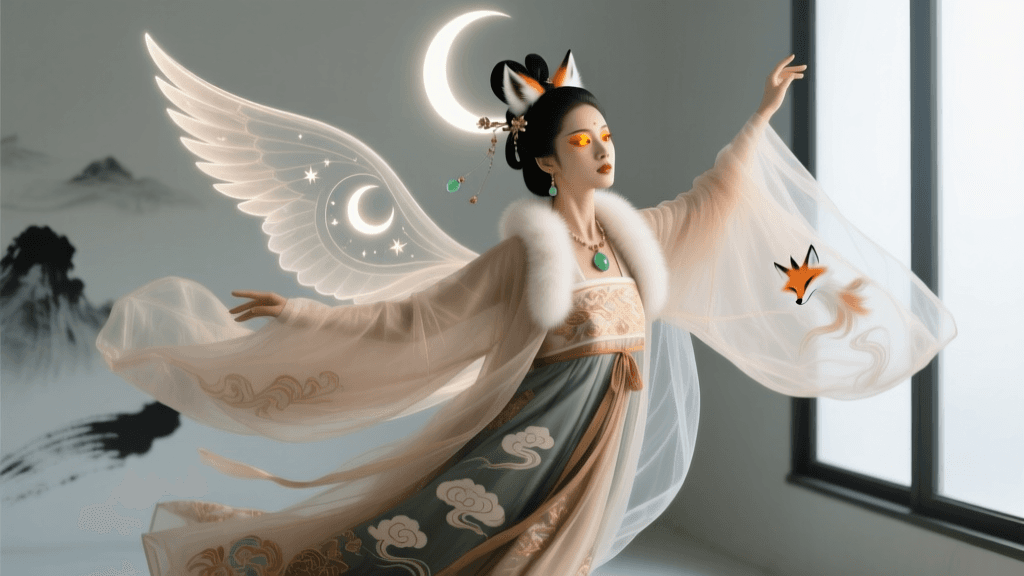
The legend of Chang'e, the woman who drank the elixir of immortality and floated to the moon, is one of China's most enduring myths. As detailed in Encyclopedia Britannica, her story is intrinsically linked to the moon, autumn, and ethereal beauty. To recreate Chang'e, the goal is to achieve a 'floating' silhouette that mimics the anti-gravity effect of celestial flight.
Garment Selection and Measurements
The ideal ensemble for Chang'e is the Qixiong Po Qun (chest-high slit skirt) paired with a Da Xiu Shan (large-sleeve outer robe). The Po Qun, or 'broken skirt,' is constructed from multiple trapezoidal panels of fabric sewn together. For a deity-like flare, opt for a 12-panel or 16-panel Po Qun. A standard 100cm length skirt will require approximately 6 to 8 meters of lightweight fabric to achieve the necessary volume.
The Da Xiu Shan is where the true mythological magic happens. To simulate celestial robes, the sleeves must be exceptionally wide and long. Look for or commission a Da Xiu Shan with a sleeve width of at least 80cm to 100cm, and a sleeve length that extends 30cm to 40cm past your fingertips. When you raise your arms, the excess fabric will drape dramatically, mimicking the 'Feitian' (flying apsara) murals found in the Dunhuang caves.
Fabrics and Textiles
Avoid heavy cottons or stiff linens. The Metropolitan Museum of Art notes that Chinese silk weaving has historically been prized for its luster and drape, qualities essential for deity cosplay. Use 16 momme silk chiffon or silk organza for the outer Da Xiu Shan to provide structure without weight. For the inner layers and the skirt, 8 momme silk habotai or high-quality polyester chiffon (if on a budget) will provide the necessary fluid movement. Incorporate a 3-meter long silk sash (Pibo) draped over the arms to complete the floating illusion.
Huli Jing (The Nine-Tailed Fox Spirit): Enchanting Allure
Fox spirits, or Huli Jing, occupy a complex space in Chinese folklore, ranging from malevolent shapeshifters to benevolent, devoted lovers. Styling a Huli Jing requires balancing human elegance with subtle, wild undertones. The Ming Dynasty Aoqun (lined jacket and skirt) is perfect for this, as its structured silhouette conveys a sense of ancient nobility often associated with fox spirits who have cultivated human form for centuries.
Garment Selection and Measurements
Choose a Pipa-sleeve Ao (jacket with curved, narrow sleeves) paired with a Mamian Qun (horse-face skirt). The Pipa sleeve is historically accurate for the Ming dynasty and provides a sleek, refined look that contrasts beautifully with the voluminous skirt. The jacket should be tailored to fit closely to the torso, ending just below the hips. The Mamian Qun should feature deep, sharp pleats—ideally 4 to 6 pleats per side panel—to create a striking geometric flare when walking or spinning.
Adding the 'Spirit' Element
To hint at the fox nature without resorting to theatrical cosplay ears or tails, focus on texture and motif. Add a detachable faux-fur collar (approximately 12cm to 15cm wide) around the neckline of the Ao. White, silver, or rust-colored faux fox fur adds an immediate animalistic luxury. For the Mamian Qun, select jacquard brocade featuring subtle flora and fauna, specifically avoiding dragon or phoenix motifs, which are reserved for imperial or divine figures. Instead, look for peony, plum blossom, or hidden beast patterns woven in metallic gold threads.
Long Wang (The Dragon King): Imperial Authority
The Dragon Kings of the Four Seas are powerful water deities responsible for weather and rainfall. Styling a Dragon King or a high-ranking water deity requires garments that project authority, structure, and martial prowess. The Yuanling Pao (round-collar robe) or the Feiyu Fu (flying fish garment, a type of赐服 or bestowed robe) are the most appropriate choices.
Garment Selection and Tailoring
The Yuanling Pao should be worn with a leather or heavy fabric belt (Ge Dai) to cinch the waist and create a broad-shouldered, commanding silhouette. The robe should measure from the base of the neck to the floor, with a slight train (about 10cm) to add gravitas. The sleeves should be 'arrow sleeves' (Zha Xiu) or standard wide sleeves gathered at the wrist with ornate bracers (Huo Wan), allowing for ease of movement if you are also carrying a prop sword or staff.
Color and Embroidery
Water deities are traditionally associated with the colors of the deep ocean and the heavens. Utilize rich shades of azure, teal, and deep indigo. To represent the dragon aspect, incorporate Zhuanghua (brocade weaving) or intricate embroidery featuring the 'Mang' (python) or 'Feiyu' (flying fish) patterns. These motifs are visually similar to dragons but were historically permissible for high-ranking officials and guards, making them perfect for deity portrayals without crossing into exclusive imperial dragon (Long) territory.
Sourcing Materials and Accessories for Deity Attire
Creating a mythological Hanfu ensemble is only half the battle; the accessories elevate the outfit from historical clothing to divine representation.
- Hair Crowns (Shuguan): For male deities like the Dragon King, a jade or metallic Shuguan is essential. Secure it with a single wooden or bone hairpin (Zan) inserted horizontally through the crown and the topknot.
- Dangling Hairpins (Buyao): For goddesses and spirits, Buyao with swaying tassels mimic the movement of water and wind. Look for brass or silver-plated Buyao featuring lotus, cloud, or rabbit motifs. Ensure the metal is lightweight to prevent pulling on the hair.
- Forehead Adornments (Huadian): A staple for female deities, the Huadian is a decorative mark or appliqué placed between the eyebrows. Use metallic gold leaf flakes or traditional red paper cutouts shaped like lotus petals or crescent moons. Apply using a gentle, skin-safe spirit gum or eyelash adhesive.
- Footwear: Avoid modern shoes. Invest in a pair of traditional cloud-head shoes (Yun Tou Xie). For a taller, more imposing deity look, female wearers can opt for wooden platform versions, which add 5cm to 8cm of height and force a slower, more graceful gait.
Dyeing Techniques for Celestial Gradients
Mythological beings are rarely clad in flat, solid colors. To achieve the ethereal gradients seen in celestial robes, look for Hanfu that utilizes Jianran (clip-resist dyeing) or modern dip-dyeing techniques. A skirt that transitions from deep indigo at the hem to pale silver at the waist mimics the depths of the Dragon King's ocean, while a sleeve that fades from pearl white to soft pink evokes the dawn sky of the heavenly realm. If you are dyeing your own silk organza, use acid dyes specifically formulated for protein fibers, and employ a gradual immersion technique to ensure a seamless, cloud-like gradient.
Conclusion
Dressing as a figure from Chinese mythology is a profound way to engage with the cultural and spiritual heritage of the region. By carefully selecting historically grounded Hanfu silhouettes—such as the floating Da Xiu Shan for Chang'e, the structured Aoqun for the Huli Jing, and the authoritative Yuanling Pao for the Dragon King—you bridge the gap between ancient folklore and modern sartorial art. Pay close attention to fabric weights, precise sleeve measurements, and symbolic accessories, and you will not merely wear a costume; you will embody a legend.