Murasaki Shikibu's Fashion Legacy: Mastering Heian Color Layering
The Literary Icon Who Defined Japanese Aesthetics
When discussing the foundational pillars of Japanese fashion, few figures loom as large as Murasaki Shikibu, the legendary 11th-century author of The Tale of Genji. While primarily celebrated as a literary genius, Murasaki was also a meticulous observer and chronicler of Heian-period court aesthetics. Her writings did not merely describe the clothing of her era; they codified the emotional and seasonal resonance of textile layering. According to the Metropolitan Museum of Art's Heilbrunn Timeline of Art History, the Heian period (794–1185) was characterized by an intense focus on native Japanese arts, where the subtle layering of silk garments became a primary medium for personal expression, poetic communication, and social ranking.
Murasaki’s detailed observations of court life cemented the kasane no irome (layered color combinations) as a cornerstone of Japanese aesthetics. Today, her fashion legacy continues to influence modern kimono styling, offering a masterclass in how color, seasonality, and texture can be harmonized to tell a visual story.
Decoding Kasane no Irome: The Art of Color Layering
At the heart of Murasaki Shikibu’s fashion legacy is the junihitoe, the iconic twelve-layer robe worn by high-ranking court ladies. However, the true artistry lay not in the sheer volume of fabric, but in the precise arrangement of colors at the cuffs, hems, and collars. This system, known as kasane no irome, required the wearer to layer specific shades of silk to evoke the natural world—such as the melting snow revealing plum blossoms, or the autumn leaves turning over a dark river.
As highlighted in the Victoria and Albert Museum's 'Kimono: Kyoto to Catwalk' exhibition, the evolution of Japanese dress is deeply rooted in these early aesthetic codes. The Heian aristocracy viewed nature through a deeply poetic lens, and a woman’s sleeves, peeking out from behind bamboo blinds (misu), served as her visual voice. A mismatched layer or an out-of-season color was considered a profound social faux pas, indicating a lack of refinement and poetic sensibility.
Historical Color Combinations and Their Meanings
To understand the genius of Heian layering, one must look at the specific combinations that Murasaki and her contemporaries utilized. Below is a structured guide to classic kasane no irome pairings that defined the Heian wardrobe:
| Season | Combination Name | Outer Layer (Uwagi) | Inner Layer (Shitagi) | Symbolic Meaning |
|---|---|---|---|---|
| Early Spring | Yamabuki (Japanese Kerria) | Yellow | Light Green | Fresh sprouts beneath yellow blossoms |
| Late Spring | Kurenai (Deep Crimson) | Crimson | Pink | Fading cherry blossoms on the branch |
| Summer | Ao (Blue/Green) | Light Blue | White | Cool waters and clear summer skies |
| Autumn | Kikuchiba (Yellow-Brown) | Yellow-Brown | Dark Red | Autumn leaves turning over dark earth |
| Winter | Shiroubai (White Plum) | White | Pink | Plum blossoms blooming beneath snow |
The Rules of Rank: Kinjiki and Yurushi-iro
Murasaki Shikibu’s diaries and fiction frequently reference the strict sumptuary laws of the Heian court. Colors were divided into kinjiki (forbidden colors) and yurushi-iro (permitted colors). Deep purples, certain rich crimsons, and specific yellow-greens were reserved exclusively for the imperial family and the highest-ranking nobles. For deeper historical context on court rankings and dress codes, the Metropolitan Museum of Art's archival exhibition on The Tale of Genji provides extensive visual evidence of how these color restrictions dictated the visual hierarchy of the court. Modern kimono wearers can honor this history by reserving the most opulent, deep purple and gold-threaded garments for the most formal of occasions, mirroring the reverence once held for imperial hues.
Translating Heian Elegance to Modern Kimono Styling
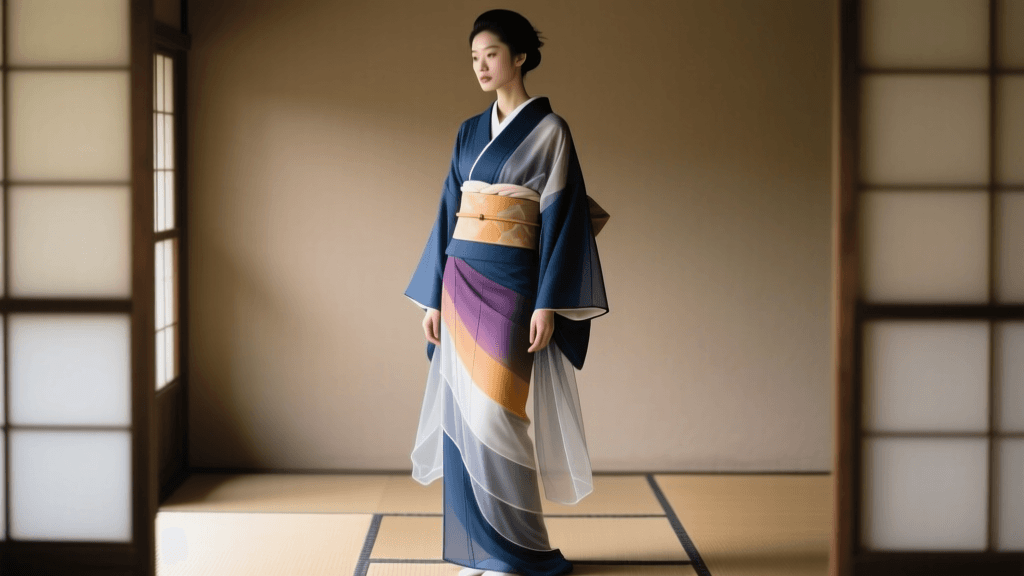
While the heavy, twelve-layer junihitoe is no longer practical for daily wear or modern ceremonies, the principles of kasane no irome remain highly relevant. Today’s kimono enthusiasts can replicate the depth and poetry of Heian layering through strategic accessory pairing and modern tailoring techniques.
1. The Kasane-Eri (Layered Collar) Technique
The most direct descendant of Heian layering is the kasane-eri or date-eri. This is a secondary, contrasting collar pinned beneath the main collar of the kimono to create the illusion of multiple layered garments.
- Measurements: A standard han-eri (removable collar) is 15.5 cm wide and 100 cm long. When adding a kasane-eri, ensure it is slightly narrower (about 14 cm) so that exactly 1 to 1.5 cm of the underlying color peeks out at the nape of the neck and the chest.
- Application: For a 'Shiroubai' (Winter Plum) effect in January, wear a crisp white kimono with a pale pink kasane-eri. Pin the secondary collar securely using traditional eri-sugata clips or small safety pins hidden beneath the folds.
2. Obiage and Obijime Color Pairing
The obiage (silk sash scarf) and obijime (decorative cord) serve as the modern equivalents of the inner and outer sleeve layers. By contrasting these two elements, you can recreate the visual tension of Heian color theory.
- Spring Styling: Pair a pale green obiage (representing new willow leaves) with a vibrant yellow obijime (representing the Yamabuki flower).
- Autumn Styling: Use a deep crimson obiage tucked just slightly above the obi, paired with a textured, golden-brown obijime to mimic the Kikuchiba combination.
Practical Guide: Building a Heian-Inspired Wardrobe
For collectors and practitioners looking to infuse their wardrobe with Murasaki’s aesthetic legacy, here is an actionable purchasing and styling guide, complete with estimated costs and seasonal timing.
- Silk Kasane-Eri Set ($25 - $45): Purchase a set of interchangeable date-eri collars in pale pink, light green, and soft yellow. These are cost-effective ways to change the seasonal narrative of a single, solid-colored kimono.
- Chirimen (Silk Crepe) Obiage ($30 - $80): Invest in shibori (tie-dyed) silk crepe obiage. The textured surface mimics the organic, natural elements celebrated in Heian poetry. Look for gradient-dyed (bokashi) pieces that transition from white to pink, perfectly capturing the 'fading cherry blossom' motif.
- Seasonal Timing (Risshun to Geshi): In the traditional Japanese calendar, spring begins on Risshun (around February 4th). Begin wearing your 'Yamabuki' and 'Shiroubai' color combinations in late January to anticipate the season, as wearing a motif or color after it has peaked in nature is considered aesthetically late. Transition to 'Ao' (blue/white) combinations by early June, ahead of the rainy season.
- Kyoto Dyeing Workshops ($150 - $250): For a truly bespoke connection to the legacy, book a Kyo-yuzen dyeing workshop in Kyoto. Many artisan studios allow you to dye your own han-eri or obijime using historic plant-based dyes like benibana (safflower) for crimson and ai (indigo) for summer blues.
Preserving the Legacy: Care, Etiquette, and Maintenance
The Heian aristocracy treated their silks with immense reverence, airing them out on specialized wooden racks during the autumn mushiboshi (insect-drying) days. To maintain modern Heian-inspired silk garments, strict care protocols must be followed.
Never store layered silk collars or kimono in plastic, which traps moisture and causes the silk to yellow and degrade. Instead, wrap your garments in tatou (traditional Japanese paper) or acid-free tissue paper, and store them in a breathable tatou box or a paulownia wood chest (kiri-dansu). Paulownia wood naturally regulates humidity and repels insects, ensuring that the vibrant crimsons, delicate pinks, and deep blues of your Heian-inspired wardrobe remain as vivid as the day they were dyed.
By understanding and applying the kasane no irome system, modern wearers do more than simply put on traditional clothing; they participate in a thousand-year-old poetic dialogue. Murasaki Shikibu’s fashion legacy reminds us that clothing is not merely functional, but a canvas for expressing our deep connection to the natural world and the fleeting beauty of the seasons.