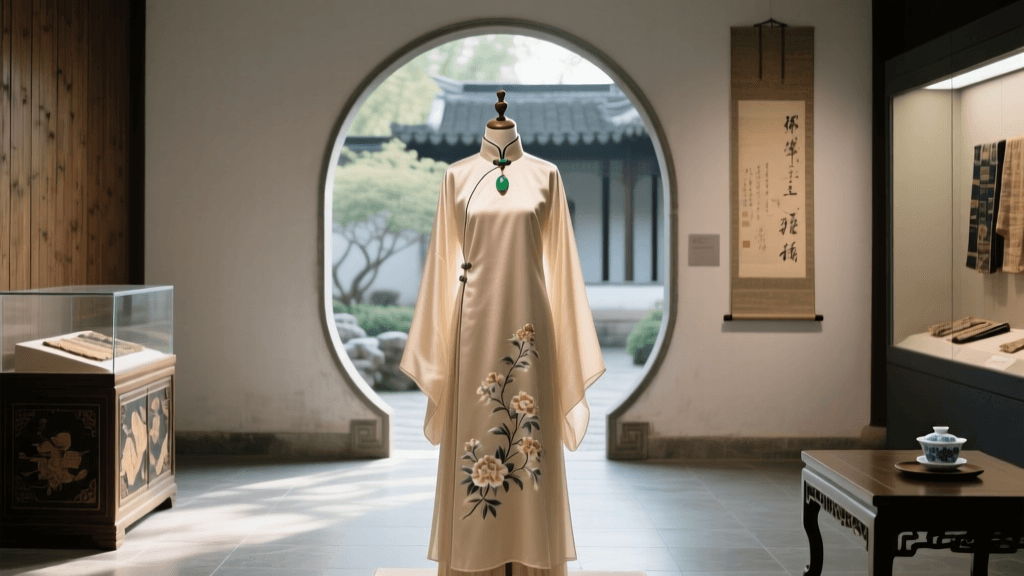
Mamianqun Drape Analysis: Academic Research Trends 2026
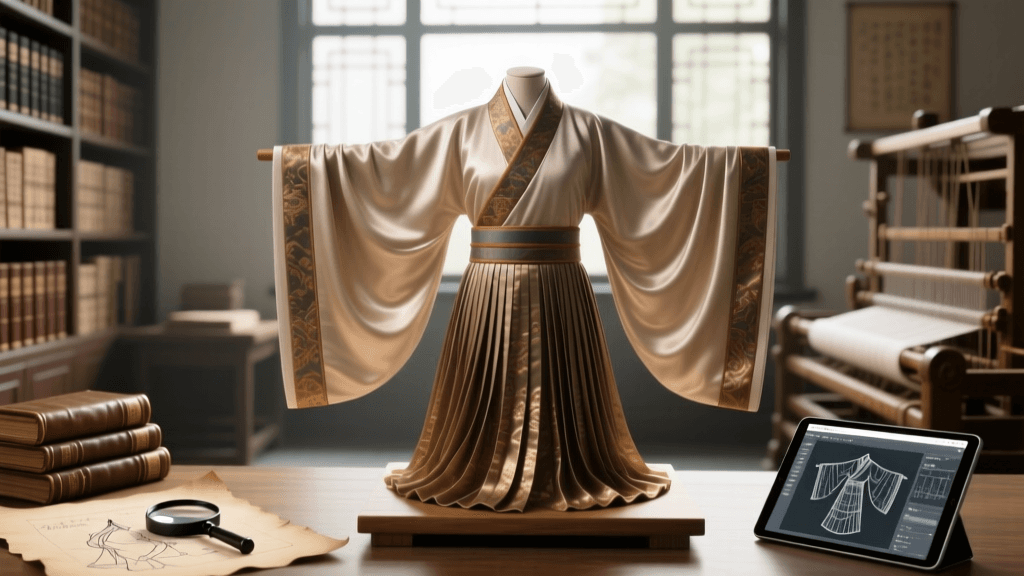
The Intersection of Ancient Chinese Fashion and Modern Material Science
The intersection of ancient Chinese fashion history and modern academic research has reached a fascinating zenith in 2026. Driven by the explosive global popularity of the Xin Zhongshi (新中式) movement, universities and independent scholars are no longer relying solely on two-dimensional historical paintings or fragile archaeological textiles. Instead, the academic focus has shifted toward rigorous, data-driven fabric drape analysis of iconic garments like the Ming Dynasty Mamianqun (horse-face skirt). This article explores how Chinese fashion history education is leveraging 3D simulation, digital archaeology, and material science to decode the kinetic elegance of traditional Hanfu, providing a roadmap for students and researchers entering this rapidly expanding field.
The Evolution of Chinese Fashion History Education in 2026
In 2026, fashion history education at top-tier institutions like Donghua University in Shanghai and the Beijing Institute of Fashion Technology (BIFT) has evolved into a highly interdisciplinary, STEM-adjacent field. The traditional pedagogy of memorizing dynastic clothing regulations and sketching flat patterns has been augmented by digital twin technology and kinetic textile engineering. Students are now required to understand the physics of textiles—specifically how historical weaving techniques influence the gravitational drape, pleat retention, and kinetic movement of garments.
This academic shift is largely a response to the commercial and cultural demands of the Xin Zhongshi movement. As modern consumers demand historically accurate yet wearable traditional garments, academic programs have integrated digital archaeology into their core curricula. Researchers utilize advanced spectrophotometry to analyze surviving textile fragments, while simultaneously employing 3D garment simulation software to reconstruct the exact drape of Ming Dynasty silk damasks. According to the Textile Society of America, the integration of material physics into historical costume studies represents one of the most significant pedagogical shifts in global fashion education over the last decade.
Decoding the Mamianqun: What is Fabric Drape Analysis?
The Mamianqun, characterized by its flat front and back panels intersecting with intricate side pleats, is a masterclass in structural fashion design. However, its aesthetic success relies entirely on the drape of the fabric. Drape analysis in an academic context refers to the quantitative measurement of how a fabric deforms under its own weight. For the Mamianqun, the kinetic movement of the side pleats during walking, sitting, or wind exposure is dictated by three primary mechanical properties: bending stiffness, shear rigidity, and surface friction.
To measure these properties, academic labs in 2026 utilize the FAST (Fabric Assurance by Simple Testing) system alongside digital drape testers. By inputting these physical metrics into simulation engines, researchers can accurately predict how a specific historical textile—such as a 15th-century silk-satin weave—would behave when constructed into a 6-meter circumference skirt. This data-driven approach allows historians to understand why certain pleating techniques were favored during the Ming Dynasty (1368–1644) based on the localized availability of silk versus ramie fibers.
Comparative Data: Historical Silk vs. Modern Xin Zhongshi Textiles
One of the primary objectives of current academic research is to compare the mechanical properties of authentic historical textiles with the modern synthetic and semi-synthetic blends used in today's Xin Zhongshi market. The table below outlines data gathered from university textile labs in 2026, demonstrating the variance in drape mechanics.
| Material Type | Bending Length (mm) | Shear Rigidity (N/m) | Historical Era / Application |
|---|---|---|---|
| Ming Dynasty Silk Damask (Artifact) | 42.5 | 35.2 | Authentic 15th-Century Court Wear |
| Modern Mulberry Silk Crepe | 28.1 | 18.4 | High-End Xin Zhongshi Replicas |
| Polyester-Jacquard Blend | 55.8 | 62.1 | Mass-Market Fast Fashion Hanfu |
| Traditional Ramie-Linen Weave | 68.3 | 75.0 | Ming Dynasty Summer / Commoner Wear |
As the data illustrates, modern polyester blends exhibit significantly higher shear rigidity, resulting in stiff, unnatural pleat flaring that fails to replicate the fluid, water-like kinetic drape of authentic Ming Dynasty silk damask. This empirical data is frequently cited in 2026 academic papers critiquing the historical accuracy of commercial Hanfu manufacturers.
Leading Academic Institutions and Digital Archives
For students and independent researchers looking to access primary data, several institutions are leading the charge in Chinese fashion history preservation and digital reconstruction. Donghua University's Shanghai History Museum of Costume remains the premier destination for physical artifact analysis, housing thousands of Ming and Qing dynasty textile fragments. Researchers there utilize non-destructive 3D scanning to map the microscopic weave structures of deteriorating silks.
On a global scale, institutions like the Metropolitan Museum of Art's Heilbrunn Timeline of Art History provide invaluable open-access archives on Chinese silk production and historical trade routes, offering vital context for the material origins of historical garments. Furthermore, the Tsinghua University Academy of Arts & Design has pioneered the use of AI-assisted pattern drafting, allowing scholars to reverse-engineer the complex, zero-waste cutting techniques of the Mamianqun from surviving flat-lay artifacts.
Practical Guide: Setting Up a Drape Analysis Lab
For graduate students and independent fashion historians establishing a drape analysis workflow in 2026, a hybrid approach combining physical testing and digital simulation is the academic standard. Below is the recommended hardware and software stack currently utilized in university labs.
Recommended Hardware and Software for 2026
- Digital Simulation Engine: CLO Virtual Fashion remains the industry and academic standard. Its 2026 enterprise update includes specialized algorithms for simulating complex, multi-layered pleated structures and historical weave-specific friction coefficients.
- Physical Drape Testing: The FAST testing kit is essential for measuring physical bending length and hysteresis. For budget-constrained independent researchers, the Cusick Drape Tester remains a reliable, low-cost alternative for generating 2D drape coefficient charts.
- Material Scanning: Portable digital microscopes (such as the Dino-Lite Edge series) are used to capture the warp and weft density of historical textiles, which is then translated into the simulation software's material editor.
Step-by-Step Methodology for Hanfu Drape Research
Conducting a peer-reviewed drape analysis study on traditional Chinese garments requires a meticulous, multi-step methodology. Academic advisors in 2026 recommend the following workflow for graduate theses:
- Artifact Selection and Scanning: Select a well-preserved textile fragment or extant garment. Use photogrammetry to create a 3D mesh of the physical object, noting any degradation that might affect its current drape compared to its original state.
- Material Parameter Extraction: Test a modern, historically accurate replica fabric using the FAST system to extract bending, shear, and weight metrics. Do not rely on default software fabric presets.
- Digital Pattern Reconstruction: Draft the Mamianqun pattern using historical proportional rules (e.g., the Ming Dynasty caidu measuring system) rather than modern Western block patterns.
- Kinetic Simulation and Validation: Run the 3D simulation through a series of kinetic avatars (walking, sitting, bowing). Compare the digital pleat flare and settling time against historical portraiture and video references of modern reconstructionists.
The Impact of Xin Zhongshi on Academic Funding
The commercial explosion of the Xin Zhongshi movement has had a profound, positive impact on academic funding for Chinese fashion history. In 2026, government cultural grants and private sector investments from major Chinese fashion conglomerates are heavily subsidizing digital archaeology labs. This influx of capital has allowed universities to purchase advanced spectrophotometers, high-speed kinetic capture cameras, and enterprise licenses for 3D simulation software.
More importantly, this funding has democratized access to historical data. Open-source databases featuring the exact material physics of historical Chinese textiles are being launched, allowing global researchers to accurately simulate Hanfu without needing physical access to fragile museum archives. As the line between historical preservation and digital fashion continues to blur, the academic study of the Mamianqun stands as a testament to how ancient traditions can be preserved, understood, and celebrated through the rigorous application of modern science.