Ming Dynasty Hanfu Rank Badges and Color Codes Explained
The Visual Resume: Ming Dynasty Sartorial Hierarchy
In the rich tapestry of Asian traditions, few sartorial systems were as rigorously codified and visually striking as the official dress codes of the Ming Dynasty (1368–1644). For modern Hanfu enthusiasts and historians alike, understanding Ming official attire is not merely about appreciating beautiful silk textiles; it is about decoding a complex visual resume. During this era, traditional Chinese clothing was governed by strict sumptuary laws that dictated every aspect of a garment, from the weave of the silk to the specific hue of the dye and the mythical creatures adorning the chest. These garments were not just fashion statements; they were immediate indicators of a wearer's political rank, societal role, and proximity to the imperial throne.
Decoding the Ming Color Code
Color in Ming Dynasty official Hanfu was heavily regulated, serving as the first visual cue of an official's status before one even noticed the intricate embroidery. The imperial court reserved the brightest, most vibrant shades for the highest echelons of power, while lower-ranking officials were relegated to more subdued tones.
The Hierarchy of Hues
- Scarlet (Fei) and True Red (Hong): Reserved exclusively for the highest-ranking officials (1st to 4th rank). Achieving a vibrant, colorfast red required expensive natural dyes, primarily derived from safflower (Carthamus tinctorius) and madder root. The brilliance of the red directly correlated to the wearer's prestige.
- Green (Lu): Designated for mid-level officials (5th to 7th rank). These shades were typically achieved using indigo combined with yellow dyes like rattan yellow or pagoda tree buds, creating a spectrum from deep forest green to vibrant jade.
- Blue (Qing) and Cyan: Worn by lower-ranking officials (8th and 9th rank). Indigo dye was relatively accessible, making these cooler, darker shades appropriate for those at the base of the bureaucratic pyramid.
It is crucial for modern Hanfu revivalists to note that 'yellow' in its pure, bright form (Ming Huang) was strictly reserved for the Emperor and the immediate imperial family. Wearing imperial yellow as an official without explicit permission was considered an act of treason.
Buzi: The Architecture of Rank Badges
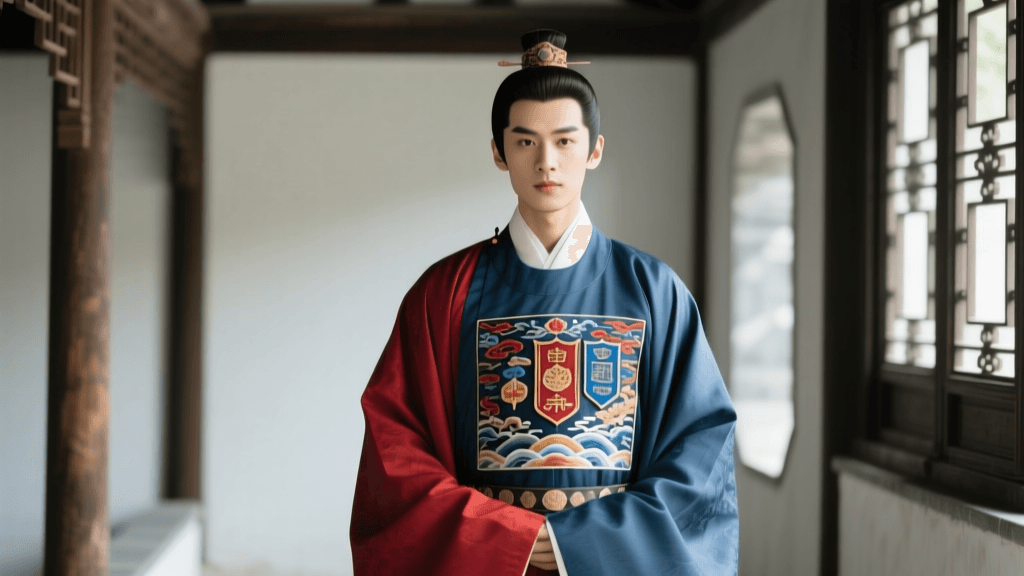
While color established the general tier of an official, the Buzi (rank badge) provided the exact rank and division. Formalized during the Ming Dynasty and later adopted by the Qing, the Buzi consisted of two large, square embroidered or woven panels affixed to the chest and back of the official's outer robe, known as the Changfu or Buzi robe. According to The Metropolitan Museum of Art, these badges were masterpieces of textile art, featuring specific birds for civil officials and beasts for military officers, set against a backdrop of stylized clouds, waves, and mountains.
Civil and Military Hierarchy Chart
The Ming Dynasty divided its bureaucracy into nine primary ranks. Civil officials were represented by birds, symbolizing elegance, literary prowess, and grace. Military officials were represented by beasts, symbolizing strength, courage, and ferocity.
| Rank | Civil Official (Birds) | Military Official (Beasts) |
|---|---|---|
| 1st | White Crane (Xianhe) | Lion (Shi) |
| 2nd | Golden Pheasant (Jinji) | Lion (Shi) |
| 3rd | Peacock (Kongque) | Tiger (Hu) |
| 4th | Wild Goose (Yunyan) | Leopard (Bao) |
| 5th | Silver Pheasant (Baihan) | Bear (Xiong) |
| 6th | Egret (Silu) | Panther (Biao) |
| 7th | Mandarin Duck (Xichi) | Rhinoceros (Xi) |
| 8th | Quail (Anchun) | Rhinoceros (Xi) |
| 9th | Paradise Flycatcher (Lianque) | Sea Horse (Haima) |
As noted by textile historians at the Smithsonian Magazine, the creation of these intricate garments was a monumental task, often requiring specialized imperial workshops where artisans spent months on a single robe using techniques like Kesi (silk tapestry) to ensure the motifs were integrated directly into the warp and weft of the fabric.
Actionable Guide: Commissioning and Wearing Ming Official Hanfu
For modern practitioners of the Hanfu movement, historical accuracy is paramount. If you are commissioning, purchasing, or styling a Ming Dynasty official robe for a traditional ceremony, cultural exhibition, or high-end photoshoot, you must adhere to specific measurements, materials, and construction techniques. Here is your practical guide to acquiring authentic Ming-style official attire.
1. Measurements and Proportions
Many modern commercial Hanfu brands inaccurately shrink the Buzi rank badges to fit smaller, modern garment cuts. Historically, Ming Dynasty rank badges were massive, typically measuring between 35cm x 35cm to 40cm x 40cm (approx. 14 to 16 inches square). When commissioning a custom robe, insist on these dimensions. The badge should dominate the chest, stretching nearly from shoulder seam to shoulder seam on a traditional flat-cut sleeve structure. Furthermore, the Zhili (a popular Ming official robe style with side pleats) should feature a hemline that rests exactly 2-3 centimeters above the ankle bone when wearing traditional cloud-toe shoes.
2. Fabric and Material Selection
Avoid synthetic brocades and modern polyester jacquards if you seek historical authenticity. The Ming court favored heavy, structured silks that held their shape and caught the light dynamically.
- Silk Damask (Chou): Ideal for the base robe. Look for tone-on-tone woven patterns featuring subtle cloud motifs or floral scrolls.
- Kesi (Silk Tapestry): The gold standard for high-ranking Buzi badges. Kesi involves weaving the colored silk threads only where the pattern requires, creating a 'carved' look with tiny slits between color blocks. It is highly prized and historically accurate for 1st to 3rd rank officials.
- Zhuanghua (Brocade): A heavier, raised weave suitable for winter official garments, often incorporating real gold or silver threads.
3. Costs and Investment Breakdown
Authentic Ming official Hanfu is an investment. Here is what you should expect to pay in the current market for high-quality, historically informed pieces:
- Machine-Embroidered Badges on Silk Blend: $80 – $150 USD. (Acceptable for casual Hanfu gatherings, but lacks historical depth).
- Hand-Embroidered Badges on Pure Silk Damask: $350 – $800 USD. (Requires skilled artisans using traditional couching and satin stitches; excellent for ceremonies).
- Authentic Kesi Woven Robes (Bespoke): $1,500 – $4,000+ USD. (Commissioned from specialized heritage workshops in Suzhou or Nanjing. These are museum-quality investment pieces).
4. Timing and Lead Times
If you are ordering a bespoke hand-embroidered or Kesi-woven Ming official robe for a specific event (such as a traditional wedding or a cultural heritage gala), you must plan well in advance. Hand-embroidery of a 40cm badge takes a single artisan 4 to 8 weeks. True Kesi weaving, which is done entirely by hand on a specialized loom, can take 4 to 6 months for a full robe. Always factor in an additional 2-3 weeks for the final tailoring and flat-cut sleeve assembly.
5. Styling and Accessories
A Ming official robe is incomplete without its accompanying headwear and belt. Civil officials wore the Wushamao (black gauze hat with wing-like flaps), while military officials wore helmets or specific martial caps. The waist must be cinched with a Gedai (leather belt) adorned with jade or horn plaques, the material of which was also strictly dictated by rank. Ensure your belt plaques match your Buzi rank to maintain total historical coherence.
Conclusion
The Ming Dynasty's approach to color codes and rank badges represents one of the most sophisticated intersections of politics, art, and fashion in Asian history. By understanding the deep symbolism behind the crimson dyes, the soaring cranes, and the roaring lions, modern wearers can do more than just dress up; they can resurrect a profound cultural legacy. Whether you are investing in a bespoke Kesi robe or carefully selecting a hand-embroidered Buzi, respecting these historical codes ensures that the visual language of traditional Chinese clothing continues to be spoken with accuracy and reverence.