Ming Dynasty Hanfu Drape Analysis: Academic Research Tools 2026
The Evolution of Chinese Fashion History Education in 2026
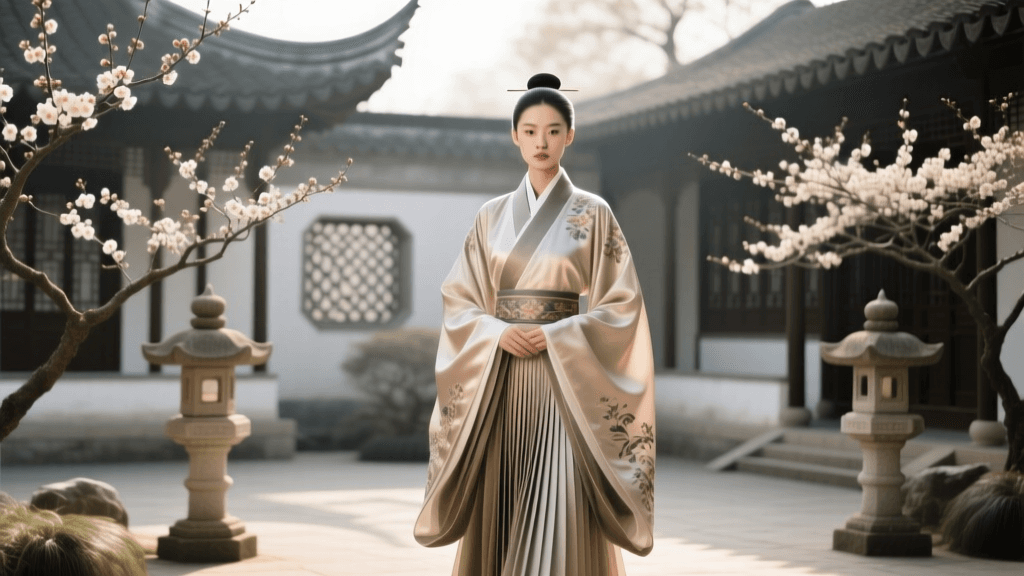
In 2026, the academic study of Chinese fashion history has transcended traditional archival research, evolving into a highly interdisciplinary field that merges material culture with advanced computational physics. Universities across Asia and the globe are no longer relying solely on static, two-dimensional pattern drafting to understand historical garments. Instead, the integration of 3D drape analysis and digital archiving has revolutionized how scholars, conservators, and designers approach traditional Chinese clothing. This shift is particularly evident in the study of Ming Dynasty Hanfu, where the complex structural dynamics of garments like the Mamianqun (horse-face skirt) require sophisticated simulation to fully comprehend their historical accuracy and kinetic behavior.
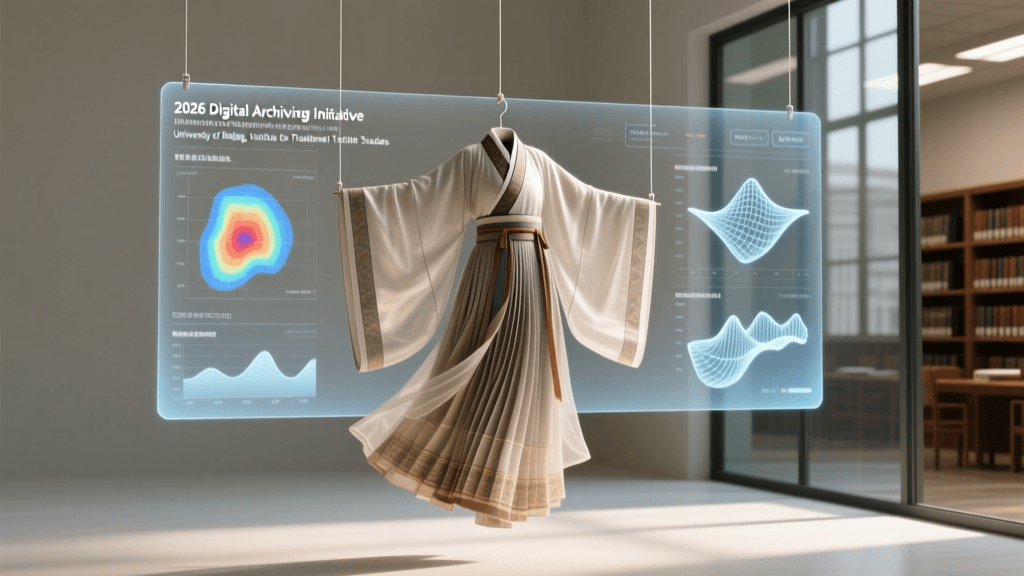
The contemporary academic landscape demands a rigorous, data-driven approach to historical dress. Institutions such as Donghua University have pioneered curriculums that require fashion history students to master both traditional textile conservation and modern 3D garment simulation software. By digitizing fragile excavation textiles, researchers can analyze the drape, tension, and structural integrity of ancient silks without risking damage to the original artifacts. This methodology not only preserves the physical heritage but also provides empirical data that fuels the booming Xin Zhongshi (新中式) movement, ensuring that modern commercial adaptations remain historically grounded.
Bridging Physical Archives and Digital Laboratories
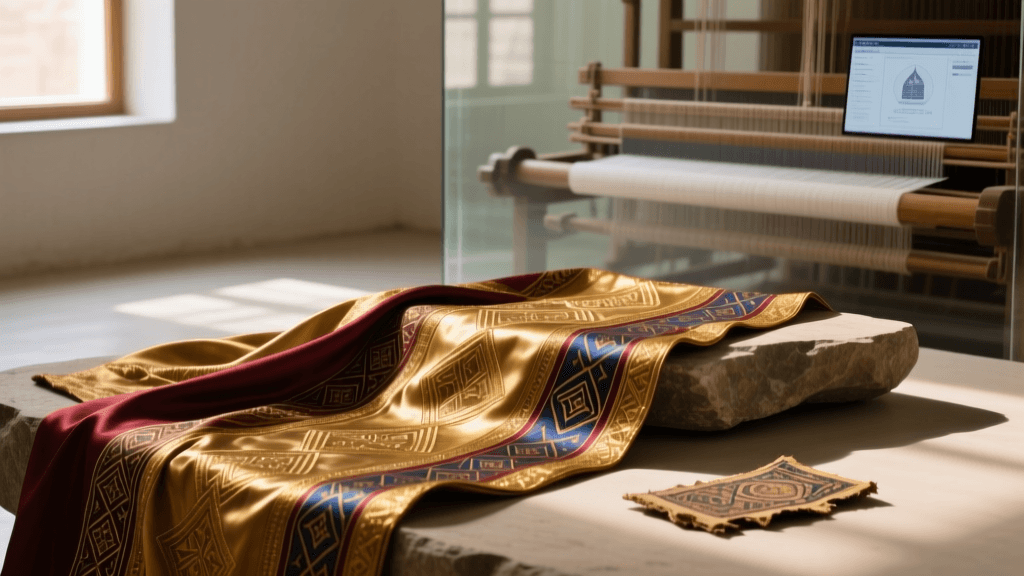
While digital tools dominate the analytical phase, the foundation of Chinese fashion history education remains rooted in the physical examination of surviving textiles. In 2026, top-tier academic laboratories operate under strict environmental protocols to maintain the integrity of ancient silks before they are scanned and digitized. Understanding the physical properties of historical fabrics is a prerequisite for creating accurate digital twins.
Environmental Controls for Ming Dynasty Silks
- Temperature and Humidity: Archival storage units are maintained at a strict 18°C to 20°C (64°F to 68°F) with a relative humidity (RH) of 45% to 55%. Fluctuations beyond this range cause the protein fibers of silk to expand and contract, leading to micro-fractures.
- Lux Levels: Light exposure is capped at 50 lux for exhibited textiles, but for active academic research and high-resolution scanning, garments are exposed to specialized, UV-filtered LED arrays for strictly timed intervals not exceeding 15 minutes per session.
- Support Structures: Custom-carved, acid-free Ethafoam mounts are used to support the weight of heavy brocades, ensuring that the warp and weft threads are not subjected to gravitational stress during the digitization process.
The Mechanics of 3D Drape Analysis in Academic Research
Drape analysis is the study of how a fabric behaves under the influence of gravity, body topology, and kinetic movement. For Ming Dynasty garments, which often utilized wide, uncut lengths of fabric to preserve the continuity of woven motifs, understanding drape is essential. Unlike Western historical tailoring, which relied heavily on cutting and seaming to create three-dimensional shapes, traditional Chinese garment construction is primarily two-dimensional, relying on the fabric's natural drape to accommodate the human form.
In 2026, academic researchers utilize automated fabric testing systems, such as the KES-FB (Kawabata Evaluation System for Fabrics), to measure the precise physical properties of historical textiles. These metrics are then inputted into 3D simulation environments. The critical metrics include:
- Bending Stiffness: Determines how the fabric folds and pleats, crucial for analyzing the sharp, structured pleats of a Mamianqun.
- Shear Rigidity: Measures the fabric's ability to resist deformation when pulled at an angle, vital for understanding how bias-cut elements or wide sleeves behave during movement.
- Surface Friction: Dictates how layers of silk interact with one another, particularly important when simulating the layered wearing of inner garments (Zhongyi) and outer robes (Pifeng or Aoqun).
Actionable Guide: Simulating the Ming Dynasty Mamianqun
The Mamianqun, characterized by its flat front and back panels with heavily pleated sides, is a focal point of current academic research. Recreating its kinetic drape requires a meticulous, step-by-step digital methodology.
- Algorithmic Pattern Drafting: Researchers begin by drafting the pattern based on surviving museum specimens. A standard academic reconstruction utilizes a waistband of 120 cm, with the skirt body requiring up to 6 meters of fabric width to accommodate the deep, overlapping side pleats.
- Material Assignment: Using data from physical silk organza and heavy brocade tests, the digital material is assigned a GSM (grams per square meter) of 45 for the inner lining and 120 for the outer brocade. The bending stiffness is set to 0.85 to mimic the crispness of historically woven silk.
- Pleat Stabilization Simulation: Historically, pleats were stabilized using heavy pressing techniques and sometimes subtle top-stitching. In the 3D environment, researchers apply virtual ironing algorithms to set the pleat memory, testing how well the pleats retain their shape after 10,000 simulated walking cycles.
- Kinematic Testing: A virtual avatar programmed with motion-capture data of a traditional Chinese walking gait is used to test the skirt's swing. Researchers measure the flare angle at the hem during movement to ensure the digital reconstruction matches the historical descriptions of the skirt blooming like a lotus when the wearer walks.
2026 Academic Software Comparison for Textile Research
Selecting the right software is critical for university labs. Below is a comparison of the leading 3D garment simulation platforms utilized in Chinese fashion history research in 2026.
| Software | Best For | Silk Drape Accuracy | 2026 Academic License Cost |
|---|---|---|---|
| CLO 3D | Comprehensive kinetic analysis and pleat memory | Exceptional (Advanced particle physics) | $1,200 / year per lab seat |
| Browzwear (VStitcher) | Supply chain integration and modern Xin Zhongshi manufacturing | High (Focus on commercial fabric libraries) | $1,500 / year per lab seat |
| Marvelous Designer | Conceptual visualization and rapid historical prototyping | Moderate (Optimized for animation over physics) | $800 / year per lab seat |
For rigorous academic research and peer-reviewed publications, CLO 3D Education remains the gold standard in 2026 due to its granular control over fabric physics and its ability to export precise drape data for academic journals.
AI-Driven Fragment Reconstruction
One of the most exciting advancements in 2026 is the application of artificial intelligence in reconstructing fragmented excavation textiles. When ancient garments are unearthed, they are often degraded, with missing warp threads and faded dyes. Researchers at institutions affiliated with the Metropolitan Museum of Art's Asian Art Department and similar global archives now use machine learning algorithms trained on thousands of intact Ming Dynasty textiles.
These AI models analyze the remaining weave structure, dye penetration depths, and thread counts to predict and digitally reconstruct the missing sections of a garment. This allows historians to visualize the complete drape and silhouette of a fragmented robe, providing a holistic understanding of the garment's original aesthetic and structural intent. This technology has drastically reduced the time required for textile conservation planning, allowing physical conservators to focus their efforts on stabilization rather than guesswork.
The Xin Zhongshi Movement: From Lab to Runway
The rigorous academic research conducted in these digital laboratories does not exist in a vacuum. It directly informs the Xin Zhongshi (新中式) movement, which has dominated global fashion weeks in 2026. Modern designers rely on the empirical drape data and structural reconstructions provided by university researchers to create contemporary garments that honor traditional Chinese aesthetics while meeting the functional demands of modern life.
By understanding exactly how a Ming Dynasty Ao (jacket) draped over the shoulders, or how the side slits of a historical skirt facilitated movement, contemporary designers can adapt these features using modern, sustainable textiles. The academic validation of these historical structures elevates the Xin Zhongshi movement from mere pastiche to a deeply informed, culturally resonant design philosophy.
Conclusion
The landscape of Chinese fashion history education in 2026 is a testament to the power of interdisciplinary research. By combining the meticulous care of physical archival storage with the boundless analytical capabilities of 3D drape analysis and AI reconstruction, scholars are unlocking the secrets of traditional Asian garments with unprecedented accuracy. As these academic methodologies continue to evolve, they ensure that the rich sartorial heritage of China is not only preserved for future generations but also serves as a dynamic, living foundation for the future of global fashion design.