Ming Dynasty Court Robes: Mangpao and Feiyufu Evolution Guide
The Zenith of Imperial Elegance: Ming Dynasty Court Fashion
The Ming Dynasty (1368–1644) represents a golden era in the history of Chinese traditional clothing, characterized by a deliberate revival of Han Chinese cultural identity following the Mongol-led Yuan Dynasty. Ming court fashion was not merely about aesthetic opulence; it was a highly codified visual language that communicated rank, imperial favor, and cosmic order. For modern Hanfu enthusiasts, historians, and textile collectors, understanding the evolution of Ming court robes—specifically the Mangpao (Python Robe) and Feiyufu (Flying Fish Robe)—offers a fascinating glimpse into the intersection of politics, art, and craftsmanship. This comprehensive guide explores the historical evolution of these garments and provides actionable advice for sourcing, measuring, and styling Ming-inspired court wear today.
From Zhou Sumptuary Laws to Ming Dynasty Innovation
To understand Ming court fashion, one must look back to the foundational sumptuary laws established during the Zhou Dynasty. The Zhou introduced the Mianfu, the emperor's ceremonial attire, which utilized the 'Twelve Symbols of Sovereignty' to denote absolute authority. As noted by historians at the Metropolitan Museum of Art, subsequent dynasties adapted these codes, but it was the Ming Dynasty that perfected the integration of these ancient motifs with advanced textile technologies.
When the Hongwu Emperor established the Ming Dynasty, he sought to erase Mongol influences and restore traditional Han dress codes. However, Ming fashion did not simply copy the past; it innovated. The introduction of the Buzi (mandarin square or rank badge) system allowed officials to display their civil or military rank on the chest and back of their robes. Alongside the rank badges, the imperial court developed a system of bestowing special motif robes—such as the python, flying fish, and dipper bull—as rewards for exceptional service. These robes blurred the lines between imperial exclusivity and official prestige, creating a dynamic court fashion ecosystem.
Decoding the Court Robes: Mangpao, Feiyufu, and Qilin
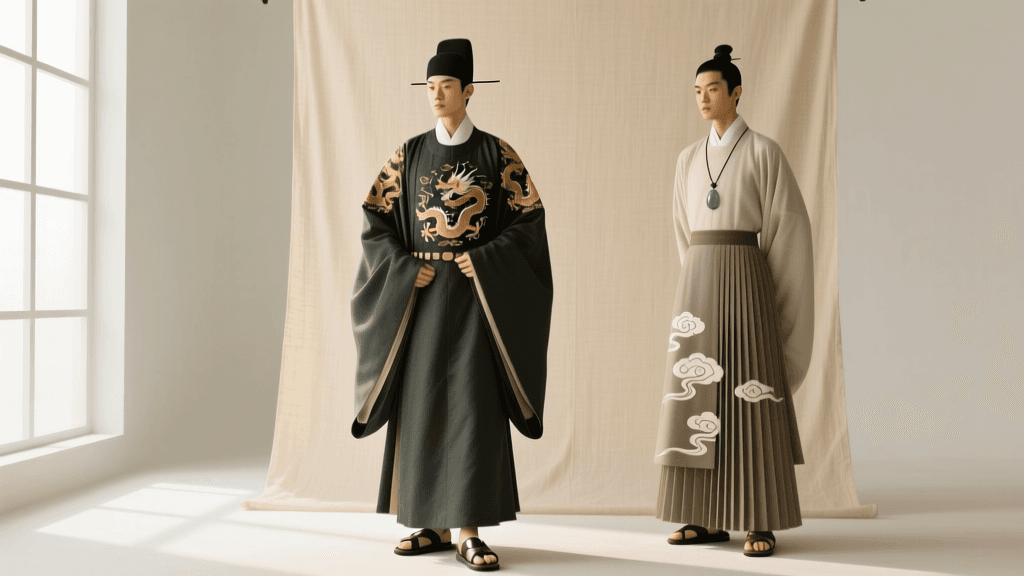
The most coveted garments in the Ming court were the motif robes. While the five-clawed dragon (Long) was strictly reserved for the Emperor and his immediate heirs, the court created mythical variants for high-ranking officials and elite guards.
- Mangpao (Python Robe): The 'Mang' is a mythical serpent-like creature with four claws. Visually similar to the imperial dragon, the Mangpao was granted to top-tier civil and military officials, as well as foreign tributary kings. It symbolized immense imperial trust and power.
- Feiyufu (Flying Fish Robe): The 'Flying Fish' is a unique chimera featuring the head and four claws of a dragon, but with the fins and tail of a fish. This robe was famously worn by the Jinyiwei (Embroidered Uniform Guard), the emperor's elite secret police and ceremonial bodyguards. The Feiyufu allowed for greater mobility and became an iconic symbol of martial authority.
- Dou Niu (Dipper Bull Robe): Featuring a two-horned dragon motif, this robe was typically awarded to mid-to-high-ranking officials and was considered a step below the Mangpao in the hierarchy of imperial gifts.
Comparison Chart: Ming Dynasty Motif Robes
| Garment Name | Mythical Motif | Claw Count | Primary Recipients | Modern Hanfu Availability |
|---|---|---|---|---|
| Longpao (Dragon) | Imperial Dragon | Five Claws | Emperor, Crown Prince | Rare (Specialty Custom) |
| Mangpao (Python) | Python Serpent | Four Claws | High Officials, Tributary Kings | High (Widely Reproduced) |
| Feiyufu (Flying Fish) | Dragon-Fish Chimera | Four Claws | Jinyiwei, Military Elite | Very High (Extremely Popular) |
| Dou Niu (Dipper Bull) | Horned Serpent | Four Claws | Mid-Tier Officials | Moderate (Niche Market) |
The Craftsmanship: Nanjing Yunjin and Kesi Silk Weaving
The breathtaking visual impact of Ming court robes was made possible by revolutionary weaving techniques, most notably Nanjing Yunjin (Cloud Brocade) and Kesi (Cut Silk) tapestry. Yunjin brocade is so named because its intricate patterns resemble colorful clouds. According to UNESCO's Intangible Cultural Heritage records, the traditional Yunjin loom requires two artisans to operate simultaneously—one to manage the warp threads from above, and one to weave the weft threads and gold or peacock-feather filaments below.
A single Ming Dynasty Mangpao could take over a year to weave by hand, utilizing real gold threads wrapped around silk cores. The Zhuanghua (妆花) technique allowed weavers to introduce multiple colors within a single weft line, creating the vibrant, gradient-like scales of the python and flying fish motifs. Today, while authentic hand-woven Yunjin remains a luxury investment, modern jacquard looms have made the visual complexity of Ming court robes accessible to a broader audience.
Practical Guide: Sourcing and Wearing Ming Court Robes Today
For modern practitioners of the Hanfu movement, acquiring and wearing a Ming-style court robe requires attention to historical accuracy, proper measurements, and thoughtful styling. Below is a practical guide to help you navigate the market.
1. Accurate Measurements for Traditional Silhouettes
Ming Dynasty robes are characterized by their generous, flowing cuts and structured collars. Unlike modern Western tailoring, traditional Chinese garments rely on flat-pattern cutting. When ordering a custom or made-to-measure Mangpao or Feiyufu, you must provide specific measurements:
- Sleeve Length (Huixiu): Traditional court robes feature 'returning sleeves' designed to cover the hands and fold back over the wrist. Measure from the nape of your neck, over the shoulder, down to your wrist, and then add 15 to 20 centimeters (6 to 8 inches) for the proper drape.
- Garment Length: A standard court robe should fall just above the ankles. Measure from the prominent vertebra at the base of your neck (C7) down to your ankle bone, typically around 125-135 cm for an average adult male, and 115-125 cm for an average adult female.
- Shoulder and Chest: Ming robes have a dropped shoulder seam. Ensure the chest measurement includes at least 15 cm (6 inches) of ease over your inner layers to prevent the stiff brocade from pulling at the cross-collar or round-collar neckline.
2. Material Tiers and Cost Breakdown
The cost of a Ming-style robe varies drastically based on the textile used. Here is what you can expect when budgeting for your garment:
- Entry-Level (Polyester/Jacquard Blend): Priced between $80 and $150 USD. These are mass-produced using modern synthetic jacquard weaves. While durable and easy to clean, they lack the breathability and historical drape of silk. Ideal for beginners or casual convention wear.
- Mid-Tier (Silk-Cotton or Rayon Brocade): Priced between $200 and $450 USD. These offer a much better drape and a subtle sheen. The motifs are usually woven rather than printed, providing a tactile, authentic feel suitable for serious Hanfu enthusiasts and photography.
- High-End (Authentic Mulberry Silk & Zhuanghua): Priced from $800 to over $2,500 USD. These garments utilize traditional or high-fidelity modern silk brocades, sometimes incorporating metallic threads. They are investment pieces meant for formal ceremonies, exhibitions, or dedicated collectors.
3. Layering and Accessories
A court robe is never worn directly against the skin. Proper layering is essential for both historical accuracy and the structural integrity of the garment.
- Zhongyi (Inner Garment): Start with a white or off-white cotton or linen cross-collar inner shirt and trousers. This protects the expensive brocade from sweat and oils.
- Daopao or Zhishen (Optional Mid-Layer): For colder weather or added volume, a plain silk mid-layer robe can be worn beneath the Mangpao.
- Belts: Ming court robes were often cinched with a Yudai (jade belt) for formal occasions, or a leather and fabric Geda belt for martial styles like the Feiyufu. Ensure your belt sits at the natural waist, allowing the lower pleats to flare outward.
- Footwear: Complete the ensemble with traditional black cloth boots with white soles (Zaoxue), which elevate the hem slightly and provide a commanding posture.
'The clothing of the Ming court was not merely fabric; it was a wearable bureaucracy. Every thread, color, and claw was a calculated display of the cosmic and political hierarchy.' — Historical Textile Analysis, Britannica Archive (Britannica Chinese Dress)
Garment Care and Preservation
Brocade and silk garments require meticulous care to maintain their structural integrity and vibrant colors. Never machine wash or wring a Ming-style court robe. For synthetic blends, gentle hand washing in cold water with a pH-neutral silk detergent is acceptable. For authentic silk brocades, professional dry cleaning specializing in historical textiles is mandatory.
When storing your Mangpao or Feiyufu, avoid wire hangers, which will distort the shoulder seams and stretch the heavy fabric. Instead, fold the garment along its natural flat-pattern seams, interleaving the folds with acid-free tissue paper to prevent permanent creasing. Store the folded robe in a breathable cotton garment bag in a cool, dark, and humidity-controlled environment to prevent the metallic threads from tarnishing or the silk from degrading.
Conclusion
The Mangpao and Feiyufu of the Ming Dynasty remain some of the most visually striking and historically significant garments in the canon of Asian traditional clothing. They represent a masterful synthesis of ancient symbolic codes and cutting-edge textile engineering. Whether you are a historian studying the evolution of imperial sumptuary laws, or a modern Hanfu wearer looking to invest in a meticulously crafted Flying Fish robe, understanding the nuances of these garments enriches the experience. By respecting the historical measurements, investing in quality materials, and practicing proper garment care, you can help keep the majestic legacy of Ming court fashion alive for generations to come.