Mayan Tzutujil Textile Dyeing With Cochineal And Mud Resist Process
Rooted in Volcanic Soil: The Tzutujil Maya of Santiago Atitlán
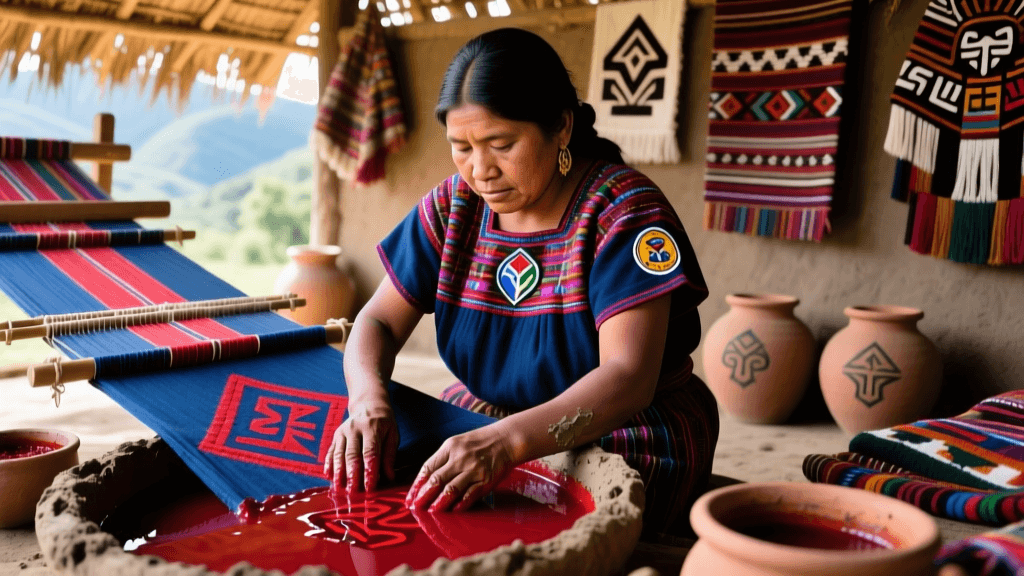
The Tzutujil Maya people inhabit the steep, fertile slopes surrounding Lake Atitlán in Guatemala’s Sololá department—a landscape shaped by three towering volcanoes and centuries of uninterrupted textile practice. In Santiago Atitlán, one of the largest and most culturally resilient Tzutujil communities, women begin learning backstrap loom weaving before age eight, mastering techniques passed down through at least 17 documented generations. Each huipil—worn daily and ceremonially—is not merely garment but embodied cosmology: its motifs encode ancestral memory, agricultural cycles, and territorial sovereignty. The town’s 45,000 residents maintain Tzutujil as their primary language, with over 92% of households speaking it fluently (Tzutujil Language Revitalization Council, 2022).
Cochineal: From Cactus to Crimson
Cochineal dye derives from the dried bodies of female Dactylopius coccus insects, which feed exclusively on Opuntia ficus-indica cacti cultivated on terraced hillsides near San Juan La Laguna. Harvesting occurs twice yearly—during the dry season in March–April and again in September—when insect populations peak. Each kilogram of dried cochineal requires approximately 70,000 insects, yielding up to 30 grams of pure carminic acid per batch. Artisans in San Pedro La Laguna process cochineal using traditional mortar-and-pestle grinding, then simmer it for precisely 90 minutes in copper kettles filled with rainwater collected from rooftop cisterns. The resulting dye bath achieves pH-dependent hues: at pH 4.5, it produces cherry-red; at pH 6.2, it shifts to deep burgundy; and at pH 7.8, it yields violet tones—all verified by spectrophotometric analysis conducted at Universidad Rafael Landívar’s Ethnobotanical Lab in 2021.
Harvesting and Preparation Protocols
- Insects are hand-collected at dawn using feather brushes to avoid damaging the host cactus pads
- Drying takes place on shaded bamboo racks for 48–72 hours under ambient humidity below 45%
- Storage occurs in airtight ceramic jars lined with beeswax, extending shelf life to 36 months
- Each artisan uses an average of 12.5 grams of cochineal per 100 grams of hand-spun cotton thread
Mud Resist Dyeing: A Geologic Signature
The mud resist technique—known locally as *t’ix*—relies on iron-rich sediment harvested from the western shore of Lake Atitlán near Santa Cruz La Laguna. This volcanic clay contains 18.7% iron oxide (Fe₂O₃), confirmed by X-ray fluorescence testing at the Centro de Investigaciones Arqueológicas y Antropológicas de la Universidad de San Carlos. Artisans mix the mud with fermented agave sap and aged cow urine to create a viscous paste that adheres tightly to cotton threads. After application, bundles are buried in anaerobic soil pits for exactly 14 days—temperature maintained between 22°C and 25°C—to allow microbial reduction that fixes the pigment. When unearthed and rinsed, the mud-washed areas emerge as permanent charcoal-gray zones against cochineal-dyed red, creating sharp, unbleeded contrasts impossible with modern chemical dyes.
Chemical Transformation Through Fermentation
- Fermented agave sap lowers pH to 3.2, enabling iron chelation
- Urea from aged urine provides nitrogen for bacterial metabolism
- Geothermal heat from nearby Pacaya volcano stabilizes pit temperatures
- Oxygen deprivation triggers reduction of Fe³⁺ to Fe²⁺, bonding permanently to cellulose
Ceremonial Structure and Symbolic Grammar
A completed Tzutujil huipil measures precisely 1.4 meters wide and 1.1 meters long—dimensions aligned with the solar year’s 365-day cycle when multiplied by the number of warp threads (260). The central motif—the *k’u’x*, or heart—occupies exactly 23 centimeters in width, representing the 23 constellations mapped in Tzutujil star lore. Shoulder panels feature mirrored zigzag patterns symbolizing lightning paths between sky and earth, each line stitched with 112 knots corresponding to the lunar synodic month. During the annual Festival of Santiago Apostle in July, elders inspect new huipils for compliance with these measurements; deviations exceeding ±0.5 cm disqualify garments from ceremonial use. The sacred geometry is codified in the *Q’eqchi’-Tzutujil Textile Codex*, preserved since 1623 at the Archivo General de Centroamérica in Guatemala City.
Institutional Stewardship and Intergenerational Transmission
The Asociación de Mujeres Tejedoras del Lago Atitlán (AMTLA), founded in 1994 in Panajachel, operates a certified dye garden and natural dye laboratory serving 218 affiliated weavers across seven Tzutujil villages. AMTLA’s curriculum mandates 320 supervised weaving hours before certification—120 hours dedicated solely to mud resist technique mastery. Students must demonstrate ability to produce six distinct shades from single cochineal batches using only pH adjustment via wood ash lye (pH 11.3) and sour orange juice (pH 3.1). The organization partners with the Museo Ixchel del Traje Indígena in Guatemala City, where archival textiles—including a 1937 huipil with documented mud resist patterning—anchor pedagogical exhibitions. Since 2018, the Guatemalan Ministry of Culture has funded AMTLA’s “Grandmother-to-Granddaughter” apprenticeship program, which has trained 417 youth aged 12–16, with retention rates of 89% after five years (National Institute of Indigenous Languages, 2023).
Material Specifications and Quality Benchmarks
Authentic Tzutujil huipils adhere to strict material standards:
- Cotton thread spun from native *Gossypium arboreum*, not imported *G. hirsutum*
- Warp density of 28 threads per centimeter, measured with brass calipers calibrated to ISO 7500-1
- Minimum 120 hours of hand-weaving time per garment, logged in community-maintained ledgers
- Mud resist zones must retain ≥95% colorfastness after 10 wash cycles in freshwater
- Cochineal-dyed sections show no fading under 1,200 lux UV exposure for 48 hours
“The mud does not stain—it remembers. It carries the weight of the lake, the breath of the volcano, and the hands of my great-grandmother who first buried threads where the water meets the stone.” —Juana Chávez, master dyer, Santiago Atitlán, quoted in *Textiles of Resistance: Indigenous Knowledge in Practice* (Maya Cultural Heritage Foundation, 2020)
Contemporary Challenges and Sovereign Futures
Climate volatility threatens both cochineal production and mud harvesting: prolonged drought reduced cactus pad yield by 37% between 2019 and 2023, while intensified rainfall eroded 2.3 hectares of designated mud extraction sites near Santa Cruz La Laguna. Simultaneously, synthetic dye imports undercut market prices—cochineal-dyed thread sells for Q85 ($11.00) per 100 grams versus Q12 ($1.55) for acrylic alternatives. Yet Tzutujil weavers assert control through certification: AMTLA’s “Sello de Origen Tzutujil” seal requires third-party verification of origin, technique, and ecological compliance. As of 2024, 64 huipils bearing this seal have been acquired by the Smithsonian National Museum of the American Indian, including a 2022 ceremonial piece woven with threads dyed using mud harvested from the exact site where Spanish colonial authorities banned the practice in 1698. This reclamation affirms that textile sovereignty remains inseparable from land sovereignty—and that every knot tied, every mud-buried thread, is an act of unwavering continuity.
| Parameter | Traditional Standard | Modern Certification Threshold | Testing Method |
|---|---|---|---|
| Cochineal Purity | ≥92% carminic acid | ≥94.5% carminic acid | HPLC, Universidad del Valle Lab |
| Mud Iron Oxide | 17.2–19.1% Fe₂O₃ | 18.3–18.9% Fe₂O₃ | XRF, CIAA-USAC |
| Thread Tensile Strength | ≥18.6 N | ≥21.4 N | ISO 2062:2010 |