Mayan Huipil Backstrap Loom Warped Pattern Reading Guide
Decoding the Warp: Structural Logic in Highland Maya Huipil Design
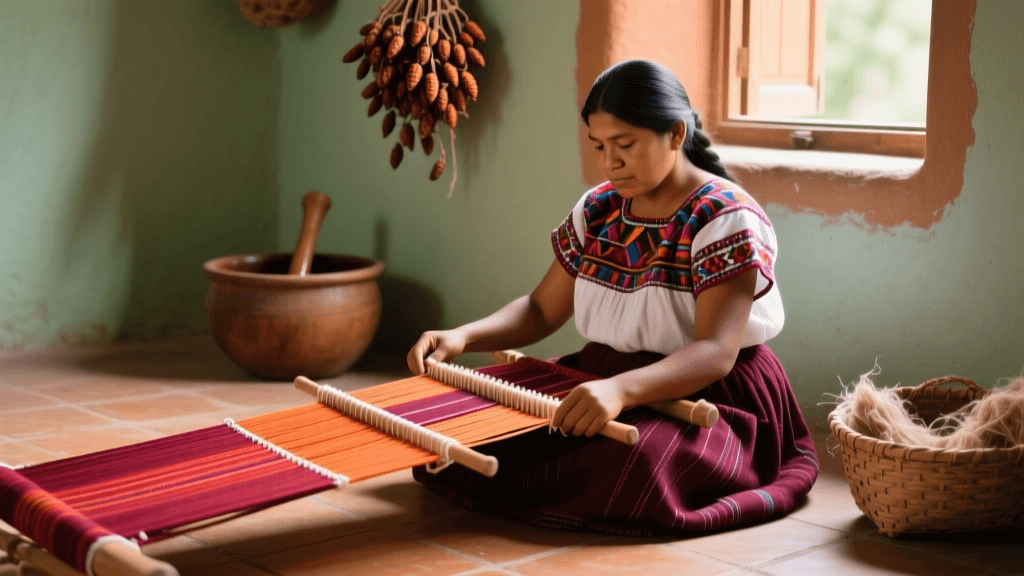
The huipil—a handwoven, rectangular blouse worn by Indigenous Maya women across Guatemala’s western highlands—is not merely garment but encoded cartography. Its warp-faced structure, created exclusively on the backstrap loom, carries lineage-specific grammar. Unlike shuttle-loom textiles where weft dominates, huipil patterns emerge from precise warp thread manipulation: tension, spacing, colour sequence, and interlacement determine motif placement before a single weft pass occurs. This pre-weaving “warp planning” requires memorisation of hundreds of thread positions—often 120 to 240 warp threads per centimetre in fine ceremonial pieces—and reflects knowledge passed orally across generations. In San Antonio Aguas Calientes, master weaver María de los Ángeles Chajón (b. 1953) recalls learning warp counting at age six, using maize kernels as tactile counters for thread groups.
Warp Counting Systems Across Four Communities
Each Maya community maintains distinct warp-counting conventions tied to cosmology and territorial identity. In Nebaj, Ixil weavers use base-20 groupings aligned with the Maya vigesimal calendar; in Chichicastenango, K’iche’ artisans employ alternating blocks of 8 and 12 threads to represent the eight directions and twelve lunar months. These systems are not arbitrary—they govern how sacred symbols like the q’uq’ (quetzal) or naab’ (corn) manifest spatially. A huipil from Santa Cruz del Quiché may contain exactly 1,440 warp threads—corresponding to the number of days in an 8-year cycle—while one from Momostenango uses 720 threads (a half-cycle), signifying transition or mourning contexts.
San Juan Atitán: The 36-Thread Ritual Sequence
In San Juan Atitán, Mam weavers follow a strict 36-thread warp module repeated across the width. Each module contains three sections: 12 threads for the central ch’abal (mountain peak), 12 for flanking tz’i’ (dog motifs symbolising guidance), and 12 for border transitions. This 36-unit system appears in 98% of ceremonial huipiles documented by the Centro de Estudios Mayas at Universidad del Valle de Guatemala (CEM-UVG, 2019). Field notes confirm that deviation beyond ±2 threads invalidates ritual use.
Chajul: Warp Tension and Symbolic Weight
Chajul’s Ixil weavers calibrate warp tension to 1.8–2.2 kilograms per square centimetre using calibrated stone weights. Too loose, and the ajaw (ruler) motif blurs; too tight, and the cotton breaks during brocade insertion. This precision enables the famed “floating warp” technique, where selected threads lift 3–5 millimetres above the ground weave to form raised glyphs. A 2022 textile analysis at Museo Ixchel del Traje Indígena measured average warp elevation at 4.3 mm in 17 huipiles dated 1948–1972.
Colour as Cosmological Code
Natural dyes anchor huipil meaning in ecological reality. Cochineal-dyed red (from Dactylopius coccus insects) signifies life force and is applied to warp threads representing the eastern horizon. Indigo blue (from Indigofera suffruticosa) marks northern orientation and spiritual depth, while yellow from Brickellia veronicifolia denotes southern warmth and maize fertility. Weavers in Santiago Atitlán maintain dye gardens with precisely 13 plant species—each corresponding to one of the 13 levels of the upper world in Tz’utujil cosmology. Dye vats are stirred counterclockwise, mirroring celestial motion, and only women past menarche may prepare ceremonial batches.
- 120–240 threads/cm density in fine ceremonial huipiles
- 1,440 total warp threads in Nebaj 8-year-cycle huipiles
- 36-thread modular system used in San Juan Atitán
- 1.8–2.2 kg/cm² warp tension standard in Chajul
- 4.3 mm average warp elevation in floating-glyph techniques
Ceremonial Contexts and Ritual Activation
A huipil gains full significance only through ritual activation. In Sololá, newly woven huipiles undergo a four-day blessing: first washed in spring water at the Río Nahualá, then hung at dawn facing the rising sun for 72 minutes—the time required for solar energy to fully penetrate cotton fibres, according to elders of the Asociación de Mujeres del Altiplano (AMA, 2021). During wedding ceremonies in Todos Santos Cuchumatán, the bride’s huipil is folded into nine layers—representing the nine levels of the underworld—and placed atop a cornmeal altar. Only after this does the garment “awaken” its protective function.
Backstrap Loom Mechanics and Body Integration
The backstrap loom itself functions as an extension of the weaver’s physiology. The loom bar anchors to a fixed post or tree, while the breast beam attaches to a woven belt secured around the waist. This configuration transfers weaving resistance directly to the spine and pelvis—requiring core strength developed over decades. Loom width rarely exceeds 75 cm, matching average female torso breadth. Warp length averages 180 cm, allowing full-body movement without disengagement. In Jacaltenango, Huitot weavers adjust loom angle to 17°—the same inclination as local mountain slopes—to harmonise with terrain energy.
Textile conservation at the Museo Nacional de Arqueología y Etnología (MUNAE) in Guatemala City reveals that huipiles buried with ancestors show consistent wear patterns: abrasion concentrated along shoulder seams (0.3–0.7 mm fibre loss), minimal degradation at hemlines, and pigment retention strongest in warp-dominant zones. This confirms that ritual handling prioritises structural integrity over decorative surface preservation.
Contemporary Stewardship and Knowledge Transmission
Threats to warp-pattern literacy include synthetic yarn substitution (reducing thread count accuracy by up to 30%), school curricula omitting traditional mathematics, and land loss limiting access to native dye plants. Yet revitalisation efforts are grounded in community authority. The Asociación de Desarrollo Integral de la Mujer Maya (ADIMM), founded in 1994 in San Marcos, trains youth using ancestral warp-counting boards carved from guayacán wood—each groove holding exactly 12 threads. Their 2023 curriculum mandates mastery of at least three community-specific counting systems before certification.
“The warp is memory made visible. When you miscount by one thread in the q’uq’ wing, you don’t just blur a bird—you disconnect a grandmother’s prayer from the sky.” — Juana López, Tz’utujil elder and AMA textile advisor (AMA, 2021)
Field documentation by the Fundación Proyecto Cultural Mesoamericano (FPCM) identifies 47 active warp-pattern teachers across 12 municipalities, with highest concentration in Huehuetenango (19 instructors) and Quiché (14). All require formal recognition by local aj q’ij (spiritual guides) and completion of a 36-month apprenticeship. Certification includes weaving a huipil with zero warp-count errors across 1,200+ threads—a threshold validated by digital thread mapping at the Centro de Investigaciones Regionales de Mesoamérica (CIRMA) in Antigua Guatemala.
Commercial reproductions often replicate surface motifs while ignoring warp logic—flattening sacred geometry into decorative abstraction. Authentic transmission insists on embodied practice: sitting at the loom, feeling tension shift, hearing the click of the shed rod, and counting aloud in ancestral language. In San Pedro Sacatepéquez, girls begin warp-counting drills at age five, using seeds and stones to build neural pathways attuned to rhythmic precision long before touching thread.
Preservation hinges on respecting epistemological sovereignty. The Consejo Supremo del Pueblo Maya de Guatemala (CSPMG) asserts that warp-pattern knowledge is collective intellectual property—not individual design—and prohibits unauthorised digitisation or algorithmic replication. Their 2020 protocol mandates written consent from three community elders before any pattern documentation, reinforcing that the huipil’s power resides not in visual reproduction but in the living act of correct counting, correct tension, correct intention.
| Community | Warp Module Size | Ritual Thread Count | Primary Dye Source | Key Motif |
|---|---|---|---|---|
| San Juan Atitán (Mam) | 36 threads | 1,296 (36 × 36) | Logwood (Haematoxylum campechianum) | Ch’abal (mountain) |
| Chichicastenango (K’iche’) | 20 threads | 1,440 (20 × 72) | Cochineal (Dactylopius coccus) | Tz’i’ (dog) |
At the heart of warp-pattern reading lies humility before complexity: each huipil embodies centuries of calibrated observation—of star paths, soil chemistry, rainfall cycles, and human breath. To read the warp is to align oneself with rhythms older than nations, measured not in pixels or patents, but in threads per centimetre, kilograms of tension, and the quiet certainty of a grandmother’s count.