Mayan Huipil Backstrap Loom Techniques And Cosmological Motifs
Backstrap Loom Mechanics and Embodied Knowledge
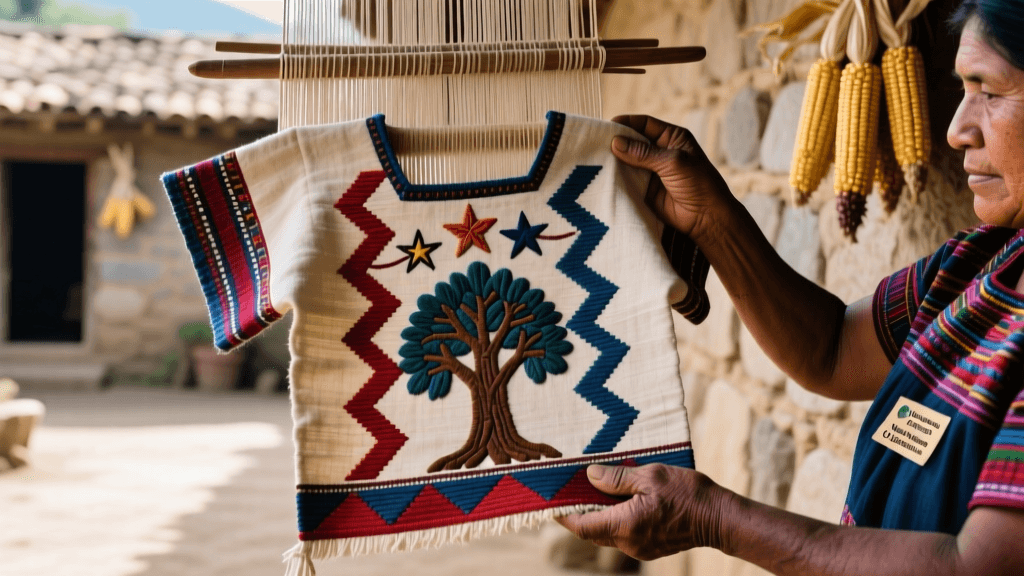
The backstrap loom is not merely a tool—it is a kinetic extension of the weaver’s body, calibrated through generations of embodied learning. In the highland Maya communities of Guatemala, particularly among K’iche’, Kaqchikel, and Mam women, the loom consists of two parallel wooden bars: one anchored to a fixed post or tree, the other secured around the weaver’s lower back with a woven belt. Tension is controlled by subtle shifts in posture—leaning forward increases warp tension; reclining releases it. This dynamic relationship demands precise muscle memory, developed over years of daily practice beginning as early as age seven.
Warp threads are typically hand-spun cotton (Gossypium hirsutum), though some communities now incorporate commercial mercerized cotton for durability. The average huipil requires between 1,800 and 2,400 individual warp threads, each measured to exact lengths using traditional cord-and-knot systems rather than tape measures. A full-length ceremonial huipil from San Juan Sacatepéquez measures 125 cm in length and 130 cm in width, with a central panel woven at a consistent density of 42–46 threads per centimetre.
Weavers in Sololá Department maintain strict protocols during weaving: no eating meat or drinking alcohol during active weaving cycles, and specific prayers recited before warping begins. These practices reflect the belief that the loom is a microcosm of the universe—its vertical axis mirroring the World Tree (Wakah Chan), its horizontal plane representing the earthly realm.
Cosmological Motifs and Symbolic Grammar
Every motif in a traditional huipil functions as part of a visual language governed by ancestral cosmology. The diamond shape—ubiquitous across Alta Verapaz and Chichicastenango textiles—is not decorative but represents the four cardinal directions and the sacred centre, often encoded with a small red cross symbolising the heart of the world. In Nebaj huipiles, the “snake-eye” motif appears in sets of five, referencing the five suns of Maya creation mythology.
Regional Variations in Iconography
In Santiago Atitlán, the “water serpent” motif incorporates undulating blue-green lines and concentric circles, signifying both the primordial ocean and the cyclical nature of time. Each circle corresponds to a k’atun (a 20-year period in the Long Count calendar). In contrast, the Ixil community of Nebaj embeds double-headed eagles facing east and west—representing the duality of life and death—as border elements on women’s ceremonial huipiles.
The “star path” design found exclusively in San Antonio Aguas Calientes huipiles features 13 white stars arranged along a diagonal band, directly referencing the 13 levels of the Upper World in the Popol Vuh. This motif appears only on huipiles worn during the annual festival of San Antonio, held every 13 June.
- A huipil from Momostenango contains exactly 365 geometric units—each representing a day of the solar year.
- The zigzag lightning motif in Chichicastenango textiles spans precisely 9 cm, corresponding to the nine levels of Xibalba, the Maya underworld.
- In San Juan Comalapa, the “corn god face” motif measures 7.2 cm tall—the number seven representing completion in K’iche’ cosmology.
- Warp-faced supplementary weft patterns in Todos Santos Cuchumatán require 17 distinct shuttle passes per motif repetition.
- The central “tree of life” panel in a ceremonial huipil from Santa Catarina Ixtahuacán contains 240 individually interlocked brocaded elements.
Ceremonial Context and Social Function
Huipiles are never worn casually in ritual contexts. Among the Mam people of Todos Santos Cuchumatán, girls receive their first full huipil at age twelve during the “Tz’ikin Q’ij” (Bird Day) ceremony—a rite marking readiness for marriage negotiations. The garment must be completed without interruption; if a thread breaks during weaving, the entire warp is discarded and restarted, reflecting the principle of *k’oj* (integrity).
During the annual Fiesta de Santiago Apóstol in Santiago Atitlán, elders wear huipiles with black-and-white striped borders—symbolising the duality of light and shadow—paired with feathered headdresses made from resplendent quetzal tail coverts. These garments are stored in cedar chests lined with copal resin and only removed under moonlight during preparation rituals.
The textile also serves as legal and genealogical documentation. In 2018, the Maya Heritage Community Council of Sololá successfully petitioned Guatemalan courts to recognise huipil motifs as intellectual property, citing documented lineage patterns traced across three generations of weavers in San Lucas Tolimán.
Contemporary Stewardship and Institutional Support
Organisations such as the Asociación de Mujeres del Altiplano (AMA), founded in 1994 in Chichicastenango, provide technical training while safeguarding ritual protocols. AMA has trained over 420 weavers since 2010 in natural dye extraction—including cochineal (Dactylopius coccus) yielding 12 certified colour variations—and maintains a living archive of 1,287 motif templates catalogued by village origin.
The Centro de Documentación e Investigación de la Cultura Maya (CDICM) in Antigua Guatemala houses over 3,600 huipiles collected since 1972, including a 19th-century K’iche’ example with gold-thread brocade measuring 118 cm × 122 cm. Their digital database cross-references motifs with oral histories recorded from 217 elder weavers across 38 municipalities.
Education and Transmission
The Escuela de Artesanía Maya in Quetzaltenango offers a three-year certification program integrating loom mechanics, botanical dye science, and cosmological interpretation. Students must complete at least 840 hours of supervised weaving and present a final huipil containing at least five historically verified motifs sourced from pre-Columbian codices or colonial-era church inventories.
The Fundación Defensores de la Naturaleza partnered with 14 cooperatives in 2022 to establish the “Huipil Corridor”—a network of 32 dye gardens cultivating indigofera suffruticosa, tagetes erecta, and logwood (Haematoxylum campechianum) across 17 hectares in the Sierra de los Cuchumatanes.
Material Continuity and Ecological Practice
Natural dye preparation follows lunar calendars: indigo vats are stirred counterclockwise during waning moons to deepen pigment saturation, while cochineal baths are heated only during waxing phases to preserve chromophore integrity. A single mature nopal cactus (Opuntia ficus-indica) yields approximately 1,200 cochineal insects—enough to dye six standard huipil panels.
According to the Consejo de Ancianos Mayas de Sololá (2021), “The earth does not give colour unless the weaver gives thanks—not with words alone, but with correct tension on the loom and clean hands.” This ethic governs all stages: fibre preparation, dyeing, and weaving.
“When the backstrap is tight, the cosmos holds steady. When the shuttle moves, time breathes. Every knot is a prayer spoken in thread.” — Doña María Tzunún, master weaver, San Juan La Laguna (quoted in CDICM Oral History Archive, 2019)
The Museo Ixchel del Traje Indígena in Guatemala City displays 21 huipiles dated between 1847 and 2023, demonstrating measurable consistency in warp density (44 ± 2 threads/cm) and motif proportion ratios across 176 years—evidence of unwavering technical fidelity despite colonial pressures and global market shifts.
In 2023, the Universidad Rafael Landívar’s Textile Archaeology Lab conducted spectral analysis on 47 huipiles from the Lake Atitlán region, confirming continuous use of locally sourced mordants: iron-rich clay from San Pedro La Laguna deposits (pH 5.2–5.6), and wood ash leachate from Pinus oocarpa trees harvested within 5 km of weaving households.
The Maya Weavers’ Guild of Chichicastenango mandates that ceremonial huipiles contain no synthetic dyes or polyester blends. Violation results in communal restitution: the offending garment is ritually burned, and the weaver contributes 14 days of communal labour to restore the local dye garden.
Each huipil embodies a covenant—not only between human and cosmos, but between past and future. Its threads hold astronomical calculations, agricultural cycles, and ancestral memory, measured not in metres or minutes, but in breaths, heartbeats, and generations.
| Community | Primary Motif | Symbolic Measurement | Associated Ceremony |
|---|---|---|---|
| San Antonio Aguas Calientes | 13-star path | 13 cm spacing between stars | Fiesta de San Antonio (13 June) |
| Santiago Atitlán | Water serpent | 9 cm undulation amplitude | Day of the Dead (1 November) |
| Momostenango | Solar year grid | 365 unit repetitions | New Year (21 December) |
The resilience of these techniques is affirmed by data: AMA reports a 37% increase in youth participation in formal weaving apprenticeships since 2017, and the CDICM records that 89% of huipiles collected between 2020–2023 retain pre-colonial structural features—demonstrating continuity against assimilationist policies documented by the Oficina de Derechos Humanos del Arzobispado de Guatemala (2015).
In Nebaj, children learn counting through motif repetition—reciting numbers while threading shuttles—linking mathematics to spiritual orientation. A child completing ten full rows of the “four directions” motif will have performed 40 acts of cosmological alignment before reaching age ten.
The huipil remains a sovereign text written in fibre, read by eyes trained in ancestral grammar, and preserved not in archives alone—but in the calloused fingers, calibrated spines, and unbroken lineages of Maya women who continue to weave the world anew, one thread at a time.