Digital Reconstruction of Mawangdui Silk Garments for 2026 Research
The Evolution of Chinese Fashion History Education in 2026
Chinese fashion history education has undergone a profound paradigm shift in the 2026 academic year. Moving beyond traditional textile conservation and static archival displays, leading institutions such as Donghua University and Tsinghua University are now integrating advanced digital humanities into their core curriculums. The focus has shifted toward the precise digital reconstruction of ancient garments, allowing researchers to study the kinetic properties, drape coefficients, and structural integrity of historical textiles without risking damage to priceless physical artifacts. This intersection of ancient weaving techniques and modern computational physics represents the frontier of Asian traditional garment research.
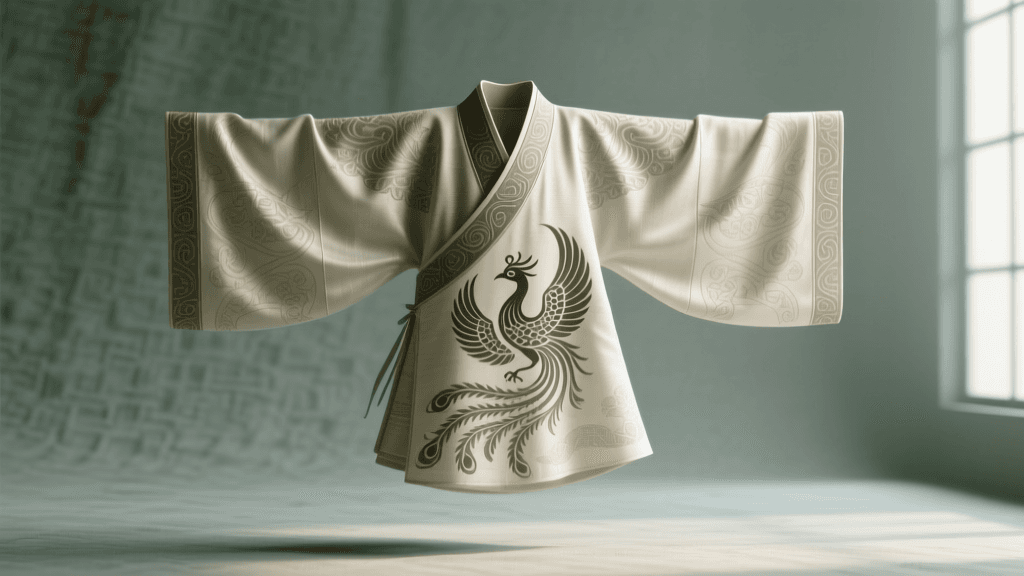
At the heart of this academic movement is the study of the Mawangdui Han dynasty tomb textiles, specifically the legendary Susha Danyi (素纱襌衣), or plain gauze gown. Weighing a mere 49 grams, this masterpiece of ancient Chinese sericulture presents a unique challenge for modern simulation engines. Reconstructing such a garment requires more than basic 3D modeling; it demands a rigorous understanding of historical weave structures, yarn twist multipliers, and AI-driven fabric drape analysis. According to the Metropolitan Museum of Art's Heilbrunn Timeline of Art History, the mastery of Chinese silk weaving during the Han dynasty laid the groundwork for global textile exchanges, making its digital preservation a matter of international academic importance.
The Physics of Han Dynasty Silk: Simulating the 49-Gram Gauze Gown
The Susha Danyi is renowned for its ethereal, almost weightless drape, a characteristic derived from its specific warp-faced plain weave structure and the exceptionally low denier of the silk filaments used. In 2026, academic researchers utilize Finite Element Method (FEM) physics engines to simulate how these ancient fabrics interact with gravity, human biomechanics, and environmental factors like humidity. To accurately digitize the plain gauze gown, students must first calibrate the simulation environment to reflect the specific mechanical properties of Han dynasty sha (gauze) silk.
This involves inputting precise parameters for tensile strength, bending rigidity, shear stiffness, and surface friction. Unlike modern, chemically treated silks, ancient Han silks possessed a natural sericin coating that altered their drape behavior. By utilizing AI-assisted material scanning, researchers can now extrapolate the mechanical decay of a 2,000-year-old artifact and reverse-engineer its original, pristine drape state at the time of its creation. This reverse-engineering process is a cornerstone of the 2026 master's level courses in historical textile conservation.
Comparison of 3D Simulation Engines for Historical Textiles
Choosing the correct software environment is critical for academic accuracy. While the gaming and film industries prioritize visual rendering speed, historical fashion research prioritizes physical accuracy and weave-level mapping. Below is a comparison of the primary 3D simulation engines utilized in Asian textile research programs in 2026.
| Software Engine | Weave Mapping Capability | Drape Physics Accuracy | 2026 Academic License Cost |
|---|---|---|---|
| CLO 3D | High (Yarn-level simulation) | Excellent (FEM-based) | $450 / year |
| Marvelous Designer | Medium (Texture-based) | Good (Visual-focused) | $399 / year |
| Blender (Cloth Sim) | Low (Requires Python scripts) | Variable (Node-based) | Free (Open Source) |
As highlighted by CLO Virtual Fashion, their FEM-based engine remains the gold standard for academic researchers who require exact measurements of fabric stress and drape coefficients. While Blender offers a cost-free alternative, the steep learning curve required to write custom Python scripts for historical weave mapping makes it less accessible for fashion history students who lack a background in computational geometry.
Step-by-Step Academic Methodology for Digital Reconstruction
For graduate students embarking on a thesis involving the digital reconstruction of Mawangdui textiles, a standardized four-step methodology has been established by the Shanghai International Fashion Innovation Center for the 2026 academic cycle.
Step 1: Archival Data and Fiber Analysis
The process begins with the aggregation of high-resolution macro-photography and spectral imaging data. Researchers cross-reference physical samples with digital archives provided by global consortiums. The International Dunhuang Project and similar Silk Road digital archives provide invaluable comparative data on Han and Tang dynasty textile fragments, allowing students to identify the exact loom setups and thread counts required for the simulation.
Step 2: Digital Loom Programming and Weave Mapping
Once the thread count (often exceeding 60 warp threads per centimeter in fine Han silks) is established, students use digital jacquard software to map the weave structure. For the Susha Danyi, this involves programming a simulated warp-weighted loom to understand how the alternating tension of the warp threads creates the microscopic pores that give the gauze its breathability and distinctive light-catching properties.
Step 3: AI Drape Simulation and Gravity Calibration
With the 2D pattern drafted based on archaeological flat-lay measurements, the garment is stitched together in the 3D environment. Here, AI drape analysis tools are employed to run thousands of micro-simulations. The AI adjusts the shear and bend parameters dynamically until the digital garment's drape coefficient matches the historical descriptions of Han dynasty court dress, which emphasized a fluid, water-like cascade over the body's natural contours.
Step 4: Environmental Stress Testing
Finally, the digital twin is subjected to virtual environmental stress tests. Researchers simulate the effects of ancient dyeing processes (such as the use of mineral-based cinnabar or plant-based indigo) on the fabric's stiffness. This step ensures that the final digital reconstruction reflects not just the raw silk, but the finished, dyed garment as it would have been worn by the Marquise of Dai.
Bridging Ancient Weaves and the 2026 Xin Zhongshi Movement
The academic rigor applied to Mawangdui reconstructions extends far beyond the walls of the university. In 2026, the Xin Zhongshi (新中式) or "New Chinese Style" fashion movement has heavily integrated these academic findings into contemporary ready-to-wear design. Modern designers collaborating with university labs are utilizing the drape data of Han dynasty sha and luo (twist) weaves to engineer modern, sustainable bio-silks that mimic the 49-gram gauze gown's ethereal silhouette without the prohibitive cost of traditional hand-reeled silk.
By understanding the exact structural geometry that allowed ancient garments to remain unlined yet structurally sound, 2026 Xin Zhongshi brands are creating summer collections that require zero synthetic interfacing. This reduction in material complexity not only honors the ancient Chinese philosophy of harmony with nature but also aligns with modern global mandates for circular fashion and textile recyclability. The academic study of ancient drape is thus directly fueling the commercial and sustainable success of modern Asian traditional fashion.
Funding and Academic Grants for Textile Research
For emerging scholars in Chinese fashion history, securing funding for digital reconstruction projects is highly viable in 2026. The National Social Science Fund of China has significantly expanded its digital humanities grants, specifically targeting projects that merge AI technology with Silk Road textile preservation. Furthermore, international collaborations between Asian universities and European fashion institutes often provide access to high-performance computing clusters necessary for rendering yarn-level FEM simulations.
Students are encouraged to publish their open-source weave maps and drape coefficient datasets on academic repositories. By contributing to the global commons of historical textile data, researchers not only preserve the legacy of Han dynasty sericulture but also provide the foundational physics required for the next generation of Xin Zhongshi innovation. The digital reconstruction of the Mawangdui silks is no longer just an exercise in historical nostalgia; it is a vital, data-driven discipline shaping the future of global garment engineering.