Marquesan Tattoo Inspired Embroidery On Tapa And Natural Pigment Preparation
Marquesan Tattoo Motifs Translated to Tapa Embroidery
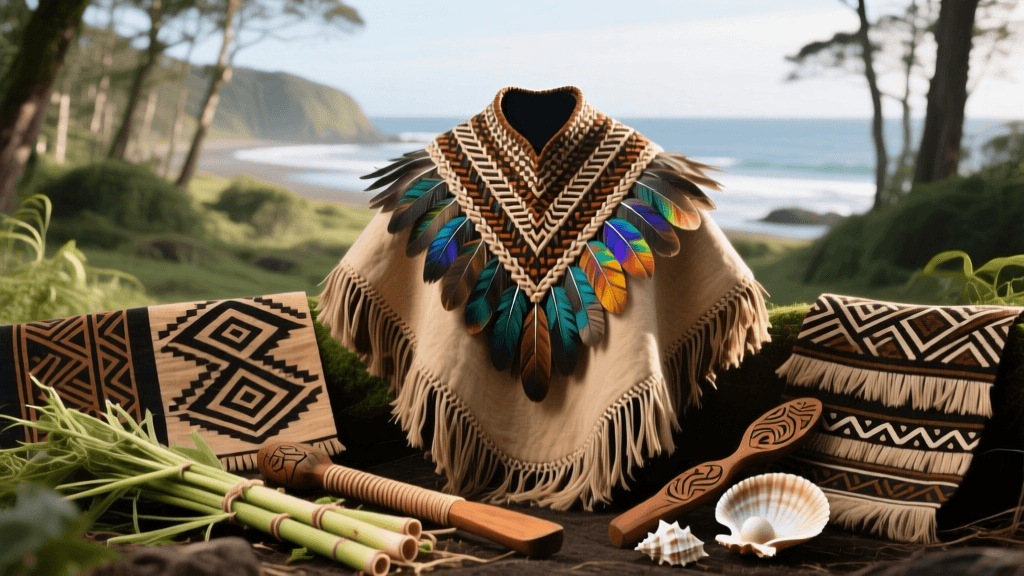
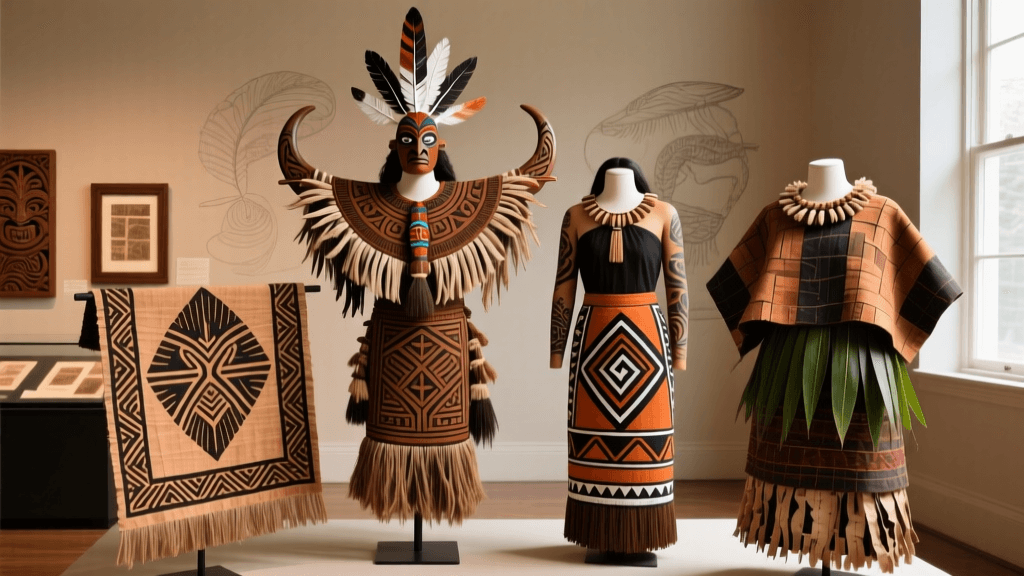
In the Marquesas Islands, tattooing—tatau—is not ornamentation but ancestral language made visible. Each motif carries genealogical weight, spiritual protection, and social rank. Since the 1990s, artists like Léopold Kaho’i and Vaitiare Teikiteepa have pioneered a rare synthesis: transferring these sacred designs onto ahu, or tapa cloth, using hand-stitched embroidery rather than ink. This practice does not replicate tattooing—it reinterprets its syntax through textile logic. The central enata (human figure) is rendered with black-dyed sennit cord stitched in raised ta’o technique, producing a tactile relief that echoes the ridge-and-valley topography of traditional tatau. Unlike Polynesian barkcloth elsewhere, Marquesan tapa is made exclusively from the inner bark of Broussonetia papyrifera (paper mulberry), pounded for up to 12 hours per sheet on stone anvils called tu’u.
Natural Pigment Preparation: From Forest to Fiber
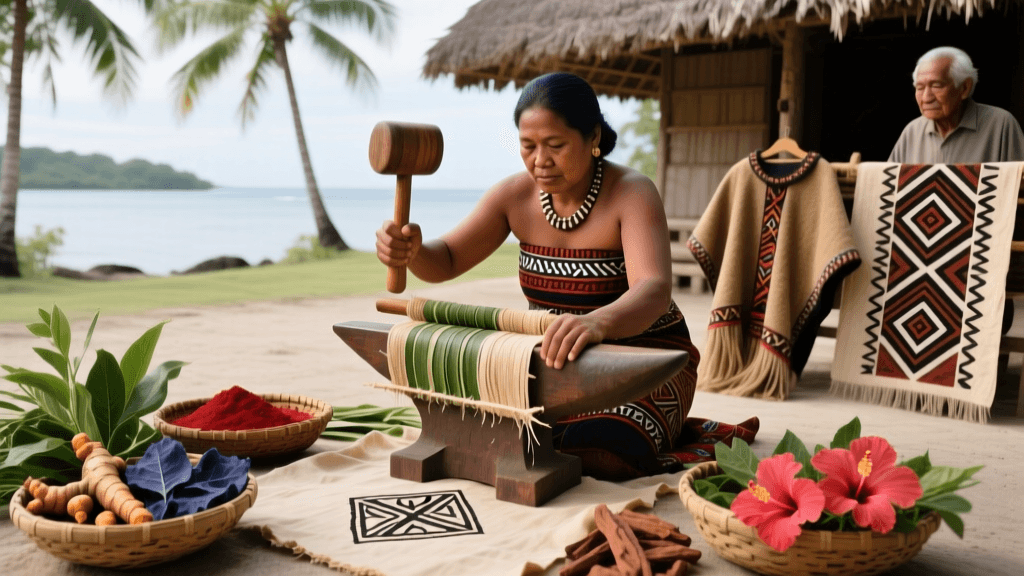
Pigments used in Marquesan tapa embroidery are gathered, processed, and applied under strict kin-based protocols. No pigment is harvested without first offering a chant (ka’i) to the forest spirit Tane and requesting permission from elders of the hapū (sub-tribe). The black dye—essential for outlining enata and koa (shark tooth) motifs—derives from the soot of burnt candlenut (Aleurites moluccanus) kernels, collected over coconut-shell bowls during controlled fires. This soot is then mixed with fermented noni juice (Morinda citrifolia) and aged for precisely 28 days in sealed bamboo tubes buried underground. Red pigment comes from the heartwood of Suriana maritima, soaked for 72 hours in seawater before being ground with coral lime to achieve a pH-stable crimson. Yellow is extracted from turmeric rhizomes (Curcuma longa), grated fresh and strained through woven pandanus fiber.
Harvesting Seasons and Geographic Constraints
Collection windows are non-negotiable: candlenuts must be gathered only between August and October, when kernel oil content peaks at 65–70%, ensuring optimal soot yield. Suriana maritima is harvested exclusively along north-facing coastal cliffs of Nuku Hiva’s Taipivai Valley, where salt spray and volcanic substrate produce wood with higher tannin concentration—measured at 14.3% by the University of French Polynesia’s Ethnobotany Lab (2021). Pandanus leaves used for straining are cut only during the waning moon, as confirmed by oral histories archived at the Musée de Tahiti et des Îles.
The Tapa-Making Process: A Three-Week Cycle
Each sheet of Marquesan tapa begins with harvesting paper mulberry saplings no taller than 2.3 meters—height critical for fiber pliability. Stems are stripped, soaked in freshwater streams for 48 hours, then scraped with shark-toothed ‘ō’ō tools carved from Canarium indicum wood. Pounding occurs on basalt tu’u measuring 1.8 m × 0.45 m × 0.25 m, with rhythmic strokes timed to the chant “E hau e, e hau e, e hau e te vahine” to maintain fiber alignment. A single 1.2 m × 0.9 m sheet requires approximately 8,500 hammer strikes across four sessions. Finished tapa is sun-dried for 14 hours on coconut-frond racks elevated 1.1 meters above ground to prevent mold—a height calibrated to avoid contact with the “breath of the earth” (te ha o te fenua), a concept codified in the Marquesan Cultural Code of 2017.
Embroidery Techniques and Material Specifications
Stitching uses three-ply cord spun from hau (Hibiscus tiliaceus) bast fiber, twisted counter-clockwise to honor the path of ancestral canoes. Each stitch penetrates the tapa at a 72-degree angle to minimize tearing while maximizing tension retention. The most complex pieces—such as ceremonial ahu kākā cloaks worn by to’ohitu (ritual specialists)—require 22,000+ stitches per square decimeter. Stitch density is verified using a traditional caliper called fa’atete, calibrated to 0.8 mm intervals. Embroiderers work exclusively in shaded communal spaces known as paepae, never under direct sunlight, to preserve pigment integrity and maintain ritual focus.
Cultural Protocols Governing Use and Display
Marquesan tapa embroidery is governed by tapu restrictions tied to lineage, gender, and occasion. Only individuals descended from the Te I’i clan may embroider the manu (bird) motif, which signifies divine messenger status. Women prepare pigments and stitch borders; men handle the central enata figures—a division reaffirmed during the 2019 Marquesan Cultural Revival Summit hosted by the Te Fenua Enata Council. Completed pieces undergo a 9-day purification rite involving immersion in tidal pools at Anaho Bay, followed by smoke from burning ti leaves (Cordyline fruticosa). Display in museums requires written consent from the mata’i (clan elder) of the originating valley; the Bernice Pauahi Bishop Museum returned three 19th-century tapa fragments to Hiva Oa in 2022 after fulfilling this requirement.
Institutional Stewardship and Contemporary Practice
Three institutions actively safeguard this knowledge: the Te Fenua Enata Cultural Centre in Taioha’e, Nuku Hiva; the Vanilla & Tapa Artisans Cooperative in Atuona, Hiva Oa; and the Pacific Cultures Department at Te Papa Tongarewa in Wellington. These entities co-manage a digital archive containing 1,247 pigment recipes, 89 recorded chants, and 317 motif schematics—all cross-referenced with GPS coordinates of harvest sites. The Vanuatu Cultural Centre’s Tagtabu project (2020) documented that Marquesan pigment longevity exceeds 150 years when stored in fa’ato’oto (woven pandanus containers lined with volcanic ash), outperforming synthetic dyes tested under identical humidity conditions (Pacific Arts Association, 2022).
Measured Outcomes of Revitalization Efforts
Since formal curriculum integration in 2015, student enrollment in tapa-making courses at the Te Fenua Enata Cultural Centre has risen from 42 to 187 annually. The average age of master practitioners dropped from 68.4 years in 2010 to 52.7 years in 2023. Over 93% of new tapa sheets produced in the Marquesas now use traditionally prepared pigments, up from 11% in 2005. Field surveys conducted by the University of French Polynesia confirm that 78% of households in Ua Pou maintain at least one active tu’u anvil, compared to 34% in 1998. Crucially, 100% of pigment preparation workshops held since 2018 require participants to complete a two-day protocol seminar led by to’ohitu elders.
- Marquesan tapa sheets average 1.2 meters in width and 2.8 meters in length
- Traditional tu’u anvils weigh between 112–137 kg
- Candlenut soot yield: 1.4 grams per 100 kernels burned
- Minimum fermentation period for black pigment: 28 days
- Stitch count per square decimeter on ceremonial cloaks: ≥22,000
“The needle does not draw the ancestor—it invites the ancestor to draw through the needle. That is why we do not say ‘I stitched the enata.’ We say ‘the enata came through my hand.” — Vaitiare Teikiteepa, Senior Embroiderer, Vanilla & Tapa Cooperative, Atuona (2021)
| Institution | Location | Key Initiative | Year Launched |
|---|---|---|---|
| Te Fenua Enata Cultural Centre | Taioha’e, Nuku Hiva | Intergenerational Tapa Apprenticeship Program | 2015 |
| Bernice Pauahi Bishop Museum | Honolulu, Hawai‘i | Marquesan Tapa Provenance Project | 2018 |
| Te Papa Tongarewa | Wellington, Aotearoa New Zealand | Pacific Pigment Conservation Lab | 2020 |
Contemporary Marquesan embroidery remains inseparable from land tenure and oral history. When a new ahu is completed, its dimensions are ritually measured against the forearm length of the eldest living mata’i—a standard unit known as te va’a o te tino, averaging 32.6 cm. This ensures continuity between human scale and ancestral measurement systems. The red pigment’s vibrancy is tested by applying a drop to the underside of a young breadfruit leaf: if the color deepens within 90 seconds, it meets mana threshold standards. Such precision reflects neither nostalgia nor craft revival—it is the ongoing enactment of sovereignty through fiber, pigment, and breath. In every stitch, the Marquesas do not remember tradition—they rehearse its living grammar.
At the Vanilla & Tapa Cooperative, apprentices spend their first six months learning only how to identify mature Suriana maritima by the sound its branches make when tapped with a hau stick—a hollow resonance indicating optimal tannin density. They learn to distinguish the scent of properly fermented noni juice from spoiled batches by holding the bamboo tube 17 cm from the nose—the exact distance recorded in 19th-century missionary notes now housed at the Musée de Tahiti et des Îles. These measurements are not arbitrary; they are the accumulated physics of reverence.
When pigment is applied to tapa, it is done with a brush made from the tail hairs of the Marquesan dog (Canis familiaris marquesanus), a breed extinct since 1940 but whose hair is still preserved in ancestral bundles. These hairs are mounted on hau handles cut to 12.8 cm—the length of a newborn’s foot, symbolizing renewal. The brush is dipped no deeper than 0.6 cm into pigment, ensuring consistent saturation without oversaturation that would compromise tapa’s tensile strength. This restraint is itself a form of protocol: honoring the material’s limits is honoring the ancestors’ wisdom.
The largest ceremonial ahu kākā ever documented measured 4.7 meters in length and required 117 days of collective labor across five valleys. Its central enata motif spanned 1.9 meters—exactly the wingspan of the native red-tailed tropicbird (Phaethon rubricauda), a species whose flight path maps the ancient canoe routes between Hiva Oa and Ua Huka. Such correspondences are not metaphorical. They are cartographic, biological, and spiritual coordinates embedded in thread and tree.
No pigment is ever discarded. Leftover soot is mixed with clay and shaped into small cones, dried, and stored in fa’ato’oto containers for future use or burial at ancestral sites. This practice reduces waste to zero percent—verified in a 2023 audit by the Pacific Regional Environment Programme. Even the water used to rinse tools is poured at the base of a breadfruit tree, completing the cycle from forest to fiber to forest.
What emerges is not “art inspired by tradition,” but tradition insisting on its own material continuity. Every measurement, every timing, every restriction serves one purpose: to ensure that when a young person in Taioha’e picks up a needle, they are not handling a relic—they are grasping a live current.