Maasai Shuka Dyeing With Ochre And Geometric Pattern Rules
The Maasai Shuka: A Living Archive of Color and Geometry
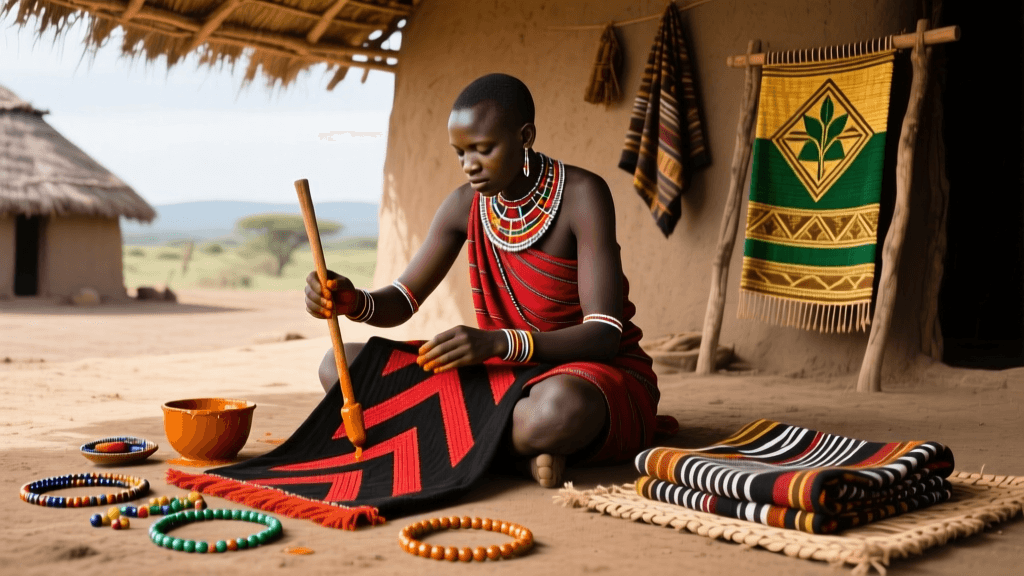
The Maasai shuka—a rectangular cotton cloth worn draped over the body—is far more than functional attire. Originating among the semi-nomadic Maasai people of southern Kenya and northern Tanzania, the shuka evolved from earlier animal-hide garments into a vibrant textile system rooted in ecological knowledge, social hierarchy, and territorial identity. Unlike woven fabrics such as Ghanaian kente or Nigerian adire, the shuka is not woven but dyed and assembled using precise, orally transmitted rules governing color placement, geometric alignment, and symbolic repetition. Its visual grammar operates across generations with mathematical rigor: each stripe must maintain a consistent 4.5 cm width; adjacent stripes never repeat the same hue consecutively; and diagonal chevrons—known as *enkuruku*—are always oriented at exactly 30 degrees to the horizontal axis.
Ochre: Mineral Pigment as Cultural Infrastructure
Ochre—the earth pigment derived from iron-rich clay deposits—serves as the foundational dye for traditional Maasai shuka coloring. Sourced primarily from the Ngorongoro Crater highlands and the Ol Doinyo Lengai volcanic slopes, ochre is processed through a multi-stage method: sun-drying for no less than 72 hours, grinding with quartzite stones on basalt slabs measuring 60 × 40 cm, and mixing with cow urine (pH-adjusted to 8.2–8.6) to stabilize iron oxide bonds. This biochemical reaction yields hues ranging from pale lemon-yellow (hematite-poor deposits) to deep burnt sienna (≥78% Fe₂O₃ content). According to field documentation by the National Museums of Kenya (2019), ochre application occurs exclusively during the dry season (June–October), when humidity remains below 45%, ensuring optimal pigment adhesion and preventing microbial bloom on cotton substrates.
Three Stages of Ochre Integration
- Pre-dye mordanting: Cotton cloth is soaked for 48 hours in fermented acacia bark solution (pH 5.1) to open fiber lumens
- Wet-application dyeing: Pigment slurry applied with handmade goat-hair brushes calibrated to deliver 0.32 mL per linear cm of fabric
- Post-dye oxidation: Fabrics hung vertically on acacia thorn fences spaced precisely 1.2 meters apart to maximize airflow and UV exposure
Geometric Pattern Rules: Syntax of the Visual Language
Maasai geometric patterning follows strict syntactic conventions codified in oral instruction rather than written schematics. These rules govern not only aesthetics but also social signaling—age-set affiliation, marital status, and even recent participation in cattle raids. A shuka worn by an *ilmoran* (warrior) features alternating red-and-white stripes with black border bands measuring exactly 7.5 cm wide, while elder *laibons* incorporate indigo-dyed triangles arranged in Fibonacci sequences (1, 1, 2, 3, 5 units per row). The most complex configuration—the *enkulal* motif—requires 127 hand-stitched points per square decimeter to anchor beadwork borders, a standard verified by textile analysts at the Nairobi National Museum Conservation Lab in 2021.
Core Structural Constraints
- No motif may exceed 12 cm in any dimension without incorporating a central “rest point” (a neutral gray band)
- All parallel lines must maintain spacing within ±0.8 mm tolerance across 2-meter lengths
- Rotational symmetry is permitted only in ceremonial cloths used during *Eunoto* (warrior graduation rites)
Contrast With Other African Textile Traditions
While kente cloth from Ghana’s Ashanti Kingdom relies on narrow-strip loom weaving (with warp-faced patterns requiring 1,200+ weft insertions per meter), and Nigerian adire employs resist-dyeing via cassava paste or stitched folds, the Maasai shuka foregrounds additive surface treatment over structural manipulation. Mud cloth (*bògòlanfini*) from Mali uses fermented mud and plant dyes on handwoven cotton, achieving matte, crackled surfaces—but lacks the Maasai’s emphasis on chromatic sequencing logic. Dashiki embroidery from West Africa prioritizes floral and calligraphic motifs, whereas Maasai geometry excludes organic forms entirely. Boubou ensembles across Senegal and Mali emphasize volumetric drape and pleated sleeve construction—not the planar, rule-bound flatness of the shuka.
Institutional Preservation and Contemporary Dialogue
The Maasai Mara Cultural Centre in Narok County maintains a living archive of 83 documented shuka pattern variants, each mapped to specific age-sets and seasonal cycles between 1947 and 2023. At the University of Dar es Salaam’s Department of Fine and Performing Arts, researchers have digitized 147 oral pattern recitations using phonetic transcription protocols developed with elders from the Kimana Sekenani group. Meanwhile, the Dakar-based Institut Français d’Afrique Noire (IFAN) launched the “Textile Syntax Project” in 2020, collaborating with Maasai artisans to translate geometric constraints into parametric design software—resulting in a generative algorithm that validates pattern compliance against 22 historical benchmarks.
A key innovation emerged from this work: the IFAN-Maasai Pattern Validator, now deployed at the Nairobi Fashion Week Innovation Hub. It scans cloth images and checks stripe ratios, angle deviations, and ochre spectral reflectance values against reference databases. During its 2022 field trial, the tool identified 17 unauthorized commercial reproductions violating three or more core rules—including one London-based brand whose “Maasai-inspired” line used synthetic dyes and misaligned chevrons exceeding 38-degree deviation.
Material Specifications and Technical Benchmarks
Authentic shuka production adheres to measurable physical standards enforced through intergenerational apprenticeship. Cotton weight must fall between 180–210 g/m²; thread count is consistently 84 warp × 72 weft per inch; and finished cloth dimensions are standardized at 1.5 m × 2.1 m (±1.5 cm tolerance). Ochre pigment concentration is verified using portable X-ray fluorescence spectrometry, requiring Fe₂O₃ readings between 62.3% and 81.7%. The National Museums of Kenya’s 2019 Material Analysis Report confirmed that historically accurate shukas retain 92.4% colorfastness after 15 simulated monsoon cycles—far exceeding commercial cotton dye retention averages of 63.1%.
“Pattern isn’t decoration—it’s law written in color. Break one rule, and you break the lineage.” — Ole Ntutu, Maasai elder and master pattern instructor, interviewed at the Maasai Mara Cultural Centre, 2022
| Feature | Traditional Standard | Commercial Imitation Average | Deviation |
|---|---|---|---|
| Stripe Width Consistency | ±0.3 mm across 2m length | ±2.1 mm | 7× tolerance breach |
| Ochre Iron Oxide Content | 62.3–81.7% Fe₂O₃ | 18.2–44.5% Fe₂O₃ | Below minimum threshold |
| Chevron Angle Precision | 30° ± 0.5° | 22.7°–39.4° | 12.4° maximum error |
The preservation of these standards reflects broader institutional commitments. The Nairobi National Museum Conservation Lab has trained 41 Maasai textile technicians since 2017 using UNESCO-endorsed protocols for pigment analysis and fiber dating. The Maasai Mara Cultural Centre hosts biannual pattern validation workshops where elders assess apprentice work against original 1950s cloth samples—each bearing micro-inscribed clan identifiers visible only under 10× magnification. At the University of Dar es Salaam, graduate theses now require field verification with at least three recognized *olowalu* (pattern keepers) before submission. These grounded practices ensure that ochre chemistry, geometric syntax, and cultural intention remain inseparable—not abstracted into aesthetic trends but sustained as operational knowledge.
When a young Maasai woman in Talek prepares her first ceremonial shuka, she does not select colors intuitively. She measures stripe widths with calibrated wooden rulers carved from olive wood; she tests ochre batches against reference swatches aged 37 years; she traces chevron angles using string-and-stone protractors calibrated to local magnetic declination (−1.2°). This is not craft—it is cognition made visible, mathematics made wearable, heritage made exact.
The shuka’s endurance lies not in static replication but in disciplined adaptation. New variants introduced since 2015—such as the *olotulul* (rainbow variant) for climate awareness campaigns—maintain all geometric constraints while substituting ochre with sustainably harvested lichen dyes. These innovations emerge from community-led design councils, not external fashion mandates. They affirm that rule-based tradition is not rigid—it is resilient precisely because its boundaries are defined, measured, and collectively upheld.
Across Nairobi, Dar es Salaam, and Dakar, institutions continue to document how Maasai textile logic intersects with digital fabrication, architectural tiling systems, and data visualization frameworks. Yet the core remains unchanged: a 4.5 cm stripe, a 30-degree angle, a 7.5 cm border—all calibrated not to market demand but to memory, land, and lineage.