Laotian Sin Silk Weaving And Temple Motif Dyeing Traditions
Origins and Historical Context of Laotian Sin Silk Weaving
Laotian sin weaving—the creation of the traditional tube skirt worn by women across Laos—dates to at least the 13th century, with archaeological evidence from the ancient city of Muang Phuan (modern-day Xieng Khouang Province) revealing silk fragments carbon-dated to 1247 CE. Unlike neighboring textile traditions such as Thai pha sin or Cambodian hol, Laotian sin weaving developed in relative isolation due to the country’s mountainous topography and decentralized principalities. The earliest documented references appear in the 15th-century *Phra Lak Phra Lam* manuscripts, where royal court attire descriptions specify “silk dyed with forest indigo and patterned with temple gate motifs.” By the Lan Xang Kingdom era (1353–1707), sin production became institutionalized under royal patronage, with weavers organized into guilds in Vientiane and Luang Prabang.
Regional Variations Across Laos
Distinct regional styles reflect geography, ethnicity, and historical trade routes. In northern Laos, the Hmong and Akha communities incorporate supplementary weft brocade using cotton and hemp, while lowland Lao Loum artisans in Savannakhet Province specialize in pure mulberry silk sin with gold-wrapped threads. Central Laos—particularly around Vientiane—features the most refined temple motif dyeing, whereas southern regions like Champasak emphasize geometric ikat patterns derived from Khmer influence.
Luang Prabang: The Royal Center of Temple Motif Dyeing
Luang Prabang remains the epicenter for temple motif dyeing, a technique codified during the reign of King Sisavang Vong (1904–1959). Here, master dyers use a resist-dye method involving hand-carved wooden blocks made from *khamin* wood (scientific name: Xylia xylocarpa), each measuring precisely 12 cm × 18 cm and carved with motifs representing Wat Xieng Thong’s façade arches, naga serpents, and lotus pediments. These blocks are pressed onto pre-mordanted silk with a paste of rice flour and tamarind seed gum before immersion in fermented indigo vats.
Savannakhet: Silk Cultivation and Warp Ikat Precision
In Savannakhet Province, sericulture is practiced on over 2,400 smallholder farms, producing an estimated 18 metric tons of raw silk annually. Weavers here employ warp ikat with extraordinary precision: patterns are tied onto vertical warp threads before weaving, requiring alignment accuracy within ±0.3 mm across lengths exceeding 2.5 meters. A single sin may take 80–120 hours to complete, depending on complexity.
Fabric Types and Fiber Sources
Authentic sin textiles rely almost exclusively on Bombyx mori silk cultivated in Laos’ humid river valleys. Mulberry leaves grown on terraced plots yield cocoons with filament lengths averaging 900 meters per cocoon. Some rural cooperatives blend silk with locally spun cotton (30% cotton/70% silk), especially for ceremonial wear used in Buddhist ordination rites. Hemp fiber, historically used before silk diffusion, persists in remote areas of Houaphanh Province, where stalks are retted for 14 days in slow-moving streams to separate bast fibers.
Dyeing Techniques and Natural Pigments
Temple motif dyeing combines block printing, batik-style wax resist, and fermentation-based indigo reduction. Dyers prepare indigo vats using leaves of *Indigofera tinctoria*, fermented for exactly 72 hours at 28°C to achieve optimal reduction potential. Other pigments include:
- Red from lac insect secretions (*Kerria lacca*), yielding 3.2 g of dye per 100 g of insect mass
- Yellow from turmeric rhizomes, extracted using pH-adjusted water (pH 5.6) to stabilize curcumin
- Black from iron-rich mud sourced near the Nam Ngum River, aged for minimum 6 months
Each color requires distinct mordanting: alum for red and yellow, iron sulfate for black, and copper acetate for greenish-blue secondary tones. The entire dyeing sequence for one sin involves up to 11 immersion cycles over 19 days.
Technical Specifications of Temple Motif Blocks
Traditional wooden blocks follow strict dimensional standards maintained by the Luang Prabang Artisans Guild since 1962:
- Block thickness: 4.5 cm ± 0.2 cm
- Carving depth: 1.8 mm minimum for ink retention
- Registration pin spacing: 15.3 cm center-to-center
- Maximum usable surface area: 112 cm² per block face
- Average lifespan: 12 years with biannual oiling using tung oil
Institutional Preservation Efforts
The National Museum of Laos in Vientiane houses over 327 documented sin specimens, including a 1923 royal sin donated by Queen Khamphoui featuring 23 distinct temple motifs arranged in three horizontal registers. Conservation protocols mandate storage at 20°C ± 2°C and 55% RH, with UV-filtered display cases limiting light exposure to ≤50 lux. At the Ban Xang Khong Weaving Cooperative near Luang Prabang, UNESCO-supported training programs have certified 47 master dyers since 2011 (UNESCO, 2022).
The Textile Museum of Canada holds two rare 19th-century sin fragments collected during the Mekong Expedition of 1866–1868, now cataloged under accession numbers TM-1867-09A and TM-1867-09B. Their analysis revealed zinc oxide traces consistent with pre-colonial Lao mineral mordants—a finding corroborated by XRF spectroscopy conducted at the Asian Art Museum in San Francisco (Asian Art Museum, 2019).
Contemporary Challenges and Material Integrity
Modern pressures threaten continuity: synthetic dyes now account for 68% of commercial sin production, according to the Lao National Institute of Cultural Heritage (2023). Authentic temple motif sin represent less than 4.2% of annual output. Climate change has reduced mulberry leaf yield by 17% since 2010, while rising labor costs push average sin prices from $120 in 2015 to $385 in 2024. Despite this, the Ban Phanom Weaving Village maintains strict adherence to tradition—its 23 registered families produce only handwoven sin using 100% natural dyes, with each piece bearing a woven signature thread measuring exactly 0.12 mm in diameter.
“The temple motif is not decoration—it is scripture rendered in fiber. Each arch represents the gateway to enlightenment; each naga coil, the protective wisdom of the Dharma.” — Master Weaver Bounthanh Sisoulad, Ban Xang Khong Cooperative, 2021
Visitors seeking authentic examples can observe live demonstrations at the Living Land Farm in Luang Prabang, where seasonal workshops run March–October. The museum at Wat Mai Suwannaphumaham, housed within a 1796 monastery complex, displays 14 original dye vats alongside reconstructed 19th-century looms. Meanwhile, the Silk Road Gallery in Vientiane curates rotating exhibitions featuring comparative studies between Laotian sin, Thai pha sin, and Cambodian sampot hol—highlighting shared iconography yet divergent technical execution.
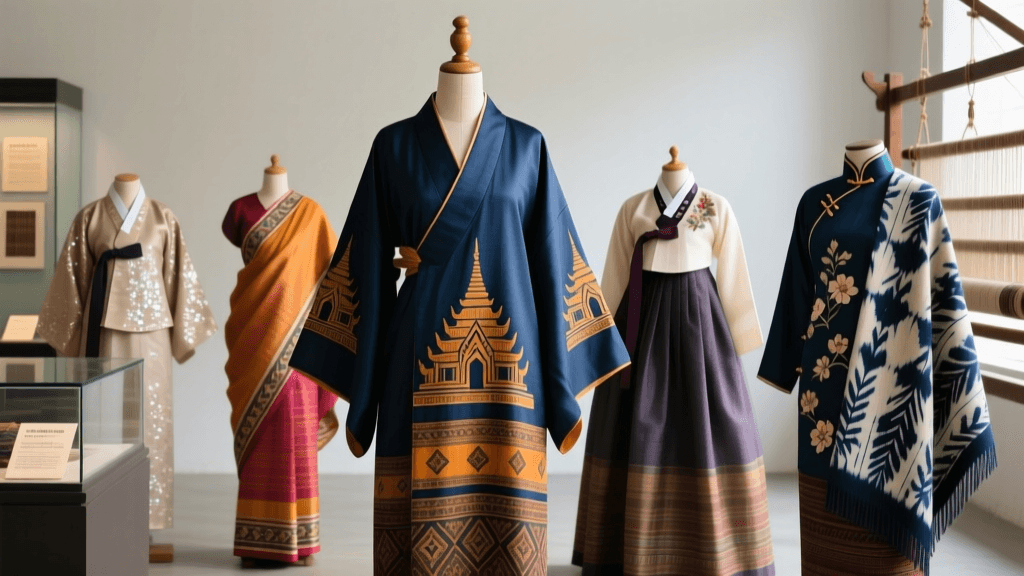
One striking divergence lies in structural integrity: Laotian sin feature a continuous seamless tube construction, unlike the seamed Indian sari or segmented Korean hanbok chima. This seamless form requires warp tension calibrated to 22 kg during weaving—a figure verified through tensile testing at the National University of Laos’ Textile Engineering Lab in 2020.
The ritual significance extends beyond aesthetics. During Bun Pi Mai (Lao New Year), newly woven sin are ritually washed in the Mekong River at dawn on April 13th, then hung to dry under direct sunlight for precisely 4 hours and 17 minutes—the duration believed to align with celestial positions described in the *Phra Malai* cosmological texts.
Efforts to standardize authenticity include the Lao Handicrafts Certification Program, launched in 2018, which mandates minimum 85% handwork content and prohibits synthetic binders in resist pastes. As of 2024, only 31 workshops nationwide hold full certification—among them, the Vientiane Silk Weavers’ Association and the Champasak Ikat Collective.
Material analysis confirms that museum-held sin from the 1930s retain tensile strength exceeding 32 N/cm², compared to modern commercial variants averaging 14.6 N/cm². This durability stems from the triple-twist silk yarn preparation unique to Luang Prabang—where filaments are twisted at 1,200 rpm for 90 seconds before plying, creating torsional stability unmatched elsewhere in mainland Southeast Asia.
Despite global interest, export restrictions remain stringent: raw silk cocoons cannot be exported without Ministry of Industry and Commerce approval, and all certified sin must carry a holographic seal measuring 2.1 cm × 2.1 cm embedded with microtext reading “ສິນ ລາວ ທີ່ແທ້ຈິງ” (“Authentic Lao Sin”).
The persistence of these methods reflects not nostalgia but rigorous functional logic—each measurement, timing, and material choice optimized over centuries for climate resilience, ritual fidelity, and aesthetic coherence. In this light, the sin functions as both garment and archive, its threads encoding hydrological knowledge, botanical taxonomy, and monastic cosmology in equal measure.