Exploring Kyoto Nishijin Ori Kimono Weaving Workshops
The Legacy of Nishijin-Ori: Japan’s Premier Kimono Textile
Kyoto is universally recognized as the cultural heart of Japan, a city where ancient traditions seamlessly intertwine with daily life. Among its most prestigious cultural exports is Nishijin-ori, a luxurious, intricately woven textile that represents the absolute pinnacle of Japanese kimono craftsmanship. For centuries, the Nishijin district in Kyoto’s Kamigyo Ward has been the epicenter of this exquisite weaving tradition, producing the magnificent brocaded obi (sashes) and formal kimono fabrics worn by emperors, shoguns, and geisha alike. Today, exploring the artisan workshops of Nishijin offers a profound glimpse into a world where patience, precision, and artistic vision converge to create wearable masterpieces.
The history of Nishijin-ori dates back over a millennium, but its name originates from the devastating Onin War (1467–1477). During this conflict, Kyoto was divided into eastern and western military camps. The weavers who fled the city eventually returned to the area formerly occupied by the western camp, or "Nishijin," and revived their looms. According to the Nishijin Textile Industry Association, this post-war renaissance laid the foundation for the highly specialized weaving hub that exists today, earning the district its enduring moniker.
Inside the Artisan Workshop: The 20-Step Weaving Process
Unlike many traditional crafts where a single artisan oversees a piece from inception to completion, Nishijin-ori is defined by an intricate division of labor. The creation of a single, high-quality Nishijin obi involves more than twenty distinct, highly specialized steps, each performed by a dedicated master artisan. This hyper-specialization ensures that every thread, dye lot, and weave structure is executed with absolute perfection.
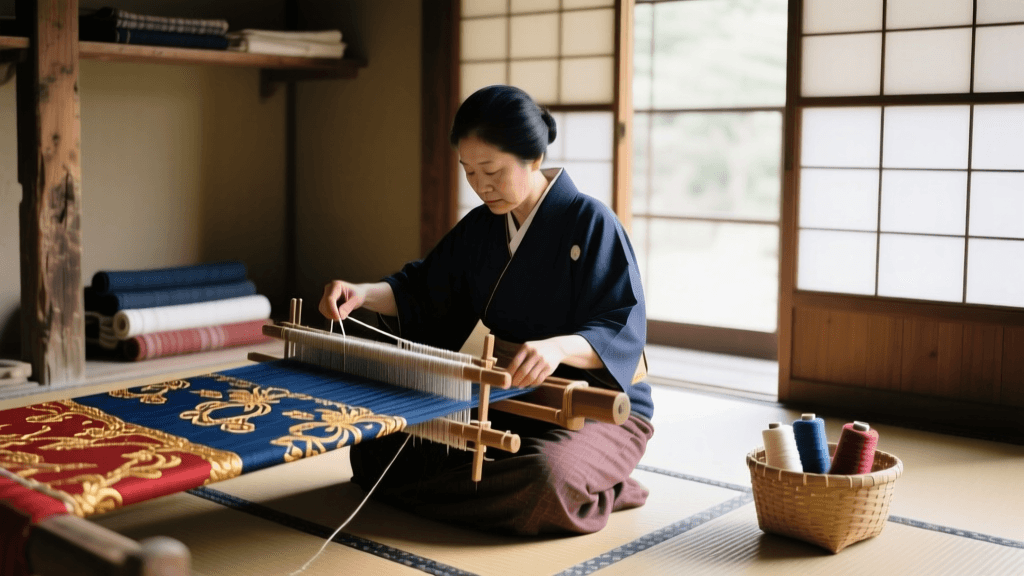
When you step into a traditional Nishijin workshop, the first thing that strikes you is the rhythmic, deafening clatter of the looms. The air is thick with the smell of raw silk and the hum of concentration. The process generally follows these critical phases:
- Design and Pattern Drafting: The process begins with a master designer who sketches the motif. Historically, this was translated into a grid pattern, but today, complex designs are often programmed into digital Jacquard looms.
- Silk Thread Preparation and Dyeing: Raw silk is reeled, twisted, and dyed. Artisans use both traditional plant-based dyes and modern synthetic colors to achieve the vibrant, fade-resistant hues required for formal kimono.
- Warping and Harness Making: The warp threads (longitudinal threads) are meticulously measured and aligned. For intricate brocades, artisans create complex harness systems that dictate how the weft threads will interlace.
- The Jacquard Loom Programming: Nishijin was one of the first regions in Japan to adopt the French Jacquard loom in the late 19th century. The punch-card system used to control the warp threads is widely considered a precursor to modern computer programming.
- Weaving: The final step requires the weaver to operate the loom, often using a traditional wooden shuttle for the weft threads. A master weaver must maintain perfect tension and rhythm, as a single misplaced thread can ruin months of preparatory work.
Visiting Nishijin Workshops: Practical Guide for Travelers
For textile enthusiasts and cultural travelers, visiting the Nishijin district is an essential Kyoto itinerary addition. The area is easily accessible via the Karasuma Subway Line to Imadegawa Station, followed by a short walk or bus ride into the historic weaving streets. While many small, family-run studios are closed to the public to protect proprietary techniques and maintain focus, several exceptional venues welcome visitors to observe the craft firsthand.
Below is a comparison of the most prominent Nishijin workshop experiences available to the public:
| Venue Name | Location / Access | Admission Cost | Highlights & Experiences | Booking Required? |
|---|---|---|---|---|
| Nishijin Textile Center (Nishijin Ori Kaikan) | Horikawa-Imadegawa (Bus 9, 12, 50) | Free Entry (Shows: 500 JPY) | Daily kimono fashion shows, large showroom, basic loom demonstrations, and a vast retail space. | No |
| Orinasu Kan | Chiekoin-dori (Near Imadegawa Stn) | 500 JPY | Intimate museum housed in a historic merchant home. Features antique looms, textile archives, and quiet gardens. | No |
| HOSOO Flagship Store & Gallery | Nakagyo Ward (Near Karasuma-Oike) | Free | A fusion of traditional Nishijin weaving and modern luxury interior design. Excellent for seeing how heritage crafts adapt to contemporary markets. | No |
| Tatsumura Textile Studio | Kamigyo Ward (By appointment) | Varies (Typically 3,000+ JPY) | Exclusive, guided tours led by master weavers. Includes deep dives into imperial reproduction textiles and hands-on weaving sessions. | Yes (Advance) |
Investing in Nishijin-Ori: A Buyer's Guide
Purchasing authentic Nishijin-ori is an investment in Japanese cultural heritage. Because of the intense labor and premium materials involved, genuine pieces command high prices. However, the district offers a wide range of products, from multi-thousand-dollar formal obi to accessible, everyday accessories. When shopping, look for the official "Traditional Craft Product" seal, a certification managed by the Ministry of Economy, Trade and Industry (METI), which guarantees the item was handmade in the designated region using traditional techniques and materials.
As noted by the Victoria and Albert Museum (V&A) in their extensive archives on Japanese dress, the structural integrity and metallic thread work of Nishijin brocades are unparalleled, making them highly sought after by collectors and museums worldwide. The heavy, stiff nature of a Nishijin obi is specifically designed to hold the complex knots of formal kimono dressing, a functional requirement that dictates the textile's dense weave.
Cost Breakdown of Nishijin Textiles
Understanding the pricing structure can help you navigate the showrooms and find a piece that fits your budget and appreciation for the craft:
- Formal Maru / Fukuro Obi: 300,000 JPY to 1,500,000+ JPY. These are the masterpieces of the weaver's art, often incorporating real gold and silver leaf wrapped around silk threads.
- Nagoya Obi (Semi-formal): 80,000 JPY to 250,000 JPY. Lighter and more versatile, featuring beautiful woven patterns suitable for tea ceremonies and seasonal festivals.
- Haori Himo (Kimono Jacket Cords): 15,000 JPY to 40,000 JPY. Intricately braided and woven cords that serve as both functional fasteners and decorative accents.
- Small Accessories (Wallets, Pouches, Ties): 5,000 JPY to 30,000 JPY. Often made from upcycled vintage obi or smaller loom runs, these are excellent entry-level souvenirs that showcase the brilliant metallic brocade work.
Preserving the Loom: The Future of Traditional Weaving
Despite its prestigious status, the Nishijin weaving industry faces significant challenges. The artisan population is aging rapidly, and the grueling, highly specialized nature of the work makes it difficult to attract young apprentices. Furthermore, the declining daily use of the kimono in modern Japanese society has reduced the domestic market for luxury textiles.
To combat this, the Nishijin Textile Industry Association and local government bodies have launched aggressive preservation and modernization initiatives. Workshops are increasingly collaborating with international fashion houses, interior designers, and technology companies to find new applications for their textiles. HOSOO’s expansion into luxury hotel interiors and global fashion runways is a prime example of how ancient techniques can be sustained through modern innovation.
"The survival of Nishijin-ori does not rely solely on preserving the past, but on weaving its unparalleled quality into the fabric of the future. Every thread spun today is a bridge between the artisans of the Onin War and the designers of tomorrow."
For the cultural traveler, visiting a Nishijin workshop is more than a tourist activity; it is an act of witness. By observing the master weavers, listening to the percussive heartbeat of the Jacquard looms, and supporting the local artisan economy, visitors play a vital role in ensuring that Japan’s most magnificent textile tradition continues to thrive for generations to come.