Kyoto Artisan Workshops: Mastering Yuzen and Nishijin Crafts
The Heartbeat of Japanese Textile Heritage
Kyoto is universally recognized as the cultural capital of Japan, a city where centuries-old traditions are not merely preserved in museums but are actively practiced in hidden machiya townhouses and bustling artisan districts. For garment enthusiasts, fashion historians, and travelers seeking authentic cultural immersion, Kyoto offers unparalleled access to the foundational crafts that create the Japanese kimono. Among the most revered of these disciplines are Kyo-Yuzen dyeing and Nishijin weaving. These two distinct yet complementary artisan practices represent the pinnacle of Japanese textile artistry, transforming raw silk into wearable masterpieces that convey social status, seasonal awareness, and aesthetic philosophy.
Participating in a traditional craft workshop in Kyoto is not simply a tourist activity; it is an exercise in mindfulness, precision, and historical appreciation. This comprehensive guide will walk you through the technical nuances, practical booking details, and cultural etiquette required to experience these legendary artisan workshops firsthand.
Kyo-Yuzen: The Art of Painting on Silk
Historical Context and Technique
Originating in the late 17th century under the guidance of Miyazaki Yuzensai, a fan painter from Kyoto, Yuzen dyeing revolutionized Japanese fashion. Prior to Yuzen, garments were primarily decorated through embroidery, tie-dye (shibori), or woven patterns. Yuzen introduced a method to paint elaborate, multi-colored designs directly onto silk, allowing for sweeping pictorial landscapes and intricate floral motifs that flowed seamlessly across the seams of a kimono.
The hallmark of authentic Kyo-Yuzen is the use of itome-nori, a thick, cone-applied rice paste resist. Artisans trace the outlines of a design with this paste, which acts as a dam to prevent liquid dyes from bleeding into adjacent areas. Once the outlines are set, the artisan paints the interior spaces using specialized brushes and vibrant pigments. The fabric is then steamed to set the colors, and the rice paste is washed away in a process historically known as yuzen-nagashi (washing in flowing river water), revealing crisp, white outlines that define the motif.
What to Expect in a Yuzen Workshop
Many historic dye houses in Kyoto, such as the renowned Marumasu Nishimuraya, open their doors to visitors for hands-on experiences. Because authentic kimono dyeing takes months, workshops condense the process into a manageable session where participants dye a smaller item, such as a silk scarf, a furoshiki (wrapping cloth), or a tote bag, using pre-outlined stencils.
- Duration: Typically 90 to 120 minutes.
- Cost: Ranges from 5,500 JPY for a small handkerchief to 16,500 JPY for a large silk scarf or wall hanging.
- Process: You will use specialized Yuzen brushes to apply pigments within the pre-applied rice paste boundaries. Instructors will teach you the 'bokashi' (gradation) technique, blending two colors seamlessly.
- Takeaway: Items usually require steaming and washing by the artisans post-workshop. Most studios will ship the finished, professionally treated item to your hotel or home address within a week.
Nishijin-Ori: Weaving the Threads of Nobility
Historical Context and Technique
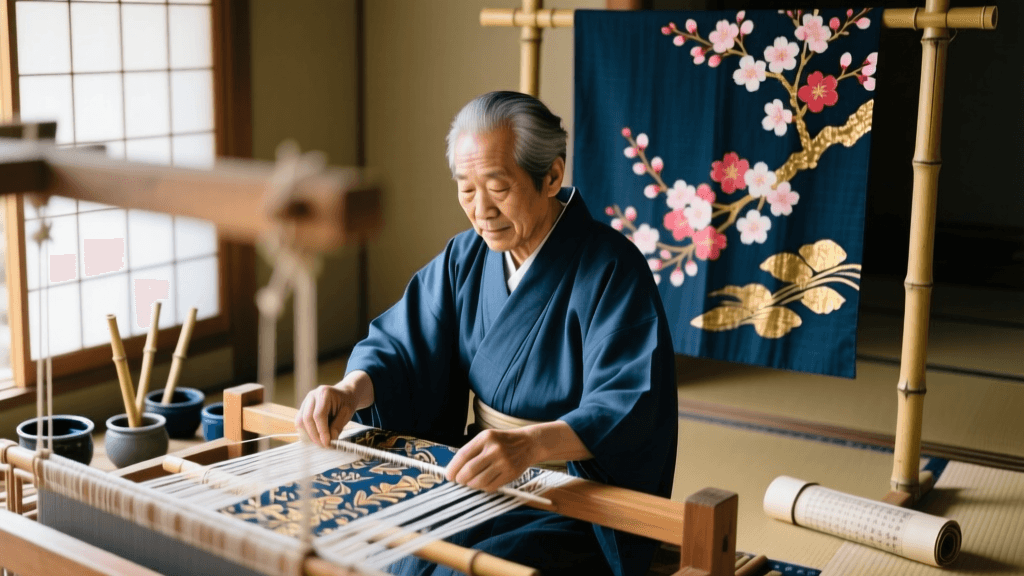
While Yuzen is a surface-level application of color, Nishijin weaving (Nishijin-ori) builds the pattern directly into the structure of the fabric. Dating back over 1,200 years, Nishijin textiles were the exclusive domain of the Imperial Court and the shogunate. The name 'Nishijin' refers to the northwestern district of Kyoto where weavers settled after the Onin War in the 15th century.
Nishijin weaving is characterized by its staggering complexity and the use of opulent materials, including gold and silver leaf threads, silk, and metallic foils. The creation of a single Nishijin obi (kimono sash) can involve up to twenty distinct specialized steps, from the initial design and thread dyeing to the warping of the loom and the final weaving. Today, while traditional hand-operated Jacquard looms (sorabata) are still used for bespoke, ultra-high-end pieces, much of the production utilizes advanced computerized Jacquard looms that still require immense artisan oversight to manage the thousands of warp and weft threads.
Visiting and Weaving at the Nishijin Textile Center
The Nishijin Textile Center serves as the primary hub for public engagement with this craft. It operates as both a museum and an active workshop space. Visitors can observe master weavers operating massive, clacking hand looms, watch daily kimono fashion shows, and participate in weaving experiences.
- Duration: The weaving experience takes about 45 to 60 minutes, though you can spend half a day exploring the museum and shows.
- Cost: General admission and the kimono shows are entirely free. The hands-on weaving workshop costs approximately 3,300 JPY.
- Process: Participants use a miniature, traditional table loom to weave a small coaster or a miniature wall tapestry. Instructors guide you through the rhythmic process of passing the shuttle and beating the weft threads into place using the reed.
- Takeaway: You take your finished woven piece home with you immediately on the same day.
Workshop Comparison: Yuzen vs. Nishijin
Choosing between a dyeing workshop and a weaving workshop depends on your artistic preferences, schedule, and desired takeaway. Below is a structured comparison to help you decide which artisan experience aligns best with your interests.
| Feature | Kyo-Yuzen Dyeing | Nishijin Weaving |
|---|---|---|
| Primary Medium | Liquid pigments and rice paste resist on white silk | Dyed silk threads, gold leaf, and metallic foils |
| Artistic Focus | Color blending, brush control, and pictorial design | Rhythm, structural tension, and geometric/patterned precision |
| Physical Demand | Low; requires steady hands and fine motor skills | Moderate; requires repetitive arm and shoulder movements |
| Time Required | 1.5 to 2.5 hours | 1 to 3 hours (including museum exploration) |
| Average Cost | 5,500 JPY - 16,500 JPY | Free (entry) / 3,300 JPY (workshop) |
| Item Completion | Delayed; requires professional steaming and shipping | Immediate; take your woven piece home the same day |
Practical Advice for Booking and Participation
Booking Logistics
Artisan workshops in Kyoto are often run by small, multi-generational family businesses with limited physical space. Consequently, walk-ins are rarely accepted for hands-on experiences. You must book in advance. Use platforms like Klook, Voyagin, or the official Kyoto City tourism website to secure your spot. For highly specialized, private sessions with master dyers, enlisting the help of your hotel concierge or a specialized local fixer is highly recommended, as these masters may not have English-language web presences.
Workshop Etiquette and Attire
When entering a traditional Japanese workshop, you are stepping into a sacred space of labor and heritage. Observe the following etiquette:
- Footwear: You will almost certainly be required to remove your shoes at the genkan (entryway). Wear clean, presentable socks without holes.
- Clothing: If you are participating in Yuzen dyeing, avoid wearing white or expensive clothing. While aprons are provided, liquid pigments can splatter and stain permanently.
- Hair and Jewelry: Tie back long hair and remove dangling bracelets or rings that could catch on loom threads or drag across wet silk.
- Photography: Always ask for explicit permission before photographing the artisans, their tools, or the looms. Some proprietary designs and loom mechanisms are closely guarded trade secrets.
Preserving the Future of Japanese Artisan Crafts
Despite their beauty, traditional Japanese textile crafts face an existential threat. The artisan population is aging rapidly, and the grueling, multi-year apprenticeships required to master techniques like tsuzure-ori (tapestry weave) or natural indigo fermentation struggle to attract younger generations. Furthermore, the modern decline in daily kimono wear has reduced the domestic market for these luxury textiles.
To combat this, the Japanese government has implemented rigorous preservation strategies. The Ministry of Economy, Trade and Industry (METI) officially designates specific regional crafts as Traditional Craft Products. This designation requires that the craft be used in everyday life, primarily handmade, and utilize traditional techniques and materials that have been continuous for over a century. This government backing provides financial subsidies for apprentice training and promotes international export initiatives.
Organizations like the Japan National Tourism Organization (JNTO) also actively promote craft tourism, recognizing that international appreciation and workshop revenue provide vital economic lifelines to these aging artisan communities. By participating in a Kyoto workshop, you are not merely buying a souvenir; you are directly funding the transmission of intangible cultural heritage to the next generation.
Conclusion
The kimono is far more than a garment; it is a canvas that reflects the natural world, the changing seasons, and the profound dedication of the artisans who bring it to life. Whether you find yourself meticulously painting a cherry blossom motif with a Yuzen brush or rhythmically beating gold threads into a Nishijin loom, the experience will forever alter how you view Japanese traditional clothing. You will leave Kyoto not just with a beautiful textile, but with a profound, tactile understanding of the patience, precision, and passion required to sustain these magnificent Asian traditions.