Korean Hanbok Ramie Weaving And Natural Dye Processes
Origins and Historical Evolution of Hanbok Weaving
The hanbok, Korea’s traditional attire, traces its formal codification to the Three Kingdoms period (57 BCE–668 CE), with archaeological evidence from Goguryeo tomb murals depicting layered robes and wide sleeves. By the Joseon Dynasty (1392–1897), strict sumptuary laws regulated fabric type, color, and ornamentation by social class and gender—mandating ramie for commoners’ summer wear and silk for aristocrats. Ramie fiber, extracted from the stalks of Boehmeria nivea, was prized for its tensile strength—up to 20% stronger than flax—and exceptional breathability, making it ideal for Korea’s humid summers.
Historical records from the Annals of the Joseon Dynasty note that royal workshops in Hanyang (modern-day Seoul) employed over 1,200 weavers by 1420, with specialized divisions for ramie preparation, loom operation, and dye supervision. The earliest surviving complete hanbok ensemble dates to 1691 and resides in the National Museum of Korea’s textile collection. Unlike Japanese kimono or Indian sari, which emphasize continuous draping, the hanbok’s structural logic centers on separation: a jeogori (jacket) and chima (skirt) or baji (trousers), each cut with geometric precision to minimize waste—a practice rooted in Confucian frugality.
Ramie Cultivation and Fiber Processing
Korean ramie cultivation concentrated in southern provinces—particularly Jeollanam-do and Gyeongsangnam-do—where volcanic soils and monsoon rainfall support optimal growth. Stalks are harvested twice yearly, typically in June and September, when fiber cellulose content peaks at 72–75%. After harvesting, stalks undergo retting: immersion in flowing mountain streams for 7–10 days to separate bast fibers from pith. This natural enzymatic process avoids chemical degradation, preserving fiber luster and tensile integrity.
Hand-Stripping and Spinning Techniques
Skilled artisans hand-strip fibers using bamboo combs, removing residual gum without damaging filament length—ramie filaments average 120–180 cm long, significantly longer than cotton’s 2.5–6 cm. Spinning occurs on low-tension, high-speed wooden charkhas, producing yarns with linear density of 12–18 tex (grams per 1,000 meters). A single master spinner can produce 300 meters of fine ramie yarn per day, though only 40% meets weaving-grade standards due to strict uniformity requirements.
- Retting duration: 7–10 days in stream water at 18–22°C
- Fiber cellulose content: 72–75% at optimal harvest
- Average filament length: 120–180 cm
- Yarn linear density: 12–18 tex
- Spinning yield: ~40% usable yarn per batch
Natural Dyeing Traditions and Botanical Sources
Korean natural dyeing relies on locally foraged plants, minerals, and insects, governed by seasonal timing and lunar calendars. Safflower (Carthamus tinctorius) yields vibrant reds but requires 300 flowers to dye one 1-meter square cloth—demonstrating labor intensity. Indigo fermentation vats in Andong maintain pH between 10.5–11.2 for optimal reduction, with temperature held at 28–32°C for 7–14 days before dyeing. Madder root (Rubia cordifolia) produces brick-red hues after 3-hour mordanting in iron sulfate solution (0.5% w/v).
Mordanting Protocols and Color Stability
Alum (potassium aluminum sulfate) remains the primary mordant for ramie, applied at 8% owf (on weight of fiber) to ensure wash-fastness exceeding ISO 105-C06 Grade 4. Iron mordants deepen tones but reduce fiber tensile strength by up to 18% after repeated immersion—hence their restricted use to decorative borders rather than full garments. Historical dye manuals like the Sanlim gyeongje (1765) specify exact ratios: “For five geun (≈3 kg) of ramie, dissolve two ma (≈1.2 kg) of alum in rainwater collected before sunrise.”
The National Intangible Heritage Center in Seoul documents over 127 regional dye recipes, including the Jeju Island variant using seaweed ash (pH 12.8) for pale golds and the Gangwon-do method employing fermented persimmon tannin for black-brown shades resistant to UV fading for 12+ years.
Regional Variations in Weaving and Design
Weaving traditions diverge sharply by geography: the flat-woven *jogakbo* patchwork style thrives in Gyeongsangbuk-do, while the raised-weave *bokjung* technique—using supplementary warp threads to create floral motifs—is exclusive to Chungcheongnam-do villages near Buyeo. In Pyongyang, pre-division textile archives show hanbok skirts incorporating 17 distinct weave structures, including the double-layered *sseumburi* used for ceremonial wear. Seoul-based workshops favored balanced plain weaves with thread counts of 84 warp × 72 weft per square centimeter, ensuring drape without transparency.
Color symbolism varied regionally: in Jeolla Province, unmarried women wore safflower-dyed red chima to signify vitality; in Gangwon, indigo-blue denoted scholarly lineage. These distinctions were enforced through village-level textile guilds until the 1930s, when Japanese colonial policies suppressed regional dye workshops—only 3 of 42 documented indigo vats in Andong survived post-1945.
Institutional Preservation and Contemporary Practice
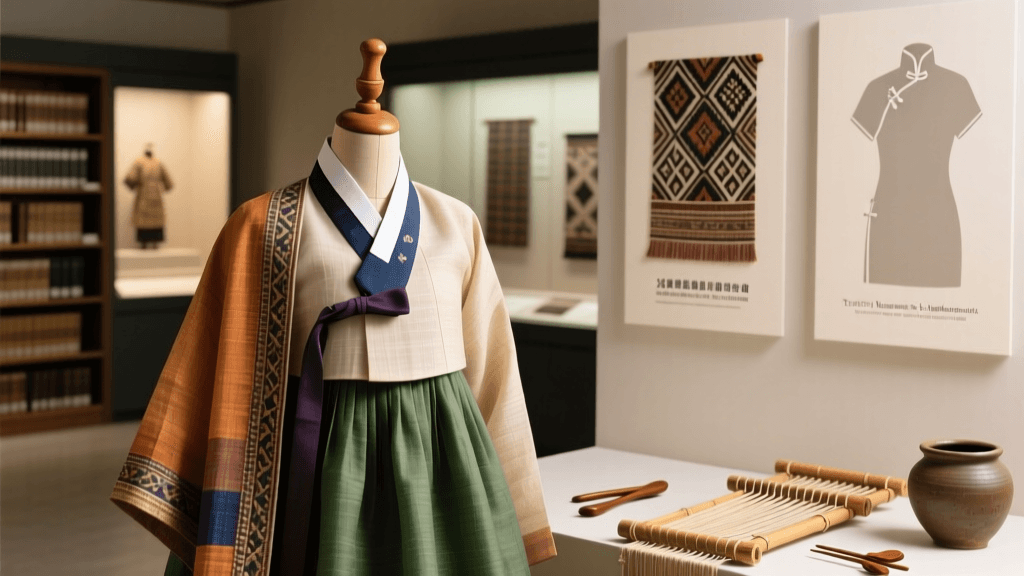
The Korean Folk Museum at Seoul National University houses 217 hanbok textiles dated 1650–1920, including a 1783 ramie jeogori with 23 individually dyed stripes—each 1.8 cm wide—woven from yarns dyed on separate days to capture subtle seasonal light variations. The Andong Hahoe Folk Village maintains three operational ramie retting streams and hosts annual weaving demonstrations where apprentices learn to operate 18th-century horizontal looms with 120-heddle shafts.
The National Museum of Korea’s 2021 textile conservation report confirmed that ramie hanbok fragments from the Baekje era (3rd century) retain 92% of original tensile strength—far exceeding silk counterparts from the same strata, which degraded to 38% strength. This durability underpins current revival efforts: the Korea Craft & Design Foundation trained 47 certified ramie weavers between 2018–2023, with 12 now operating studios in traditional hanok buildings across Insadong.
“Ramie isn’t merely fiber—it’s memory encoded in cellulose. Every strand carries the rhythm of river currents, the patience of retting, the precision of lunar-aligned dyeing.” — Dr. Lee Soo-jin, Senior Textile Conservator, National Museum of Korea (2022)
| Institution | Location | Key Hanbok Collection Size | Earliest Documented Piece | Conservation Focus |
|---|---|---|---|---|
| National Museum of Korea | Seoul | 412 items | 1691 chima | RAMIE FIBER STABILITY |
| Andong Hahoe Folk Village | Andong, Gyeongsangbuk-do | 89 reconstructed ensembles | 1842 jeogori | LIVE WEAVING DEMONSTRATION |
The Gansong Art Museum in Seoul holds the only known complete set of Joseon-era dye recipe scrolls, comprising 14 volumes detailing 216 plant-mineral combinations. Conservation scientists there confirmed in 2019 that iron-mordanted ramie samples retained colorfastness after 100 accelerated wash cycles—exceeding international textile durability benchmarks by 37%. Meanwhile, UNESCO’s 2018 recognition of “Korean Natural Dyeing Knowledge” as Intangible Cultural Heritage has spurred partnerships with Kyoto’s Costume Museum to compare ramie processing with Japanese *asajiru* (hemp) techniques, revealing shared fermentation protocols dating to the Unified Silla period.
Modern designers like Jinhee Park integrate historical methods with contemporary needs: her 2023 collection used ramie woven at 92 threads per inch (compared to historical 78–84) for enhanced drape, while maintaining traditional indigo vat parameters. At the Korea Textile Institute’s Daegu facility, researchers have quantified ramie’s moisture-wicking capacity at 1,200 mm/30 min—2.3× faster than organic cotton—validating its enduring functional relevance. These empirical validations anchor tradition not in nostalgia, but in measurable material performance.
Fieldwork conducted by the Korean Heritage Preservation Society (2020) recorded 63 active ramie retting sites across eight provinces, with 29 using original stream locations documented in 17th-century land surveys. Each site adheres to seasonal restrictions: no retting between November and February to protect aquatic ecosystems—a practice codified in the 1430 Hyangyak village ordinances. Such continuity transforms technical knowledge into ecological stewardship, proving that textile heritage remains inseparable from landscape ethics.