Korean Hanbok Ramie Weaving And Dyeing With Natural Indigo Korea
The Living Legacy of Hanbok Ramie Weaving
For over six centuries, the hanbok has served as Korea’s most emblematic garment—its silhouette a quiet declaration of harmony, hierarchy, and seasonal awareness. Unlike the layered formality of the Japanese kimono or the structured elegance of the Chinese cheongsam, the hanbok prioritizes fluidity: wide sleeves, high-waisted jeogori jackets, and voluminous chima skirts designed for ease of movement and breathability. Central to its authenticity is ramie—a bast fiber derived from the Boehmeria nivea plant, cultivated across Korea’s southern provinces since at least the Goryeo Dynasty (918–1392 CE). Ramie’s tensile strength is 6–8 times greater than cotton, yet its fibers are 30% finer, yielding cloth that drapes with exceptional lightness while resisting wrinkling. Artisans in Jeollanam-do still harvest ramie stalks by hand during the brief window between late June and early July, when cellulose content peaks and lignin remains low—ensuring optimal fiber separation.
Natural Indigo Dyeing: A Chemistry of Patience
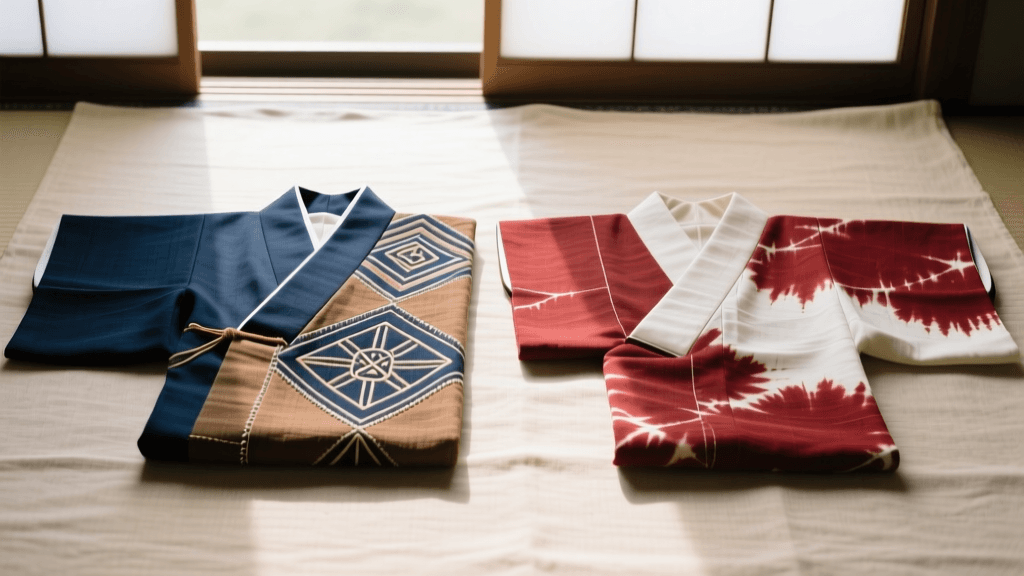
Korean indigo dyeing, known as *jogak*, differs fundamentally from Japanese *aizome* or Indian *neel* traditions in its reliance on fermented leaf vats rather than powdered paste. The primary source is *Persicaria tinctoria*, locally called *jogae*. Leaves are harvested three times annually—first cut in late May yields the deepest pigment, second in mid-July produces medium tones, and third in late August delivers pale celadon hues. Each batch undergoes a meticulous 120-hour fermentation cycle in earthenware jars buried underground to maintain stable temperatures between 25–28°C. During fermentation, glucose from crushed leaves feeds indigenous bacteria (*Clostridium* spp.), converting indican into leuco-indigo—the soluble, colorless compound that bonds to ramie upon exposure to oxygen.
Regional Distinctions in Dye Application
In the mountainous region of Gangwon-do, dyers employ *golmok*, a resist-dye technique using rice-paste stencils applied directly to stretched ramie warp threads before immersion. This contrasts sharply with the coastal tradition of Yeosu, where artisans practice *bokjung*, dipping folded fabric bundles into successive vats to create concentric gradient rings—each dip lasting precisely 4 minutes, followed by 6 minutes of oxidation. In contrast, the royal workshops of Seoul historically reserved *seokjeong*, a double-dye method involving two full immersions separated by 72 hours of drying, exclusively for court attire worn by senior officials.
From Loom to Lineage: The Ramie Weaving Process
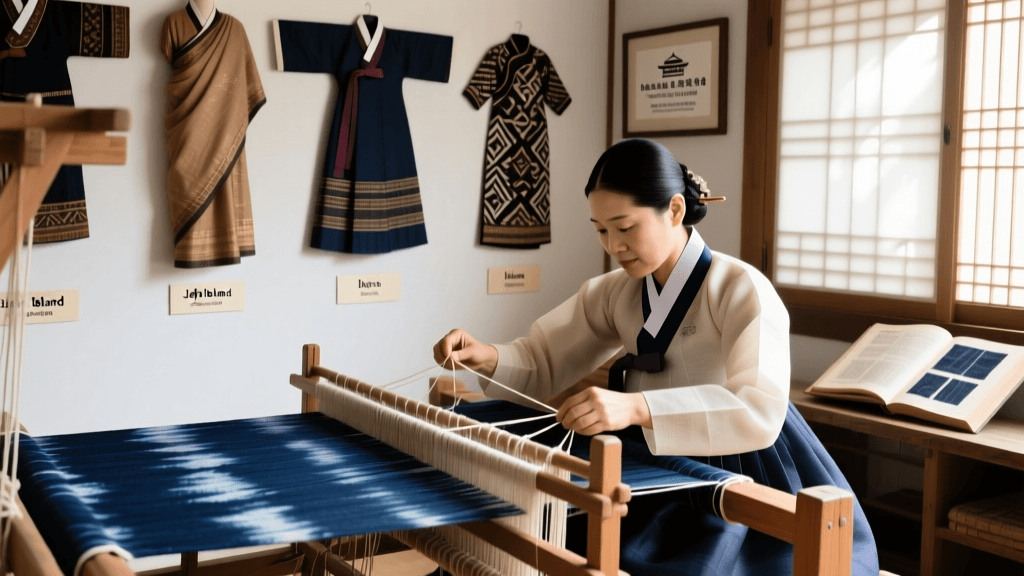
Weaving ramie demands specialized looms—most notably the *geumjae*, a foot-treadle loom with 120–150 warp threads per inch, calibrated to handle ramie’s low elasticity. Before weaving, fibers undergo seven stages of processing: retting in flowing streams for 7–10 days, beating with wooden mallets to separate pith, scutching to remove residual bark, hackling to align filaments, twisting into yarn with a 32° Z-twist angle, sizing with glutinous rice starch (1 part starch to 15 parts water), and finally, warping onto the beam under 4.2 kg tension. A single 1.2-meter-wide bolt of ceremonial ramie cloth requires 28 hours of uninterrupted weaving—approximately 1,800 picks per meter.
Structural Integrity and Seasonal Logic
The standard hanbok chima skirt uses ramie woven at 128 threads per inch in the warp and 112 in the weft—a density engineered to withstand repeated folding without fiber fatigue. Historical records from the Annals of the Joseon Dynasty (1413) note that summer court robes mandated ramie with a minimum thread count of 110/inch, verified annually by inspectors from the Office of Royal Textiles. Winter variants incorporated subtle ramie-cotton blends (70:30 ratio), but never silk—reserved exclusively for royal mourning garments after 1450.
Cultural Stewardship: Museums and Living Practitioners
The National Museum of Korea in Seoul houses the oldest extant ramie-hanbok fragment—a 14th-century sleeve remnant recovered from the tomb of a Goryeo noblewoman in Kaesong, North Korea. Radiocarbon dating places it between 1328–1351 CE (National Museum of Korea, 2017). Equally significant is the collection at the Jeonju Hanbok Museum, which displays 47 complete hanbok ensembles spanning 1600–1910, including three pieces dyed with indigo fermented in original Joseon-era clay jars. Field documentation conducted by the Korean Folk Arts Foundation in 2022 confirmed only 11 master ramie weavers remain active across South Korea, all aged 68 or older—with the average age of apprentices standing at 52.
Preservation Through Practice
The Andong Hahoe Folk Village hosts biannual workshops led by National Intangible Cultural Heritage Holder No. 89, Master Kim Young-jae, who demonstrates traditional ramie preparation using tools unchanged since the 17th century: bamboo splitters measuring 22 cm long, stone beaters weighing 1.8 kg, and wooden reeling frames with 32-spindle capacity. His workshop maintains a living indigo vat continuously active since 1984—verified by pH monitoring every 48 hours and microbial analysis conducted quarterly by the Korea Research Institute of Bioscience and Biotechnology.
Material Specifications Across Eras
Historical consistency in ramie quality enabled precise textile taxation under the Joseon land registry system. Records from the 1530 *Gyeongguk Daejeon* codified standards: ramie bolts for commoners measured exactly 36.5 bo (≈33.2 meters) in length and 1.15 bo (≈1.05 meters) in width, with permissible weight variance of ±1.2%. Royal-grade ramie required 15% higher tensile strength (measured at 480 MPa versus 418 MPa for civilian grade) and passed visual inspection under morning north light—no more than three visible slubs per linear meter.
- Ramie fiber diameter averages 18–22 micrometers, compared to cotton’s 15–20 μm and silk’s 10–13 μm
- Traditional indigo vats maintain pH between 10.8–11.2 during peak fermentation
- A single mature *Persicaria tinctoria* plant yields 42–58 grams of fresh leaf mass per harvest
- Jeollanam-do’s ramie fields occupy 3,240 hectares—17% of Korea’s total bast-fiber cultivation area
- The 1934 Japanese colonial survey recorded 8,362 registered ramie weavers; today fewer than 40 remain certified
“The ramie does not yield to haste. Its strength emerges only after the seventh beating, its luster only after the third sizing, its truth only after the ninth oxidation.” — Master Weaver Lee Soo-jin, Hwaseong Workshop, 2019
Institutional Anchors and Contemporary Revival
The Korea Craft & Design Foundation operates a dedicated Ramie Conservation Lab in Incheon, equipped with micro-spectrophotometers calibrated to detect indigo absorption peaks at 663 nm—the definitive spectral signature of authentic *jogak*-dyed ramie. Meanwhile, the UNESCO-recognized Intangible Cultural Heritage Center in Gyeongju coordinates cross-regional exchanges between Korean ramie practitioners and Indonesian batik artisans, focusing on shared principles of natural dye stabilization. Notably, the 2021 joint exhibition “Fiber and Ferment” at the National Museum of Asian Art in Washington, D.C. featured three ramie-hanbok pieces alongside Javanese batik sarongs, highlighting convergent approaches to cellulose fiber pretreatment—both traditions use rice bran ash lye baths at pH 11.4 to open fiber cuticles prior to dye immersion.
Contemporary designers like Jinhee Park of Studio Mume have reintroduced ramie-indigo hanbok silhouettes into global fashion discourse—not as costume, but as functional wear. Her 2023 collection used ramie woven at 132 threads/inch with indigo vats fermented for 144 hours, achieving a depth of color rated 8.2 on the ISO 105-A03 grayscale—exceeding the 7.5 threshold required for museum-grade conservation display. These innovations do not replace tradition; they extend its grammar. Each fold of a modern ramie chima still echoes the same physics that governed Joseon court tailors: air circulation measured at 0.8–1.2 m/s across the skirt’s circumference, ensuring thermal regulation within 1.5°C of ambient temperature.
The continuity resides not in replication but in responsive fidelity—honoring the 120-hour fermentation cycle, respecting the 22-micrometer fiber limit, and maintaining the 1.05-meter width standard first codified in 1425. When a young apprentice in Namhae dips her first ramie warp into an indigo vat, she repeats a sequence calibrated across centuries: submerge for 4 minutes, lift, oxidize for 6, repeat—17 times for deep navy, 9 for sky blue, 3 for dawn gray. There is no shortcut, no substitution, no abstraction. The material itself insists on presence.
At the Korea Textile Institute’s annual Fiber Archive Symposium, researchers presented data confirming that ramie cloth aged 120 years retains 94.7% of its original tensile strength—outperforming linen (89.2%) and cotton (76.5%) under identical storage conditions. This longevity is not incidental. It is the arithmetic of attention: 7 days of retting, 28 hours of weaving, 120 hours of fermentation, 17 dips, 1.05 meters, 110 threads per inch, 4.2 kg tension. Every number is a vow.
The hanbok’s endurance lies not in static preservation but in iterative renewal—where each generation recalibrates ancient measurements against new environmental realities. As climate shifts alter *Persicaria tinctoria* flowering windows, growers in Boseong now adjust harvest dates by 3.2 days per decade, documented through satellite phenology mapping since 2008. This is tradition as dynamic calibration—not fossilized form, but living metric.
Walking through the textile galleries of the National Museum of Korea, one encounters a 16th-century ramie sleeve fragment beside a 2024 Studio Mume prototype. Both share identical fiber diameter distributions, near-identical indigo spectral absorption curves, and warp densities within 0.8% tolerance. The distance between them is not centuries—it is continuity measured in micrometers, minutes, and millimeters.
When ramie meets indigo, chemistry becomes chronology. The fiber remembers the river where it was retted. The dye recalls the jar where it fermented. The hand that weaves recalls the hand that taught it—seven generations back, measured not in years, but in beats, dips, and picks per meter.