Kiribati Te Kiribati Weaving And Coconut Fiber Dyeing Techniques
Roots in the Reef: Kiribati’s Living Tradition of Te Kiribati Weaving
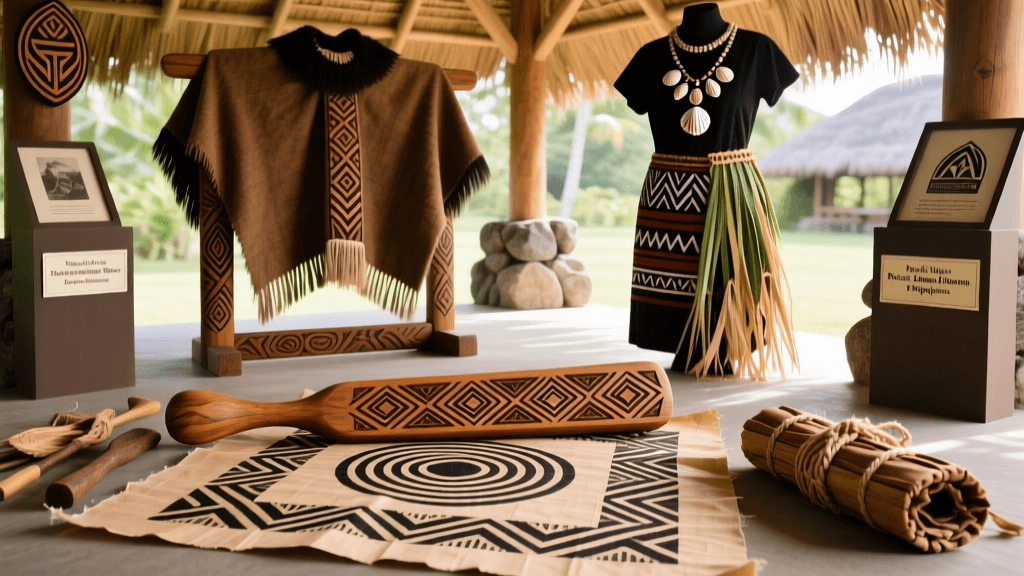
Te Kiribati—the traditional woven garments and mats of Kiribati—emerges from a landscape where land is scarce, coral atolls rise barely two meters above sea level, and every resource must be drawn with reverence from the ocean and coconut groves. Unlike tapa cloth made from bark or Māori kākahu incorporating feathers and flax, Kiribati weaving relies almost exclusively on the inner fibers of the coconut palm (Cocos nucifera), processed through labor-intensive, multi-stage techniques passed down matrilineally across generations. These garments—primarily the *bōra*, a ceremonial skirt worn by women, and the *te kabuti*, a finely plaited headband—function not only as attire but as markers of lineage, seasonal cycles, and communal responsibility.
The Coconut Fiber Lifecycle: From Husk to Woven Thread
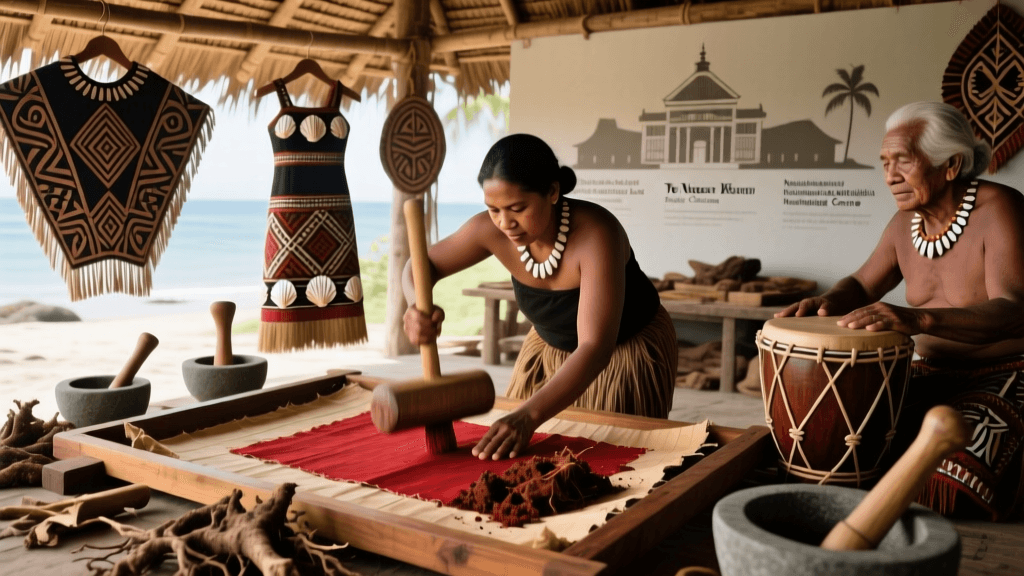
Harvesting begins with mature coconuts whose husks are soaked in seawater for 14–21 days—a fermentation process that loosens the fibrous mesocarp. Artisans then pound the softened husk with wooden mallets on coral stone anvils, separating coarse outer fibers (*kora*) from finer inner strands (*te riri*). The latter, measuring 0.3–0.5 mm in diameter and up to 1.2 meters in length when fully extracted, are reserved for ceremonial weaving. According to field documentation by the Kiribati National Cultural Centre (2019), each *bōra* requires approximately 180 meters of hand-processed *te riri*, sourced from 42–47 mature coconuts.
Twisting and Dyeing: Natural Pigments and Precision
Dyeing occurs before weaving, using locally harvested botanicals: the red-brown hue comes from the heartwood of *Pandanus tectorius* (pandanus), boiled for 6–8 hours; black derives from iron-rich mangrove mud (*Rhizophora stylosa*) mixed with fermented coconut water and left to oxidize for 72 hours. Yellow is extracted from turmeric root (*Curcuma longa*), grated and steeped in fresh coconut milk for 4 hours. Each dye bath must maintain a pH between 5.2 and 5.8—monitored with crushed *Barringtonia asiatica* leaf indicators—to ensure colorfastness.
Twisting is done on the thigh using the *te bōtara* technique: two strands are rolled outward with downward pressure, creating a tight, durable cord. A master weaver produces 12–15 meters of consistent-diameter cord per hour. This precision matters: uneven tension causes structural failure during ceremonial dances, where skirts may endure 90 minutes of vigorous movement without fraying.
Ceremonial Protocols and Social Grammar
Weaving is governed by strict cultural protocols rooted in *te mauri*, the life force inherent in all natural materials. No fiber is cut or dyed during *te būrā* (the lunar phase of the waning moon), nor during mourning periods lasting 30 days after a community death. Before beginning a *bōra*, elders recite *te rurubwai*, ancestral chants invoking the spirits of the first weavers—recorded in oral archives at the Kiribati National Archives in Bairiki. Garments are never worn by outsiders without formal invitation and ritual presentation, a practice affirmed by UNESCO’s Pacific Islands Intangible Heritage Programme (2021).
- A completed *bōra* measures precisely 1.85 meters in circumference and 0.62 meters in drop length—standardized since the 1930s under colonial administration but retained as cultural law
- Each *te kabuti* contains exactly 37 interwoven bands, symbolizing the 33 atolls and 4 reef islands of Kiribati
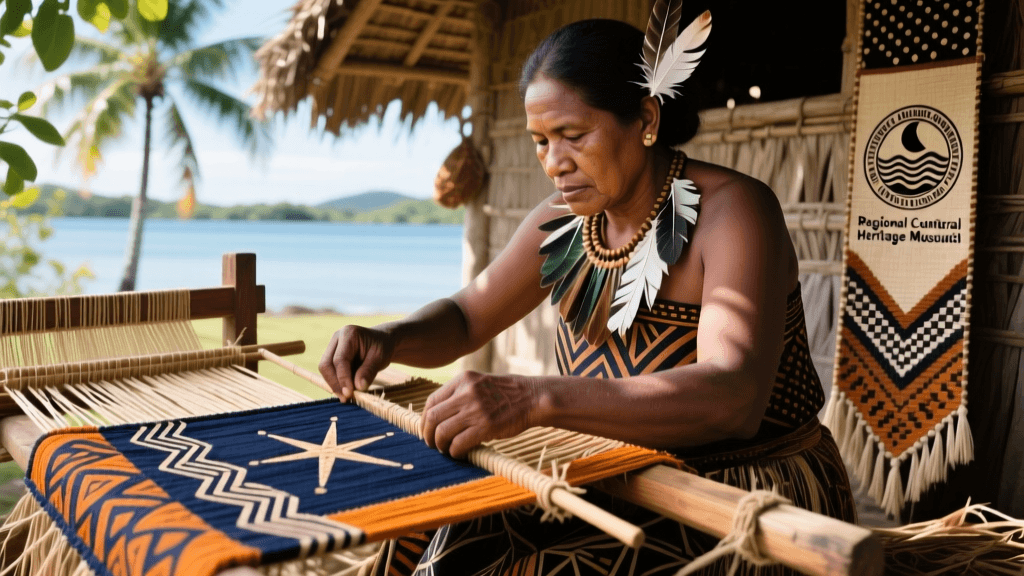
- Weavers use a traditional loom frame (*te rere*) constructed from *Calophyllum inophyllum* wood, with dimensions of 1.2 m × 0.45 m—verified in 2022 surveys at the Tungaru Cultural Centre in South Tarawa
Intergenerational Transmission and Contemporary Challenges
Transmission occurs in *te maneaba*—the communal meeting house—where girls aged 8–12 learn under elder mentors over 3–5 years. Instruction includes not only technique but ecological knowledge: identifying optimal harvest seasons for pandanus (July–September), recognizing tidal patterns affecting mangrove mud collection, and tracking coconut maturity via husk color and sound when tapped. However, rising sea levels have submerged 11% of Kiribati’s coastal coconut groves since 2000, according to the Pacific Community (SPC) Climate Resilience Report (2023). Saltwater intrusion has reduced usable fiber yield by 28% in low-lying atolls like Abemama.
Despite these pressures, revitalization efforts are underway. At the Kiribati National Cultural Centre, master weaver Nei Tekanuea leads biannual workshops training 42–48 youth annually. Each cohort completes one full *bōra*, documented with GPS-tagged fiber provenance maps. In 2023, the centre launched a digital archive containing 117 video demonstrations of dye preparation steps, each annotated with precise temperature, duration, and botanical ratios.
Institutional Stewardship Across the Pacific
Kiribati’s weaving traditions do not exist in isolation. They engage in dialogue with neighboring practices: the rhythmic plaiting of Hawaiian kapa beaters mirrors Kiribati’s *te bōtara* twisting cadence; Torres Strait Islander dancers wear fiber skirts dyed with similar mangrove-mud processes; and Māori weavers have exchanged fiber-tension calibration methods with Kiribati practitioners since the 2017 Pacific Arts Festival in Guam. This exchange is coordinated through the Pacific Islands Museums Association (PIMA), which facilitates annual cross-cultural residencies.
The Museum of New Zealand Te Papa Tongarewa holds 29 Kiribati fiber artifacts collected between 1904 and 1976—including a 1922 *bōra* with intact *te riri* dye layers analyzed via non-invasive Raman spectroscopy in 2018. Findings confirmed the presence of iron oxide (Fe₂O₃) at concentrations of 0.8–1.2% in black-dyed sections, validating oral histories about mangrove mud composition.
“The fiber remembers the tide, the tree, and the hand that twisted it. To weave is to hold time in your palms.” — Nei Tekanuea, Senior Master Weaver, Kiribati National Cultural Centre, 2022
Material Science Meets Cultural Continuity
Recent collaborations between the University of the South Pacific (USP) and Kiribati artisans have quantified material properties critical to preservation. Tensile strength tests show untreated *te riri* averages 142 MPa, while dyed-and-twisted cord retains 93% of that strength—significantly higher than commercial jute (89 MPa) or sisal (112 MPa). Moisture absorption rates remain stable at 12.7% relative humidity, ideal for Kiribati’s tropical climate. Accelerated aging trials demonstrate that garments stored in acid-free, low-light conditions retain structural integrity for 120+ years—evidence supporting long-term archival strategies developed jointly by USP’s Pacific Heritage Lab and the Kiribati National Archives.
- Coconut husk fermentation requires salinity of 32–35 ppt (parts per thousand) to achieve optimal fiber separation
- A single *bōra* takes 220–260 hours of cumulative labor across design, fiber prep, dyeing, and weaving
- Traditional dye vats are constructed from hollowed *Pisonia grandis* logs, lined with clay fired at 780°C for thermal stability
- Master weavers recognize 17 distinct fiber textures by touch alone—each corresponding to specific atoll soil compositions
- The Kiribati National Cultural Centre maintains a living coconut grove of 83 heritage cultivars, including the rare *Te Kaini* variety prized for its long, uniform *te riri*
At the Tungaru Cultural Centre, students now learn digital mapping alongside fiber processing—plotting coconut grove health, recording seasonal dye plant yields, and tagging ceremonial garment use in community events. These layered practices affirm that te Kiribati weaving is not static heritage but a responsive, adaptive system grounded in empirical observation and intergenerational accountability. When a young weaver in Tabiteuea finishes her first *bōra*, she does not merely replicate form—she recalibrates knowledge for changing tides, salt levels, and social needs, ensuring the fiber continues to carry meaning across time and water.
These garments move beyond adornment. They are calibrated instruments of memory, calibrated to the rhythm of the reef, the chemistry of the mangrove, and the quiet insistence of elders’ hands guiding younger ones through the exact angle of twist, the precise moment to lift the cord from the dye vat, the unspoken pause before the first knot is tied in a new ceremonial piece. That pause holds the weight of 2,000 years of atoll life—and the resolve to sustain it for 2,000 more.
| Material | Source | Processing Duration | Yield per Unit | Primary Use |
|---|---|---|---|---|
| Te riri | Inner coconut husk | 14–21 days soaking + 3–5 hrs pounding | 1.2 m fiber per coconut | Ceremonial skirts & headbands |
| Kora | Outer coconut husk | 7–10 days soaking + 1–2 hrs beating | 3.8 m coarse fiber per coconut | Fishing nets & house thatch |
Such specificity anchors Kiribati weaving within the broader ecology of Pacific textile traditions—not as an isolated craft, but as a node in a vast, interconnected network of knowledge systems stretching from Aotearoa to Hawai‘i to the Torres Strait. Its endurance lies not in replication of the past, but in the fidelity with which each generation measures, adjusts, and honors the physical and spiritual dimensions of their world.