Mastering Kimono Construction: Zero-Waste Cutting in 2026
The Architecture of Sustainable Asian Dress
As the global fashion industry faces stringent sustainability mandates and zero-waste requirements in 2026, designers, textile engineers, and home sewists are looking backward to move forward. Long before modern eco-conscious fashion became a trend, traditional Asian dress relied on brilliant, waste-free garment construction techniques. Among the most sophisticated of these is the traditional Japanese kimono. Unlike Western tailoring, which relies on curved armholes, darted bodices, and complex grading that leaves up to 20% of fabric on the cutting room floor, the kimono is a masterclass in geometric efficiency. By understanding the foundational construction techniques of the kimono, modern makers in 2026 can adopt sustainable practices that honor Asian heritage while drastically reducing textile waste.
The Foundation: Understanding the Tanmono
The entire construction of a traditional kimono is dictated not by the human body's curves, but by the limitations and brilliance of the traditional loom. The fabric is woven in a continuous, narrow bolt known as a tanmono. A standard tanmono measures exactly 14 inches (35.5 cm) in width and 12.5 yards (11.4 meters) in length. This specific dimension is not arbitrary; it is precisely calculated to yield one complete adult kimono with zero fabric left over. Every single inch of the 12.5-yard bolt is utilized in the final garment, from the main body panels to the collar and sleeves. According to the Victoria and Albert Museum's textile collection, this loom-width constraint forced historical artisans to develop a modular, rectangular approach to garment architecture that remains entirely relevant to modern zero-waste pattern drafting.
Chokusen-Dachi: The Ultimate Zero-Waste Geometry
The cutting technique used for the kimono is called chokusen-dachi, or straight-line cutting. Because the tanmono is narrow, the garment is constructed by folding and joining long, rectangular strips of fabric rather than cutting curved shapes. The selvage edges of the fabric are never cut away; instead, they are cleverly hidden inside the seams or utilized as finished edges, eliminating the need for hemming and preventing fraying.
The Four Primary Pattern Pieces
- Migoro (Body Panels): Two long rectangles that form the front and back of the garment. They are folded over the shoulders with no shoulder seam, creating a continuous drape.
- Sode (Sleeves): Rectangular panels attached to the migoro. The bottom of the sleeve is folded up and sewn to create a deep, built-in pocket known as the tamoto.
- Okumi (Front Panels): Two narrower rectangular strips added to the front edges to provide the necessary overlap for the wrap-style closure.
- Eri (Collar): A long, narrow strip folded and attached to the neckline, extending down the front panels.
By utilizing only rectangles and squares, the chokusen-dachi method ensures that if a kimono is entirely deconstructed, it returns to its original state as a series of flat, reusable fabric panels. As documented in the Metropolitan Museum of Art's Asian textile archives, this modularity allowed garments to be passed down through generations, easily resized, or re-dyed without ever discarding the base material.
Shitsuke: The Art of Temporary Basting
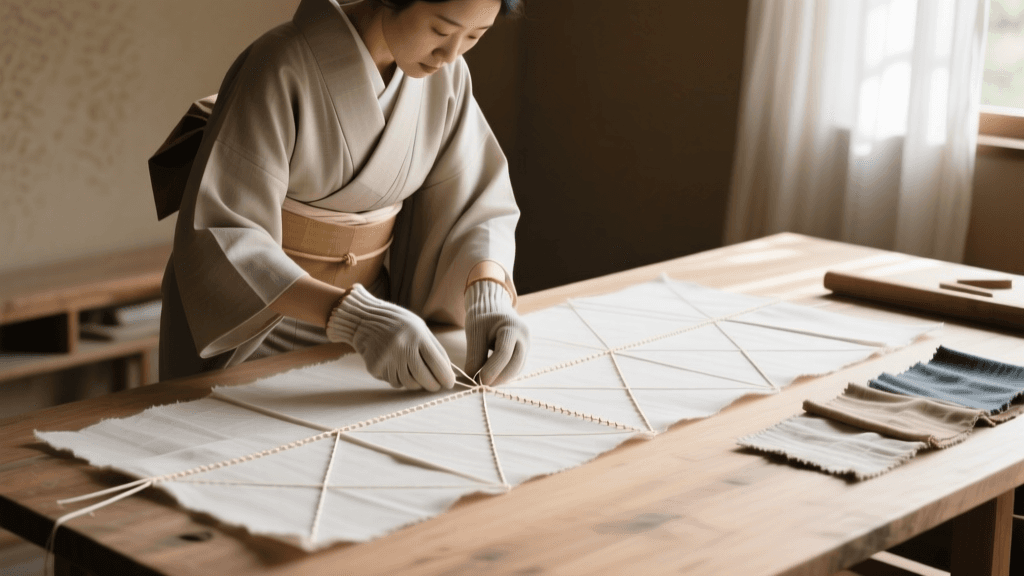
One of the most vital construction techniques in Asian dress traditions is shitsuke, the art of basting. A traditional kimono is rarely sewn with permanent, tight machine stitches. Instead, it is constructed using long, temporary running stitches. This is not due to a lack of tailoring skill, but rather a deliberate engineering choice designed for the garment's care cycle, known as arai-hari (wash and stretch).
Because silk and delicate woven textiles can warp or shrink when washed, the kimono is completely deconstructed into its flat rectangular panels before cleaning. Once washed, stretched, and dried, the panels are re-basted and sewn back together. In 2026, as consumers seek garments that can be easily repaired, resized, and maintained over decades, the shitsuke technique offers a brilliant blueprint for modular fashion.
Actionable Basting Steps for 2026 Sewists
If you are adapting traditional kimono construction for modern sewing projects, mastering the basting stitch is essential for fitting and preserving delicate fabrics.
- Thread Selection: Use 100% silk basting thread or high-grade long-staple cotton. Avoid polyester basting threads, as they can cut into delicate silk tanmono fabrics over time.
- Stitch Length: For silk and lightweight rayons, maintain a stitch length of 3mm to 4mm. For heavier wools or modern cotton adaptations, increase the stitch length to 5mm to 6mm.
- The Loop Knot: Never use backstitching to secure your basting thread. Instead, leave a 2-inch tail at the start of your seam, and secure the end with a simple loop knot that can be easily snipped during deconstruction.
- Tension Control: The basting thread must be pulled just tight enough to hold the layers together, but loose enough to allow the fabric to drape naturally. If the thread is too tight, it will distort the straight grain of the tanmono.
2026 Material Sourcing and Cost Analysis
Sourcing authentic tanmono bolts outside of Japan has historically been difficult, but the rise of global sustainable textile networks in 2026 has made these materials more accessible. Below is a comparison of traditional Japanese bolts versus standard Western fabric bolts for zero-waste sewing projects.
| Material Type | Standard Width | Total Yield | 2026 Avg. Cost (USD) | Best Application |
|---|---|---|---|---|
| Authentic Silk Tanmono | 14 inches (35.5 cm) | 12.5 yards | $350 - $1,200 | Traditional Kimono, Ceremonial Wear |
| Modern Cotton Tanmono (Yukata) | 14.5 inches (37 cm) | 13 yards | $85 - $150 | Casual Summer Wear, Zero-Waste Prototyping |
| Western Silk Crepe Bolt | 45 inches (114 cm) | 5 yards | $120 - $250 | Modern Draping, Western Tailoring |
| Upcycled Sari Silk Panels | 42 inches (106 cm) | 6 yards | $40 - $90 | Eco-Fashion, Hybrid Asian-Western Designs |
Adapting Traditional Seams for Modern Wardrobes
While wearing a full kimono may not suit every modern lifestyle, the seam techniques used in its construction are highly applicable to 2026 contemporary fashion design. The wakinui (side seam) of a kimono features a remarkably deep seam allowance—often up to 1.5 inches (3.8 cm). In Western tailoring, seam allowances are typically serged and trimmed to 3/8 of an inch to reduce bulk. However, the deep, untrimmed seam allowances of the kimono serve as built-in insurance, allowing the garment to be let out as the wearer's body changes over time.
Modern sustainable brands are adopting this 'deep allowance' technique, leaving generous seam allowances encased in bias binding rather than cutting them away. This ensures that a garment purchased in 2026 can be easily altered in 2036, extending its lifecycle and fulfilling the core promise of circular fashion.
Digital Drafting and Modern Preservation
The preservation of these techniques is no longer limited to physical archives. The Kyoto Costume Institute Digital Archives provides high-resolution structural analyses of historical garments, allowing modern pattern makers to study the exact placement of basting stitches and seam intersections. Furthermore, 2026 digital drafting software like CLO3D and Marvelous Designer now include specific 'zero-waste rectangular' modules, enabling designers to simulate the drape of a tanmono bolt without generating digital or physical waste during the prototyping phase.
'The brilliance of the kimono lies not in how it is cut to fit the body, but in how the body moves within the geometry of the fabric. It is a conversation between the wearer and the loom, mediated by the basting thread.'
Conclusion
Mastering the construction techniques of the traditional kimono requires a paradigm shift from 'shaping fabric to the body' to 'draping the body in fabric.' By embracing chokusen-dachi straight-line cutting and shitsuke basting, modern sewists and designers can create garments that are not only deeply rooted in Asian cultural heritage but are also inherently sustainable, repairable, and entirely zero-waste. As we navigate the ecological demands of 2026, the ancient wisdom of the tanmono bolt offers a flawless blueprint for the future of global fashion.