Mastering Kimono Chokusen-Dachi Straight-Line Cut 2026
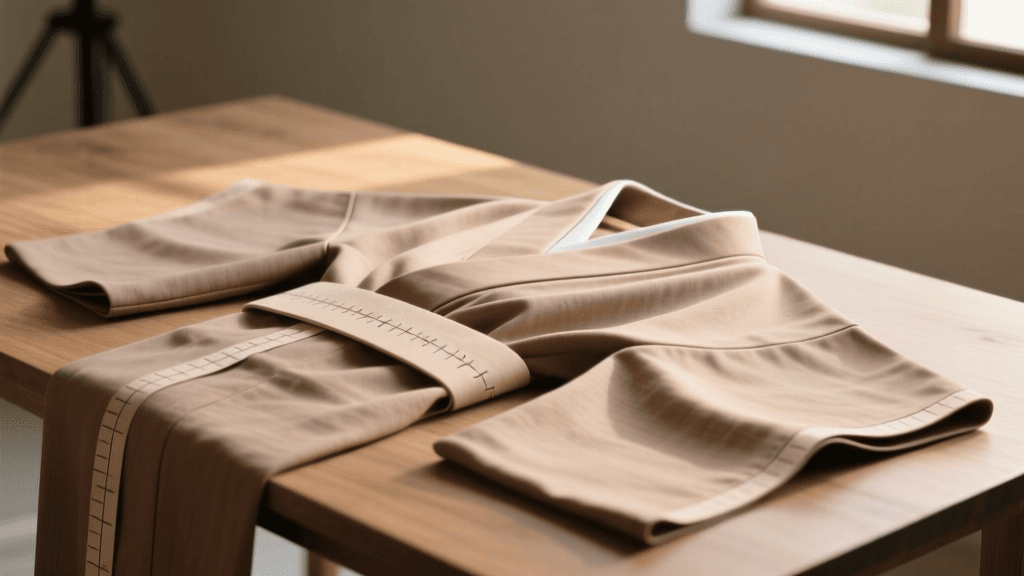
Introduction to Chokusen-Dachi: The Philosophy of Straight-Line Cutting
In the landscape of global garment construction, Western tailoring has historically relied on curved seams, darts, and complex pattern grading to mold fabric to the human form. In stark contrast, the traditional Japanese kimono employs Chokusen-dachi, or straight-line cutting. This centuries-old technique relies entirely on geometric, rectangular panels cut parallel to the selvage. As the global fashion industry pivots toward circularity and zero-waste design in 2026, the Chokusen-dachi method has experienced a massive renaissance among sustainable fashion designers, textile conservators, and independent makers.
Unlike Western patterns that discard up to 15% of fabric as offcuts around armholes and necklines, the straight-line kimono construction utilizes 100% of the textile. According to the Metropolitan Museum of Art's Heilbrunn Timeline of Art History, the structural integrity of the kimono is inherently tied to the unbroken lines of the fabric, preserving the continuity of woven and dyed motifs. In 2026, understanding these construction techniques is not merely an exercise in historical preservation; it is a masterclass in sustainable, zero-waste pattern engineering.
The Anatomy of Zero-Waste Kimono Construction
The foundation of the Chokusen-dachi method is the Tanmono, a standard bolt of fabric. Historically and continuing into 2026, a standard Tanmono is woven to a specific width—typically 36 to 38 centimeters (about 14 to 15 inches)—and a length of roughly 12 meters (about 13 yards). This exact dimension is not arbitrary; it is mathematically calculated to yield exactly one adult kimono with zero waste.
The kimono is deconstructed into eight primary rectangular panels. Because the fabric is never cut on the bias or curved, the grainline remains perfectly straight throughout the garment, providing exceptional durability and allowing the textile to be easily repurposed.
Standard Garment Components and Measurements
| Component Name | Japanese Term | Quantity | Standard Dimensions (Approx.) | Structural Function |
|---|---|---|---|---|
| Body Panels | Migoro | 2 | 36cm W x 120cm L | Forms the front and back core of the garment. |
| Sleeves | Sode | 2 | 36cm W x 110cm L | Creates the iconic drop-sleeve and pouch. |
| Overlap Panels | Okumi | 2 | 15cm W x 120cm L | Provides the front overlapping closure. |
| Collar | Eri | 1 | 10cm W x 110cm L | Frames the neckline and secures the front. |
| Sleeve Pouch | Tamoto | 2 | Integrated into Sode | Acts as a traditional pocket and weight. |
Step-by-Step Construction Technique for Modern Makers
For contemporary sewists and designers adapting these methods in 2026, mastering the kimono requires unlearning Western sewing habits. There are no ironed-open seams, no serged edges, and no curved clipping. Here is the actionable workflow for constructing a straight-line garment.
1. Preparing and Marking the Tanmono
Before cutting, the silk or hemp Tanmono must be pre-shrunk. In 2026, many makers use professional steam-tensioning machines, but the traditional method of Yunoshi (steam pressing) remains highly effective. Marking is traditionally done with Shirushi-ito (basting threads used as temporary guidelines). For modern makers, water-soluble marking pens or tailor's tacks are preferred. You will mark straight lines across the width of the fabric to separate the 12-meter bolt into the eight panels listed in the table above. The remaining fabric is used for the collar and internal facings.
2. The Basting and Assembly Process
Because kimono panels are long and slippery (especially silk chirimen crepe), basting (Shitsuke) is mandatory. Use a long running stitch with white cotton basting thread. Assemble the Migoro (body panels) first by sewing the center back seam, followed by the side seams. The Okumi (overlap panels) are then attached to the front edges of the Migoro.
3. The Running Stitch and Thread Selection
Traditional kimono sewing (Wasai) relies almost exclusively on the running stitch (Nuikomi). In 2026, while high-tenacity polyester core threads wrapped in silk are available for extra strength, purists still recommend 100% silk thread (size 50 or 60) for silk garments to ensure the thread degrades at the same rate as the fabric. Use a specialized Wasai needle, which is longer and finer than a standard Western sharps needle, allowing you to pick up 4 to 6 stitches at a time before pulling the thread through. Aim for a stitch length of 2mm to 2.5mm.
The Art of Kise: Hiding the Seam Allowances
Perhaps the most crucial and misunderstood technique in Asian straight-line construction is Kise. In Western sewing, seam allowances are typically pressed flat or serged. In kimono construction, the seam allowances are folded together and then tucked slightly under the seam line itself, creating a hidden, clean finish on the inside without the need for edge-stitching or overlocking.
To execute Kise:
- Sew your running stitch exactly 1 cm from the raw edge.
- Fold both seam allowances together in the same direction.
- Using your thumbnail or a specialized bone folder, crease the folded edge so that it sits roughly 1mm to 2mm past the actual seam line.
- This creates a tiny 'lip' that hides the raw edges inside the fold and prevents the seam from rolling outward when worn.
- The allowances are left untrimmed and uncut, preserving the structural integrity of the silk.
The Arai-Hari System: Ultimate 2026 Sustainability
The true genius of the Chokusen-dachi system is revealed at the end of the garment's lifecycle. Because the seam allowances are never cut or trimmed, a kimono can be entirely disassembled back into its original rectangular panels. This process is part of Arai-Hari (wash and stretch).
When the garment becomes soiled, the maker removes all threads, washes the individual flat panels, and stretches them on wooden boards to dry and realign the grain. The panels are then re-sewn into a fresh kimono. According to the Victoria and Albert Museum's Asian Collections, this cyclical approach to garment care highlights a cultural paradigm where the textile is valued above the specific cut of the garment. In 2026, as zero-waste and circular fashion models become industry mandates, the Arai-Hari philosophy offers a proven, centuries-old blueprint for extending the lifecycle of luxury textiles indefinitely.
Sourcing Materials and Adapting for Modern Bodies in 2026
For makers looking to source authentic materials in 2026, the market has evolved. A standard 12-meter silk Tanmono bolt sourced directly from weavers in regions like Kiryu or Nishijin typically ranges from $250 for standard crepe de chine to over $1,500 for hand-woven Oshima Tsumugi. However, modern digital textile printing facilities in 2026 now offer custom printing on 38cm wide silk bolts, allowing independent designers to create bespoke zero-waste patterns using the exact Tanmono dimensions.
Adapting Straight-Line Cuts for Non-Standard Sizing
A common critique of the Chokusen-dachi method is its limitation regarding plus-size or non-standard body types, as the 36cm bolt width restricts the overall circumference of the garment. In 2026, sustainable pattern drafters have adapted the technique by utilizing wider Western fabric bolts (typically 110cm to 140cm) while strictly maintaining the straight-line, zero-curve rule. By scaling up the rectangular panels proportionally and utilizing the excess width to create deeper Okumi (overlaps) or wider Sode (sleeves), makers can achieve custom fits without introducing curved armholes or darts, thereby preserving the zero-waste integrity of the original Asian tradition.
Conclusion
The Chokusen-dachi straight-line cutting technique is a masterclass in geometric efficiency, textile respect, and sustainable engineering. By abandoning the Western reliance on curved seams and fabric waste, modern makers can harness these Asian dress traditions to create garments that are not only culturally resonant but ecologically vital. Whether you are basting your first Migoro panel or engineering a 2026 zero-waste capsule collection, the straight line remains the most powerful tool in the sustainable designer's arsenal.