Mastering Kimono Chokudachi: Zero-Waste Construction in 2026
Introduction to Chokudachi: The Art of Straight-Line Cutting
In the landscape of global fashion history, Western garment construction has traditionally relied on complex, curved pattern drafting designed to mold fabric to the three-dimensional contours of the human body. In stark contrast, traditional Asian dress—most notably the Japanese kimono—embraces a radically different philosophy: two-dimensional flat geometry. This approach, known as Chokudachi (straight-line cutting), represents one of the most sophisticated and inherently sustainable garment construction techniques in human history. As the global fashion industry grapples with stringent new environmental regulations in 2026, the ancient zero-waste engineering of the kimono is experiencing a massive renaissance among contemporary designers and textile engineers.
The Philosophy of Flat Geometry and Modularity
The foundational principle of Chokudachi is that fabric should not be permanently altered or destroyed to fit the body. Instead, the garment is constructed entirely from straight, rectangular panels. The shaping, drape, and fit are achieved not through darts, curved armholes, or tailored seams, but through the strategic folding, wrapping, and tying of the garment around the wearer. This modular approach means that a kimono is not tailored to a specific individual's exact measurements; rather, it is tailored to the width of the fabric bolt itself. The wearer adjusts the fit using the obi (sash) and various folding techniques at the waist and hips.
Anatomy of the Kimono: Panel Breakdown
A standard kimono is deceptively simple in its geometry but highly complex in its assembly. It is constructed from eight primary rectangular panels cut from a single bolt of fabric. Understanding these panels is crucial for any garment construction specialist studying Asian traditions.
| Panel Name | English Translation | Quantity | Function and Construction Notes |
|---|---|---|---|
| Migoro | Main Body | 2 | The primary front and back torso panels. They run the full length of the garment and are joined at the center back seam. |
| Sode | Sleeves | 2 | Rectangular panels attached to the Migoro. The bottom and outer edges are often left partially open to create the iconic kimono sleeve pouch. |
| Okumi | Front Overlap | 2 | Long, narrow panels attached to the front edges of the Migoro to create the overlapping front closure essential for wrapping. |
| Eri | Collar | 1 | A long, narrow strip folded in half and attached to the neckline, running down the front overlap. |
| Tomoeri | Collar Cover | 1 | A protective overlay placed on the back of the neck to prevent the collar from soiling against the skin and hair. |
The Tanmono Bolt: Engineering Zero-Waste from the Loom
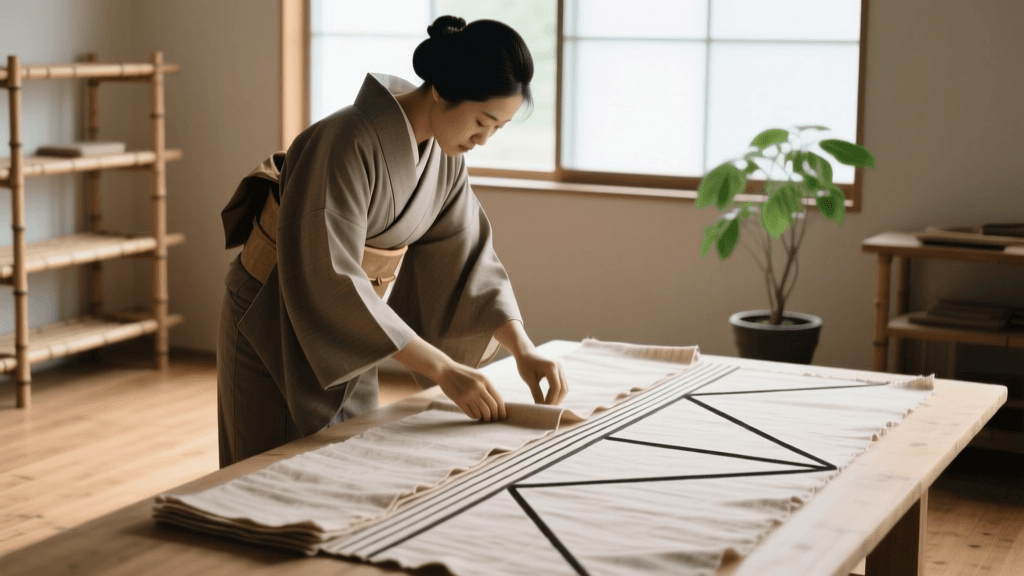
The secret to the kimono's zero-waste construction lies in the tanmono, the traditional Japanese fabric bolt. Historically, and still commonly today, a standard kimono bolt is woven to a specific width—typically between 36 and 40 centimeters (about 14 to 16 inches) and roughly 12 meters (13 yards) in length. This exact dimension is not arbitrary; it is precisely calculated to yield one adult-sized kimono with virtually zero fabric waste.
Unlike Western pattern cutting, where curved armholes and tapered waistlines result in 15% to 20% of the fabric being discarded as offcuts, Chokudachi utilizes 100% of the woven textile. The selvedges (the tightly woven edges of the fabric) are intentionally preserved and often incorporated into the seams, eliminating the need to finish raw edges and preventing fraying. According to the Metropolitan Museum of Art's Heilbrunn Timeline of Art History, this preservation of the selvedge also allows the garment to be completely disassembled, washed, and resewn, a testament to the longevity engineered into the garment from the very first thread.
Traditional Stitching and Seam Engineering
The construction techniques used to assemble these panels are as deliberate as the cutting method. Because the kimono is meant to be disassembled for cleaning—a traditional process known as arai-hari—the seams are sewn using specific, removable stitches.
- Waki-nui (Side Seams): The side seams joining the front and back Migoro panels are sewn using a standard running stitch. However, the bottom portion of the side seam is intentionally left open (the miyatsukuchi) to allow for ease of movement and to facilitate the folding of excess fabric at the waist.
- Sode-nui (Sleeve Seams): The sleeves are attached with a running stitch, but the underarm and outer sleeve edges feature deep, unsewn openings. These openings create the signature draped sleeve silhouette and allow air to circulate, providing natural climate control.
- Hon-guke (Blind Hemming): Hems and collars are attached using a specialized blind stitch that catches only a single thread of the face fabric, ensuring the stitching remains invisible on the exterior of the garment while allowing the hem to float slightly, giving the kimono its heavy, grounded drape.
Chokudachi in 2026: The Sustainable Fashion Renaissance
As we navigate the fashion landscape of 2026, the principles of Chokudachi are no longer just historical curiosities; they are vital blueprints for the future of sustainable apparel. With the full enforcement of the European Union's Strategy for Sustainable and Circular Textiles in 2026, brands are under immense regulatory pressure to eliminate pre-consumer textile waste and design for end-of-life disassembly.
Contemporary designers are actively adapting the straight-line cutting method for modern wardrobes. By utilizing wide-loom organic hemp and peace silk blends, 2026 collections are featuring modular, wrap-style outerwear and trousers that mimic the zero-waste geometry of the kimono and the traditional Korean po (robe). The Ellen MacArthur Foundation has repeatedly highlighted that designing out waste at the pattern-cutting stage is the most effective way to reduce a garment's carbon footprint, a principle that Asian dress traditions mastered centuries ago.
Step-by-Step: Drafting a Modern Straight-Line Haori
For sewists and designers looking to integrate Asian construction techniques into their 2026 workflow, drafting a modern haori (a traditional kimono-style jacket) is an excellent entry point. Here is a practical guide to drafting a zero-waste, straight-line jacket using modern 115cm (45-inch) wide linen.
1. Calculate Your Panel Widths
Because modern fabric is wider than traditional tanmono, you will cut your panels lengthwise from the fabric width. For a standard oversized jacket, cut two main body panels (Migoro) measuring 60cm wide by 120cm long. Cut two sleeve panels (Sode) measuring 50cm wide by 80cm long.
2. The Center Back and Side Seams
Join the two main body panels at the center back using a flat-felled seam for durability. Fold the joined body in half horizontally to mark the shoulder line. Attach the sleeve panels to the body at the shoulder line, ensuring the center of the sleeve aligns with the shoulder fold. Sew the side seams from the wrist, down the underarm, and down the side of the torso, stopping 25cm from the bottom hem to create the side vents.
3. Drafting the Front Overlap and Collar
Cut two front overlap panels (Okumi) measuring 20cm wide by 100cm long. Attach these to the front edges of the main body. Finally, cut a continuous collar strip (Eri) 15cm wide by 250cm long. Fold it in half lengthwise, attach it to the back neckline, and run it all the way down the front overlaps to the hem.
4. Hemming and Finishing
Instead of cutting away excess fabric to curve the hem, use the traditional hon-guke blind stitch to fold the bottom edge inward, creating a weighted hem that allows the linen to drape beautifully without flaring.
Sourcing Authentic Materials in 2026
For those seeking to practice traditional construction with authentic materials, sourcing tanmono has evolved. In 2026, heritage weaving cooperatives in Kyoto and Niigata have partnered with global digital marketplaces, allowing international artisans to purchase authentic silk, tsumugi (pongee), and ramie bolts directly. Expect to pay between $350 and $900 USD for a standard, undyed silk bolt, while modern, sustainably dyed organic cotton bolts tailored to traditional 38cm widths are available from specialized zero-waste textile mills for approximately $120 USD. Investing in these purpose-woven bolts ensures that the selvedges align perfectly, honoring the mathematical precision of the Chokudachi tradition.
By studying and applying the garment construction techniques inherent in Asian dress traditions, modern creators do more than preserve history. They actively participate in a vital, zero-waste paradigm that the 2026 fashion industry desperately needs. The kimono teaches us that true elegance lies not in forcing fabric to conform to the body through waste and cutting, but in allowing the geometry of the textile to gracefully embrace the wearer.