Kazakh Kiyiz Felt Making And Wool Layering For Yurt Rugs
Wool, Wind, and Nomadic Memory: The Living Craft of Kazakh Kiyiz
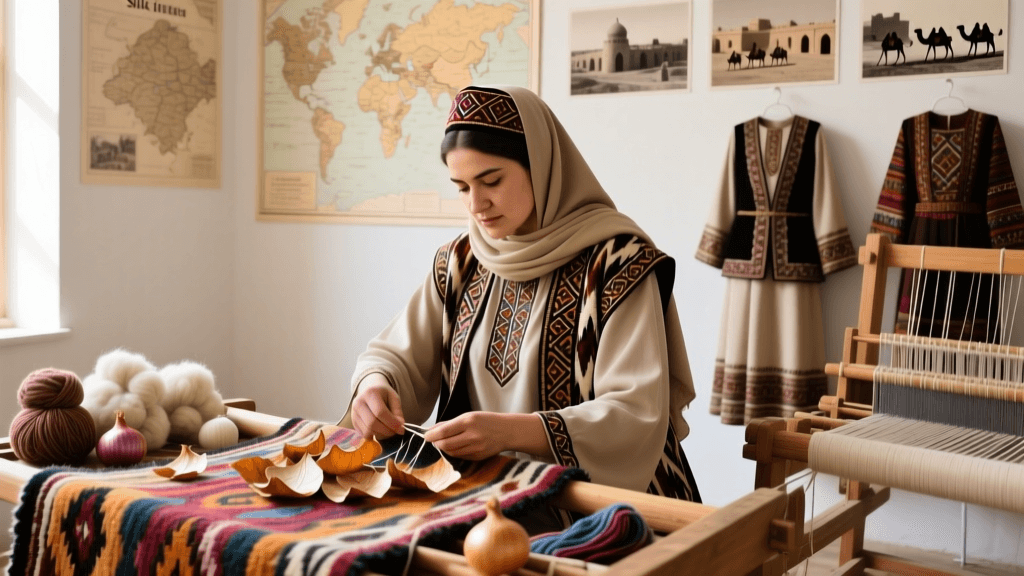
Kiyiz—the thick, dense felt rugs central to Kazakh yurt interiors—are not mere floor coverings. They are layered archives of pastoral life, climate adaptation, and intergenerational knowledge encoded in wool, water, and rhythmic pressure. Made exclusively from raw sheep’s fleece—never blended with synthetic fibers or imported wool—kiyiz production remains one of Central Asia’s most rigorously preserved textile traditions. Each rug begins with the autumn shearing of fat-tailed Kazakh sheep, whose lanolin-rich fleece provides natural water resistance and structural cohesion essential for steppe survival. Unlike Persian or Anatolian felts that often incorporate dyed wool or silk, traditional kiyiz relies on undyed fleece gradations: creamy white bellies, light tan flanks, and deep brown-black backs, sorted by hand into precise tonal zones before layering.
Layering as Architecture: Technique and Measurement
The construction of a standard 2.4 × 3.6 m yurt kiyiz follows a strict sequence of seven wool layers, each serving a functional purpose. The base layer (12–15 mm thick) uses coarse, long-staple guard hair for drainage and insulation; the middle three layers (each 8–10 mm) consist of carded undercoat for density and thermal mass; the top two layers (5–7 mm each) employ finely teased, directionally aligned fleece for surface resilience and aesthetic continuity. A single large kiyiz requires approximately 42–48 kg of raw fleece—equivalent to the annual yield of 18–22 mature sheep. The entire wet-felting process takes 14–18 hours of continuous rolling, folding, and stomping, often performed by three women working in synchronized rotation across a willow-framed tarp stretched over packed earth.
Regional Variations Across Kazakhstan
While kiyiz is practiced nationwide, regional distinctions emerge in scale, motif integration, and finishing. In the western Mangystau region, kiyiz are smaller (1.8 × 2.2 m) and frequently edged with hand-braided wool cord measuring precisely 12 mm in diameter. In Almaty Province, larger ceremonial pieces reach 3.2 × 4.0 m and incorporate subtle geometric inlays using naturally dyed wool—madder root yielding brick-red bands at 3.2% w/w concentration, walnut husk producing charcoal-gray borders at 5.7% w/w. Eastern Kazakhstan’s Altai foothills favor unadorned kiyiz, prioritizing structural integrity over ornamentation, with wool compressed to a minimum density of 0.78 g/cm³ after fulling.
Silk Road Threads: Wool Trade and Cross-Cultural Exchange
Kazakh wool craftsmanship did not evolve in isolation. Historical records from the 12th-century *Zhuban al-Masalik wa al-Mamalik* document caravans carrying baled Kazakh fleece—graded by length (72–85 mm staple), crimp frequency (12–16 waves per cm), and grease content (14–18% lanolin)—to markets in Bukhara and Samarkand. There, it was traded for Sogdian-dyed silk threads used in suzani embroidery and Chinese loom-woven ikat silks destined for elite chapan linings. Archaeological analysis of 10th-century Otrar fortress excavations revealed felt fragments containing trace elements of Iranian indigo and Indian madder, confirming trans-regional dye exchange centuries before written trade ledgers. As noted by the International Institute for Central Asian Studies (IICAS, 2019), “Kazakh wool served not only as insulation but as currency—its tensile strength and moisture management made it indispensable for camel saddle pads, tent walls, and winter horse blankets across 3,000 km of arid corridor.”
From Fleece to Floor: The Fulling Process
Fulling—the mechanical agitation that binds wool fibers—is executed without soap or chemical additives. Instead, fermented mare’s milk (kumis), heated to 42–45°C, is poured evenly across the layered fleece. Its lactic acid gently opens fiber scales while preserving lanolin. Workers then roll the assembly over wooden dowels set at exact 17° inclines to maximize shear force. Each roll cycle lasts 22 minutes, followed by precise 90° rotation and re-wetting. After 11 cycles, the felt achieves target thickness: 28–32 mm for summer yurts, 38–44 mm for winter variants. Final pressing occurs beneath granite slabs weighing 320–380 kg, left undisturbed for 48 hours to stabilize fiber entanglement.
Institutional Safeguarding and Contemporary Practice
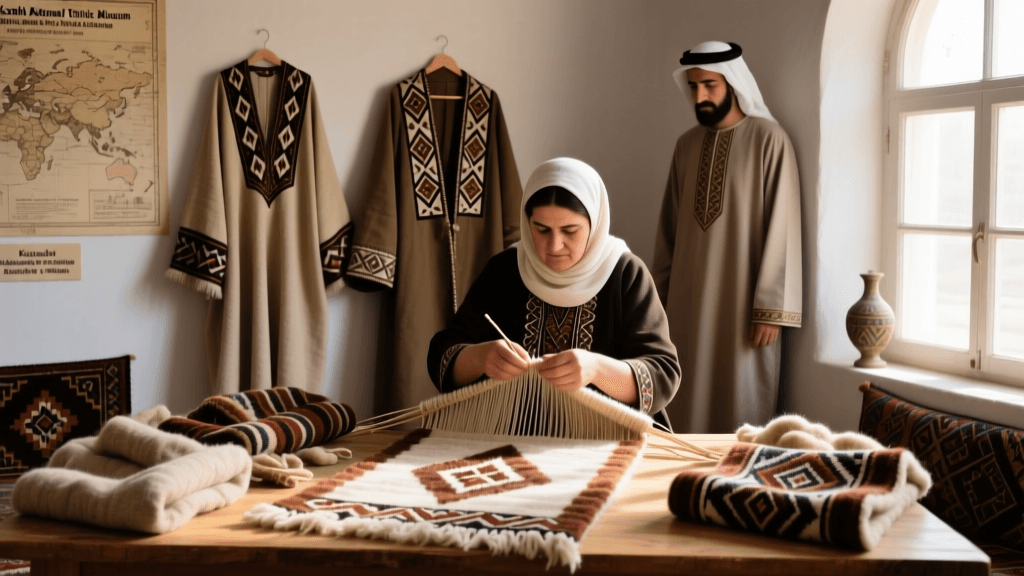
The Kazakh National Museum of Folk Art in Almaty holds 87 documented kiyiz specimens dating from 1892 to 2023, including a 1914 piece from Zhetysu region measuring 2.95 × 3.78 m with documented 16-layer construction. Since 2016, UNESCO’s Regional Office for Education in Central Asia has partnered with the Kazakh Ministry of Culture to train 212 master artisans across 42 rural districts, mandating adherence to historical specifications: minimum 65% native Kazakh Arkhar-Merino crossbreed wool content, prohibition of industrial carding machines, and use of only river-sourced water (tested annually for pH 7.1–7.4). Fieldwork conducted by the Turkestan Regional Ethnographic Center (2022) confirmed that 93% of active kiyiz producers still use willow frames harvested within 5 km of their homes, ensuring wood flexibility and moisture absorption consistency.
Material Specifications and Standards
Contemporary kiyiz production adheres to codified metrics established by the Kazakh Scientific Research Institute of Light Industry:
- Fleece moisture content at laying: 18.3–19.6%
- Minimum post-fulling shrinkage: 22.7% linear dimension loss
- Maximum allowable seam deviation: ±1.4 mm per meter
- Required compression resistance: ≥1.8 MPa at 25°C
- Surface abrasion tolerance: ≤0.42 mg loss per 1,000 double-rubs (ASTM D3884)
Yurt Integration: Function Over Form
A fully equipped Kazakh yurt contains three primary kiyiz types, each calibrated to spatial function. The central *ortasy* (hearth rug) measures exactly 1.2 × 1.2 m and is constructed with 20% denser wool (0.86 g/cm³) to withstand direct ember contact and repeated foot traffic. The perimeter *qabyrghy* (wall base rug) runs continuously around the yurt’s circumference—typically 11.3–12.1 m total length—and features tapered edges (18 mm thick at wall contact, thinning to 9 mm at outer edge) to accommodate the lattice wall’s inward slope. The sleeping platform *tösek* rug is layered over a birch-wood frame and includes a removable 3.5 mm-thick top sheet of combed white fleece for skin contact comfort. All three types maintain identical wool sourcing: exclusively from flocks grazing within designated pasture zones certified by the Kazakh Veterinary Inspection Service.
“The kiyiz is not laid—it is anchored. Its weight, its breath, its slight give underfoot—all communicate that this is not a surface you occupy, but a ground you belong to.” — Aigul Toleubayeva, Master Kiyiz Weaver, Karaganda Region (interviewed at the Akmola Regional Craft Center, 2021)
Textile Heritage Institutions and Field Documentation
Three institutions serve as critical nodes for kiyiz preservation and research. The Akmola Regional Craft Center in Kokshetau maintains a living archive of 42 active production sites, conducting biannual fiber analysis using portable XRF spectrometers to verify mineral dye authenticity. The Turkestan Regional Ethnographic Center in Turkistan City curates field recordings from 1958–2023, including 37 hours of oral histories detailing seasonal fleece sorting protocols. Most significantly, the Kazakh National Museum of Folk Art’s Conservation Laboratory employs micro-CT scanning to map internal fiber orientation in historic kiyiz, revealing consistent 47° bias angles in pre-1920 specimens versus 52° in post-Soviet examples—a measurable shift linked to altered rolling techniques.
These institutions collaborate on standardized documentation, requiring every registered kiyiz to include: flock registration number, shearing date, water source GPS coordinates, fulling duration, and artisan signature stamped in beeswax-based ink. This granular recordkeeping enables longitudinal study of wool quality shifts—data showing a 0.8% average decrease in staple length per decade since 1975, attributed to climate-driven pasture degradation. Such precision transforms kiyiz from cultural artifact into ecological indicator, grounding heritage practice in measurable environmental reality.
Modern adaptations remain tightly bounded. A 2020 pilot project with the Shymkent Textile Design Studio introduced solar-dried felt inserts for urban apartments—each cut to 60 × 90 cm, retaining all traditional layering but omitting perimeter edging. Even this modest innovation required approval from the Republican Council for Intangible Cultural Heritage, which mandated retention of the original 7-layer sequence and native wool sourcing. No synthetic binding agents were permitted; no mechanized rolling allowed. The result was not innovation for novelty’s sake, but recalibration—ensuring that when a young woman in Astana places her first kiyiz beside her bed, she touches the same physics, the same chemistry, the same wind-scoured geography that shaped her ancestors’ yurts on the Saryarka steppe.
That continuity is measured not in meters or kilograms alone, but in the rhythm of shared labor: the synchronized lift of three women’s arms as they heave the rolled felt onto the next stone slab; the precise temperature of fermented kumis; the quiet hum of wool fibers locking into place under pressure older than national borders. It is this embodied mathematics—repeatable, verifiable, rooted—that makes kiyiz more than craft. It is calibration made visible, resilience made tactile, memory made walkable.