Zero-Waste Kimono Construction: Tanmono Techniques in 2026
The Foundation of Form: Understanding the Tanmono
In the landscape of 2026 sustainable fashion, the global apparel industry is increasingly looking backward to move forward. As modern designers grapple with the environmental toll of textile waste, the traditional Japanese kimono stands as a masterclass in geometric efficiency and zero-waste garment construction. At the heart of this sartorial marvel is the tanmono, a standardized bolt of fabric that dictates not just the dimensions of the garment, but its entire structural philosophy. Unlike Western pattern-making, which carves curved shapes out of wide yardage and discards the remnants, the kimono is born from a strict, unyielding geometric constraint that results in virtually zero textile waste.
According to the Victoria and Albert Museum, the kimono's T-shape and linear construction are direct descendants of the loom's limitations and the profound Japanese reverence for materials. In 2026, as zero-waste pattern drafting becomes a critical curriculum in top fashion institutes worldwide, the tanmono system offers a perfect, centuries-old blueprint for circular fashion.
The Anatomy of Tanmono: Standardized Dimensions
To understand kimono construction, one must first understand the canvas. A standard tanmono bolt intended for a women's kimono measures approximately 36 centimeters (14 inches) in width and 12 meters (43 feet) in length. For men's kimonos, the width is slightly broader, typically around 42 centimeters. This narrow width is a historical artifact of traditional backstrap and floor looms, but it evolved into a deliberate design parameter.
When a artisan purchases a tanmono in 2026—whether it is a vintage silk chirimen (crepe) sourced from a Kyoto dealer or a modern organic hemp blend from a contemporary mill—they are buying exactly the amount of fabric needed for one complete garment. The entire 12-meter length is utilized. There are no offcuts, no discarded curved armholes, and no wasted selvedges. The selvedge edges, in fact, are intentionally preserved and utilized within the seams to prevent fraying and add structural integrity.
Straight-Line Cutting: The Geometry of the Kimono
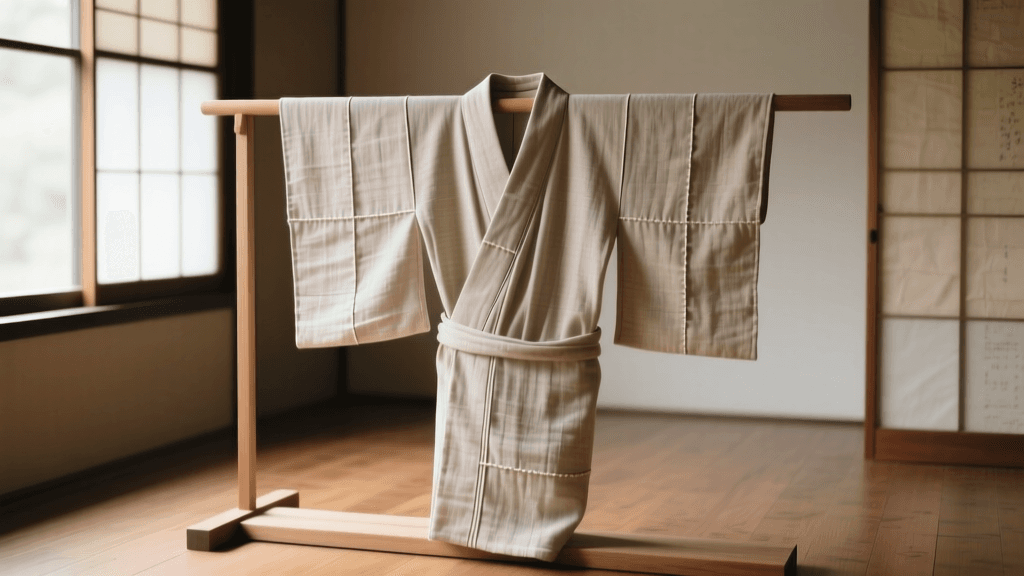
Western tailoring relies on complex, curved seams to mold flat fabric to the three-dimensional contours of the human body. Darts, princess seams, and curved armholes are standard. The kimono, conversely, embraces a two-dimensional, straight-line geometry. The fabric is cut into eight primary rectangular panels:
- Migoro (Main Body): Two long panels that form the front and back of the torso.
- Okumi (Front Overlap): Two narrower panels added to the front edges to create the overlapping closure.
- Sode (Sleeves): Two rectangular panels that are folded in half and attached to the body.
- Eri (Collar): A long, narrow strip folded and attached to the neckline.
Because the panels are cut strictly along the straight grain of the fabric, the structural integrity of the silk or hemp is maintained. The Metropolitan Museum of Art notes that this linear approach not only conserves fabric but also allows the textile's woven patterns and dyed motifs to flow uninterrupted across the garment's surface, treating the kimono as a wearable canvas.
The Art of the Seam: Wakinui and Kise
The construction of a kimono relies heavily on specific, hand-sewn techniques that prioritize future deconstruction and fabric preservation. The primary side seams, known as wakinui, and the sleeve attachment seams, sode-tsuke, are sewn using a running stitch. However, the true genius lies in the kise.
The kise is a technique where the seam allowance is not pressed flat or trimmed. Instead, a small fold of fabric is rolled over the seam line, hiding the raw edge and the stitching thread from the outside. This creates a soft, slightly padded seam that protects the delicate silk from friction and wear. In 2026, modern sustainable brands are adapting the kise technique to eliminate the need for synthetic serging and overlocking, which introduce microplastics into the laundry cycle and complicate end-of-life recycling.
The Zero-Waste Paradigm: Kimono vs. Western Tailoring
To contextualize the brilliance of the tanmono system, we must compare it to contemporary Western manufacturing standards. Even with advanced 2026 AI-driven nesting software used to optimize pattern placement, Western cut-and-sew factories still generate significant waste.
| Feature | Traditional Kimono (Tanmono) | Standard Western Tailored Dress |
|---|---|---|
| Fabric Cut | Straight rectangles, parallel to grain | Curved, contoured, multi-directional |
| Textile Waste | 0% (Entire bolt is utilized) | 15% - 30% (Offcuts discarded or downcycled) |
| Seam Allowance | Generous, folded inside via kise | Trimmed, serged, or bound |
| Structural Shaping | Achieved through folding, wrapping, and obi | Achieved through darts, pleats, and curved seams |
| End-of-Life | Unstitched, washed, and reused entirely | Difficult to recycle, often landfilled |
Arai-Hari: The Original Circular Fashion Model
The ultimate triumph of the kimono's straight-line construction is its built-in circularity. Because the garment is composed entirely of un-cut, rectangular panels sewn with a single running stitch, it can be completely deconstructed at the end of its life cycle. This process, known as arai-hari (wash and stretch), involves carefully unpicking every seam.
Once reduced to its original flat panels, the fabric is washed, stretched on bamboo frames to remove wrinkles and restore the grain, and then dried. The Heilbrunn Timeline of Art History highlights how this meticulous conservation allowed historical garments to be passed down through generations, re-dyed, or resewn into new configurations. In 2026, as the EU and other global regulatory bodies enforce strict 'right to repair' and circularity mandates for textiles, the arai-hari philosophy provides a proven, scalable model for garment longevity.
Modern Adaptations: 2026 Designers Embracing Tanmono
In 2026, the constraint of the 36-centimeter width is no longer seen as a limitation, but as a creative catalyst. Avant-garde designers and sustainable fashion houses are adopting the tanmono methodology to create modular, zero-waste streetwear and high fashion. By utilizing narrow-loom weaving and straight-line drafting, designers are eliminating the 15-20% cutting waste typical in modern apparel production.
Furthermore, the unsewn openings of the kimono—such as the miyatsukuchi (the open underarm vents for women) and the detached lower portion of the furisode (swinging sleeve)—are being reinterpreted in modern outerwear to provide dynamic drape, ventilation, and ease of movement without the need for complex gussets or elasticized synthetics.
Sourcing and Sewing Your Own Tanmono-Style Garment in 2026
For home sewists and independent designers looking to adopt these techniques in 2026, the barrier to entry is remarkably low. Here is an actionable guide to beginning your zero-waste journey:
- Sourcing the Bolt: Vintage silk tanmono can be sourced from online Japanese dealers like Ichiroya or Yamato for between $120 and $350 USD. For everyday practice, seek out narrow-width (36cm) organic cotton or hemp from specialized sustainable mills.
- Measuring: Unlike Western sizing, kimono length is determined by the wearer's height. The main body panel (migoro) should be cut to your height plus 20 centimeters for the hem fold-over (ohashori).
- Thread Selection: Never use polyester thread on silk. In 2026, high-quality mercerized cotton or pure silk thread is essential. The thread must be weaker than the fabric; if the garment experiences stress, the thread should break, not the precious silk.
- The Stitch: Use a standard running stitch if sewing by hand (traditional), or a straight stitch set to 2.5mm on a modern machine. Do not backstitch at the ends; instead, leave long tails and tie them off manually to allow for future deconstruction.
- Finishing: Practice the kise fold. Iron the seam allowance to one side, then fold the top layer back over the seam line by 2 millimeters before slip-stitching it down. This hides the tension and protects the outer fabric.
Conclusion
The traditional Japanese kimono is far more than a symbol of cultural heritage; it is a triumph of sustainable engineering. The tanmono bolt and its accompanying straight-line construction techniques prove that severe geometric constraints do not stifle creativity—they breed elegance, longevity, and environmental responsibility. As the fashion industry in 2026 continues its urgent pivot toward zero-waste and circular models, the ancient wisdom of the kimono's construction remains one of the most vital, actionable blueprints available to modern makers and designers alike.