Traditional Japanese Kimono Styling and Care in 2026
The Renaissance of Traditional Japanese Fashion in 2026
In 2026, the global slow-fashion movement has heavily embraced traditional Japanese clothing, transforming garments once reserved strictly for ceremonies into everyday statements of sustainable elegance. The comprehensive guide to Japanese fashion styles today is not merely about wearing a historical costume; it is about understanding the intricate architecture of kitsuke (the art of dressing), the heritage of regional weaving techniques, and the modern preservation of textiles. Whether you are navigating the streets of Kyoto, attending a formal tea ceremony, or integrating a vintage haori jacket into a contemporary wardrobe, understanding the foundational rules of Japanese garment styling is essential.
This guide explores the core elements of traditional Japanese fashion, providing actionable advice on layering, obi tying, footwear selection, and the sustainable care of these exquisite garments in the modern era.
Core Garments: Kimono, Yukata, and Hakama
To master Japanese fashion styles, one must first distinguish between the primary garments that form the foundation of the wardrobe. While they may appear similar to the untrained eye, their construction, fabrics, and appropriate contexts vary drastically.
The Kimono
The kimono is the quintessential T-shaped, straight-lined robe. In 2026, authentic silk kimono remain the standard for formal events, weddings, and tea ceremonies. The formality of a kimono is dictated by its fabric, pattern placement, and the number of family crests (kamon). For example, a kurotomesode (black kimono with patterns only below the waist and five crests) is the most formal attire for married women, while a furisode (featuring long, swinging sleeves) is worn by unmarried women.
The Yukata
Originally a bathrobe for the aristocracy, the yukata is now a lightweight, unlined cotton or hemp garment worn during summer festivals (matsuri) and fireworks displays. It is highly accessible, requires fewer undergarments, and is the recommended starting point for beginners exploring Japanese fashion styles.
The Hakama
Hakama are pleated, wide-leg trousers or skirt-like garments worn over a kimono. Historically worn by samurai and court nobles, today they are standard attire for university graduation ceremonies, martial arts practitioners, and Shinto priests. The seven pleats of the hakama are said to represent the seven virtues of the samurai, blending philosophical depth with striking sartorial structure.
The Architecture of Kitsuke: Layering Essentials
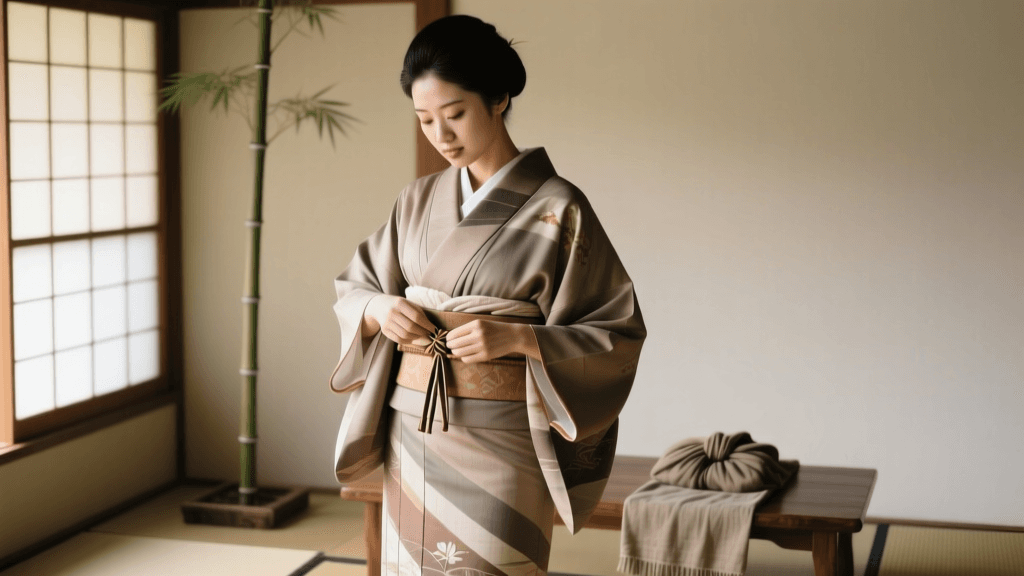
Unlike Western fashion, which often relies on tailoring and darts to fit the body, the kimono is a flat, rectangular garment. The silhouette is created entirely through the art of layering and padding. Proper kitsuke ensures the garment hangs elegantly and remains secure throughout the day.
- Hadajuban: The innermost layer, functioning as an undershirt and shorts or skirt. It protects the outer silk layers from sweat and body oils.
- Nagajuban: A full-length under-kimono, usually made of cotton, linen, or synthetic silk. Only the collar (han-eri) and the sleeves of the nagajuban are visible beneath the main kimono, adding a subtle layer of contrasting color and texture.
- Susuyoke: A half-slip worn around the waist to prevent the kimono from clinging to the legs and to allow for a smoother stride.
- Datejime and Koshihimo: These are the structural ties. Koshihimo are thin cotton cords used to secure the kimono at the hips and waist. Datejime are wider, stiffer sashes tied over the cords to flatten the torso and provide a smooth canvas for the obi.
- Kimono Belt (Obi-ita): A stiff board inserted into the front of the obi to prevent wrinkling and maintain a crisp, flat appearance.
Actionable Measurement Tip: When purchasing a kimono in 2026, the ideal body length (mitake) should be roughly your total height minus 10 centimeters. This allows for the ohashori—the folded tuck at the waist—which is mandatory for women's styling to adjust the hemline to the ankle.
Obi Tying Styles: A 2026 Comparison
The obi is the wide sash that secures the kimono. Far from a simple belt, the obi is often the most expensive and visually striking component of the ensemble. The knot tied at the back is called a musubi. The choice of musubi communicates the wearer's age, marital status, and the formality of the occasion.
| Obi Knot (Musubi) | Formality Level | Best Suited For | Difficulty |
|---|---|---|---|
| Otaiko Musubi | High / Formal | Married women, formal visits, tea ceremonies | Advanced |
| Bunko Musubi | Casual / Semi-Formal | Yukata, young women, summer festivals | Beginner |
| Fukura-suzume | High / Formal | Unmarried women, coming-of-age ceremonies | Expert |
| Kai-no-kuchi | Casual | Men's yukata and informal kimono | Beginner |
In 2026, pre-tied obi (tsuke-obi) have become incredibly sophisticated, utilizing hidden clips and magnetic closures that are virtually indistinguishable from hand-tied knots. These are highly recommended for international enthusiasts and travelers who wish to wear formal attire without the assistance of a professional dresser.
Heritage Weaving and Sustainable Preservation
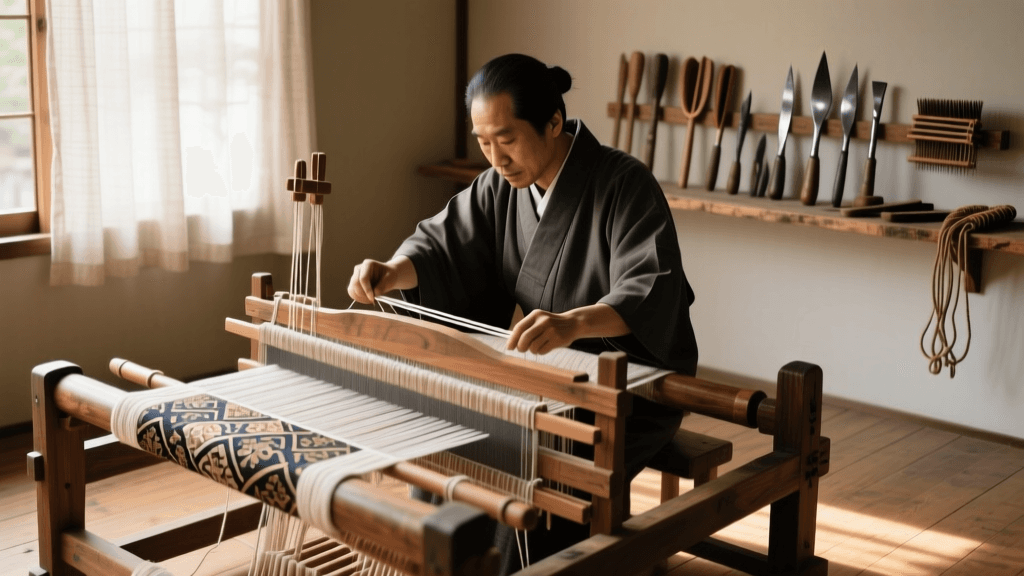
The allure of traditional Japanese clothing lies heavily in its textiles. The Ministry of Economy, Trade and Industry (METI) officially recognizes over 230 traditional crafts, many of which are textile-based. Two techniques dominating the sustainable fashion conversation in 2026 are Nishijin-ori and Boro/Sashiko.
Nishijin-ori (Kyoto Brocade)
Originating in the Nishijin district of Kyoto, this weaving technique uses pre-dyed threads to create incredibly intricate, tapestry-like patterns. A brand-new, hand-woven Nishijin-ori obi is a luxury investment, typically ranging from ¥300,000 to over ¥1,000,000 in 2026. These pieces are treated as heirloom art, often passed down through generations.
Boro and Sashiko: The Art of Mending
As the global fashion industry pivots toward circularity, the historical Japanese practices of Boro (tattered, heavily patched textiles) and Sashiko (decorative reinforcement stitching) have seen a massive resurgence. Originally born out of necessity in rural farming communities where cotton and hemp were precious, today, Sashiko is used to upcycle and repair vintage kimono. Enthusiasts in 2026 frequently purchase damaged silk kimono and use contrasting white or indigo Sashiko thread to highlight the repairs, turning flaws into striking, bespoke geometric features.
Footwear: Tabi and Zori for Modern Streets
No traditional Japanese outfit is complete without the proper footwear. The distinct split-toe design is both functional and deeply rooted in Japanese sartorial history.
- Tabi: Split-toe socks that separate the big toe from the rest of the foot. For formal kimono, white cotton tabi are mandatory. For yukata and casual wear, patterned or colored tabi are acceptable. When sizing tabi in 2026, always buy your exact foot length in centimeters; they should fit like a second skin with no bunching at the heel.
- Zori: Flat, thonged sandals made of woven straw, leather, or vinyl. Formal zori feature thick, brocade-covered soles that elevate the wearer, preventing the kimono hem from dragging on the ground.
- Geta: Wooden sandals with elevated teeth (ha). These are strictly paired with yukata or casual wear and are famous for their distinctive clicking sound on pavement.
Sourcing, Pricing, and Garment Care in 2026
Acquiring traditional Japanese clothing has never been more accessible, thanks to a robust network of vintage recycle shops and specialized online platforms. According to the Victoria and Albert Museum, the global appreciation for kimono has spurred a thriving secondary market that keeps historical garments in circulation rather than languishing in storage.
Where to Buy
In Tokyo, neighborhoods like Shimokitazawa and Harajuku host massive vintage kimono warehouses, such as the famous Chicago chain. Here, a vintage silk kimono averages ¥8,000 to ¥15,000, while a high-quality vintage silk obi can be found for ¥5,000 to ¥10,000. For brand-new, custom-tailored garments, specialized boutiques in Kyoto and Tokyo's Ginza district remain the gold standard, though prices for a full, new silk ensemble will easily exceed ¥500,000.
Preservation and Storage
The Metropolitan Museum of Art notes that the preservation of silk textiles requires strict environmental controls. To care for your kimono in 2026, follow these essential steps:
- Airing Out (Kage-boshi): After wearing, never put a kimono directly into storage. Hang it on a wide bamboo hanger in a shaded, well-ventilated room for 24 to 48 hours to allow moisture and odors to dissipate.
- Folding: Kimono must be folded along their specific seam lines (tatami folding) to prevent permanent creases in the silk.
- Wrapping: Wrap the folded garment in acid-free tatou-shi paper. Never use plastic bags, as trapped humidity will cause mold and yellowing.
- Cleaning: Traditional silk kimono cannot be washed with water. They require arai-hari, a specialized Japanese dry-cleaning process where the garment is completely taken apart, washed, stretched, and resewn. In 2026, this service costs roughly ¥15,000 to ¥25,000 per garment.
Conclusion
Navigating the world of traditional Japanese fashion is a rewarding journey into a culture that values meticulous craftsmanship, seasonal awareness, and deep respect for materials. Whether you are tying a casual bunko musubi on a cotton yukata or investing in a heritage Nishijin-ori piece, understanding the rules of kitsuke and garment care ensures these stunning styles continue to thrive in 2026 and beyond. By embracing both the strict traditions of the past and the sustainable innovations of the present, you can wear Japanese fashion with confidence, respect, and timeless elegance.