Japanese Traditional Looms & Kasuri Hand-Weaving Guide 2026
The Renaissance of Japanese Hand-Weaving in 2026
The rhythmic, percussive clack of a wooden batten striking the warp threads is a sound that has echoed through Japanese weaving workshops for centuries. As we navigate the global slow fashion and heritage textile renaissance of 2026, Japanese traditional looms and hand-weaving methods have experienced an unprecedented surge in international interest. Collectors, textile artists, and sustainable fashion designers are increasingly turning away from mass-produced fabrics, seeking the profound depth, mathematical precision, and spiritual resonance inherent in Japanese hand-woven textiles. According to the Japan Traditional Crafts Association, government-backed apprenticeship grants introduced in early 2026 have successfully lowered the average age of active master weavers, ensuring that ancient techniques like Kasuri and Tsuzure-ori are not merely preserved in museums, but actively practiced and evolved.
The Anatomy of the Jibata: Japan's Indigenous Floor Loom
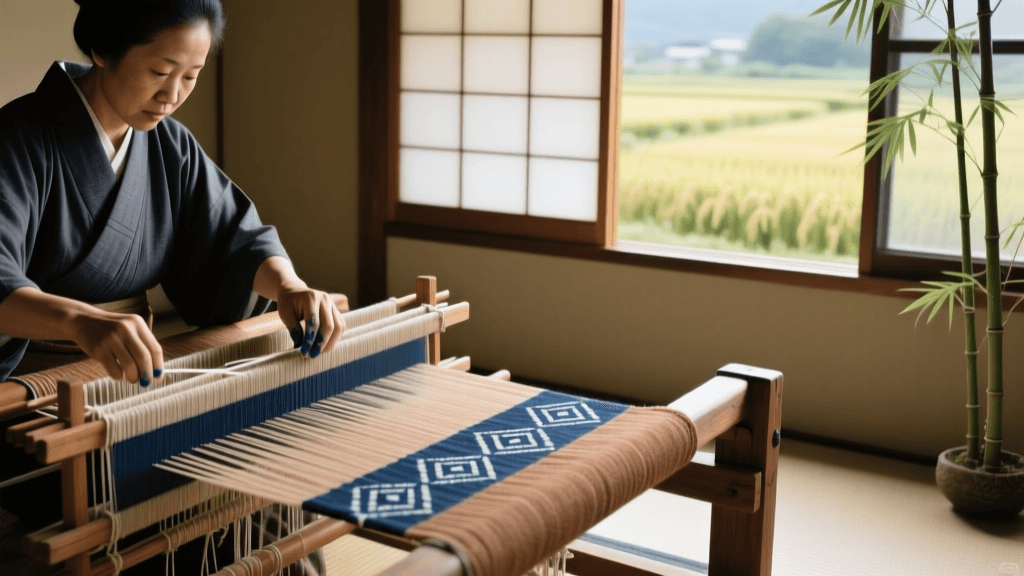
To understand Japanese hand-weaving, one must first understand the Jibata (floor loom). Unlike the heavy, counterbalance European looms that rely on complex overhead pulley systems, the traditional Japanese Jibata is a masterpiece of minimalist engineering and ergonomic harmony. The weaver sits on a low wooden board, utilizing their own body weight and core strength to maintain the tension of the warp threads. This intimate physical connection between the artisan and the textile is a hallmark of Japanese monozukuri (the art of making things).
Core Components of the Jibata
- Warp Beam (Chikiri): Positioned at the back of the loom, this heavy wooden cylinder holds the un-woven warp threads. Tension is adjusted via a ratchet and pawl system, often controlled by the weaver's feet or a side lever.
- Heddle Rods (Soko): Made from bamboo or finely polished wood, these rods separate the warp threads to create the 'shed' (the space through which the shuttle passes). Traditional Kasuri weaving often requires multiple heddle rods to manage complex pattern repeats.
- Reed (Osa): A comb-like structure made of bamboo splints bound with thread. The reed beats the weft thread firmly into place, determining the final density and width of the fabric.
- Cloth Beam (Maki): Located at the front of the loom, just past the weaver's seating position, this beam rolls up the finished textile.
In 2026, sourcing an authentic, fully restored Meiji-era Jibata loom requires a significant investment. Restorations utilizing traditional Japanese cypress (Hinoki) and hand-forged iron fittings typically range from $8,500 to $14,000 USD, reflecting both the scarcity of antique frames and the specialized carpentry required for structural reinforcement.
Mastering Kasuri: The Mathematics of Japanese Ikat
Kasuri is the Japanese iteration of the Ikat technique, a resist-dyeing and weaving method that demands a level of precision bordering on the obsessive. The Metropolitan Museum of Art notes that Japanese Kasuri is distinguished by its geometric clarity and the use of indigo, a dye that requires immense skill to manage. Unlike surface printing, the pattern in Kasuri is embedded within the very structure of the yarn.
The Four Pillars of Kasuri Production
1. Kukuri (Tying): The artisan calculates the exact mathematical repeat of the desired pattern. Bundles of cotton or silk warp and weft threads are tightly bound with cotton string or vinyl tape at precise intervals. These bound sections will resist the dye, remaining the natural color of the fiber.
2. Someshi (Dyeing): The bound threads are submerged in vats of natural fermented indigo (sukumo). Achieving the deep, rich blues characteristic of Kurume or Okinawan Kasuri requires dozens of dips, oxidations, and re-dips. In 2026, with natural indigo farming facing climate challenges, authentic Tokushima indigo commands a premium, often exceeding $300 per kilogram for the highest grade 'flower' indigo.
3. Seishi (Sizing and Alignment): Once dyed and dried, the resist bindings are removed. The threads are treated with a natural starch sizing (often made from rice or seaweed) to reduce friction and prevent breakage during the intense tension of weaving. The dyed and undyed segments are then meticulously aligned on the warp beam.
4. Orishi (Weaving): This is where the magic—and the frustration—occurs. As the weaver passes the shuttle and beats the weft with the reed, they must constantly micro-adjust the weft threads using a small bamboo pick. The goal is to align the dyed weft segments perfectly with the dyed warp segments. A deviation of even half a millimeter will result in a blurred, 'kasuri' (fuzzy) pattern. While some fuzziness is appreciated as the 'breath' of the fabric, master weavers in 2026 are achieving sub-millimeter accuracy that rivals digital printing.
Comparison of Traditional Japanese Looms (2026 Market Data)
While the Jibata is the most recognized, Japanese textile history features several specialized looms, each engineered for specific regional fabrics and weaving postures. Below is a comparative analysis of traditional looms available on the 2026 heritage market.
| Loom Type | Primary Mechanism & Posture | Traditional Use Case | 2026 Avg. Restoration Cost (USD) |
|---|---|---|---|
| Jibata (Floor Loom) | Body-tensioned; weaver sits on a low board, using foot treadles for shed. | Kasuri cotton, everyday kimono fabrics, hemp. | $8,500 - $14,000 |
| Takabata (High Loom) | Fixed frame with suspended treadles; weaver sits on a bench. | Complex silk weaves, Nishijin brocades, intricate multi-shaft patterns. | $18,000 - $25,000 |
| Izari-bata (Seat Loom) | Weaver sits inside the frame, legs extended, using a backstrap for tension. | Narrow sashes, Obijime cords, rural hemp textiles. | $3,000 - $5,500 |
| Te-bata (Hand Loom) | Small, portable frame operated entirely by hand without treadles. | Silk ribbons, decorative trims, Kumihimo integration. | $1,200 - $2,800 |
Tsuzure-ori: The Fingernail Tapestry Technique
While Kasuri relies on dyed threads, Tsuzure-ori (tapestry weave) relies on the structural manipulation of the weft to create pictorial or geometric designs. Originating in China but perfected in Japan over the last millennium, Tsuzure-ori is most famously used to create the stiff, opulent Obi sashes worn with formal Kimono.
The defining characteristic of Japanese Tsuzure-ori is the use of the artisan's fingernails. Weavers file their fingernails to a jagged, comb-like edge. Instead of using a wooden reed to beat the weft into place, the weaver uses their modified fingernails to pack the thick, multicolored silk weft threads so tightly that the warp threads are completely hidden from view. This 'weft-faced' structure allows for incredible detail, enabling weavers to render gradients, shadows, and complex scenes of nature. In 2026, a single hand-woven Tsuzure-ori Maru Obi can take up to 18 months to complete, with market prices starting at $22,000 USD for authentic, certified artisan pieces.
Sourcing Authentic Materials and Looms in 2026
For international textile artists and collectors looking to engage with Japanese weaving in 2026, navigating the supply chain requires cultural literacy and direct relationships with regional cooperatives. The days of easily finding antique Japanese looms in general auction houses are largely over; the most pristine examples are now retained within Japan or sold through specialized Kyoto-based antiquarians.
Essential Sourcing Hubs
- Kurume, Fukuoka Prefecture: The undisputed capital of cotton Kasuri. The Kurume Kasuri cooperative offers direct purchases of indigo-dyed cotton skeins, which are prized for their soft hand-feel and colorfastness.
- Nishijin, Kyoto: The epicenter of silk weaving. While large-scale Jacquard looms dominate the commercial sector, small family workshops still operate traditional Takabata looms for bespoke silk kimono fabrics. Sourcing raw silk thread here requires connecting with the local silk guild.
- Oshima Amami, Kagoshima: Famous for Oshima Tsumugi, a mud-dyed silk pongee. The iron-rich mud reacts with the tannins in the native Techigashi plant to create a profound, deep black silk that is virtually wrinkle-resistant. In 2026, authentic Oshima Tsumugi thread remains one of the most expensive and highly regulated textile materials in Japan.
Preservation and the Future of the Craft
The survival of Japanese traditional looms and hand-weaving methods is not guaranteed by nostalgia alone; it requires economic viability. The Victoria and Albert Museum has extensively documented how the cultural context of the kimono has shifted, forcing weavers to adapt. In 2026, the most successful weaving studios are those that have bridged the gap between traditional garments and contemporary interior design, creating Kasuri upholstery fabrics and Tsuzure-ori wall hangings that appeal to a global, design-conscious demographic.
Furthermore, the integration of digital tools in the design phase has revolutionized the Kukuri (tying) process. While the dyeing and weaving remain fiercely analog and hand-executed, modern weavers now use specialized CAD software to map out complex Kasuri tie-patterns, reducing the mathematical errors that historically resulted in wasted months of labor. This synthesis of ancient hand-skills and modern precision ensures that the Japanese loom will continue to sing its rhythmic song for generations to come.
Setting Up Your Own Japanese Weaving Station
For those inspired to begin their own journey into Japanese hand-weaving, setting up a dedicated space requires attention to environmental factors. Natural fibers like silk and indigo-dyed cotton are highly sensitive to humidity. In 2026, it is recommended to maintain a weaving studio at a consistent 45-55% relative humidity to prevent warp threads from snapping under tension. Essential starter tools include a traditional bamboo shuttle (hi), a wooden batten (osa), and a high-quality thread counter. By respecting the materials and the meticulous pace of the craft, modern weavers can participate in a living tradition that values patience, precision, and the profound beauty of the handmade.