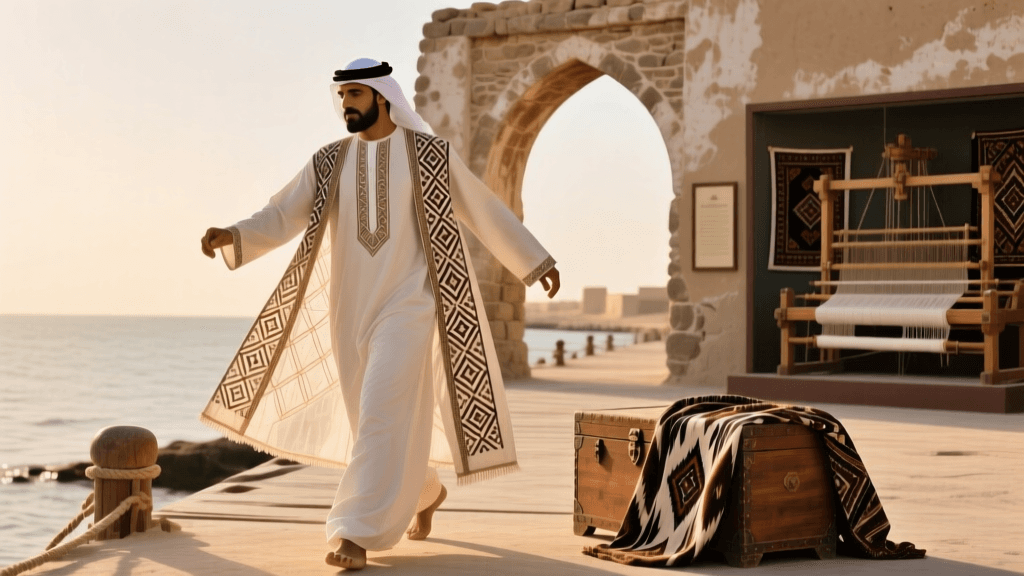
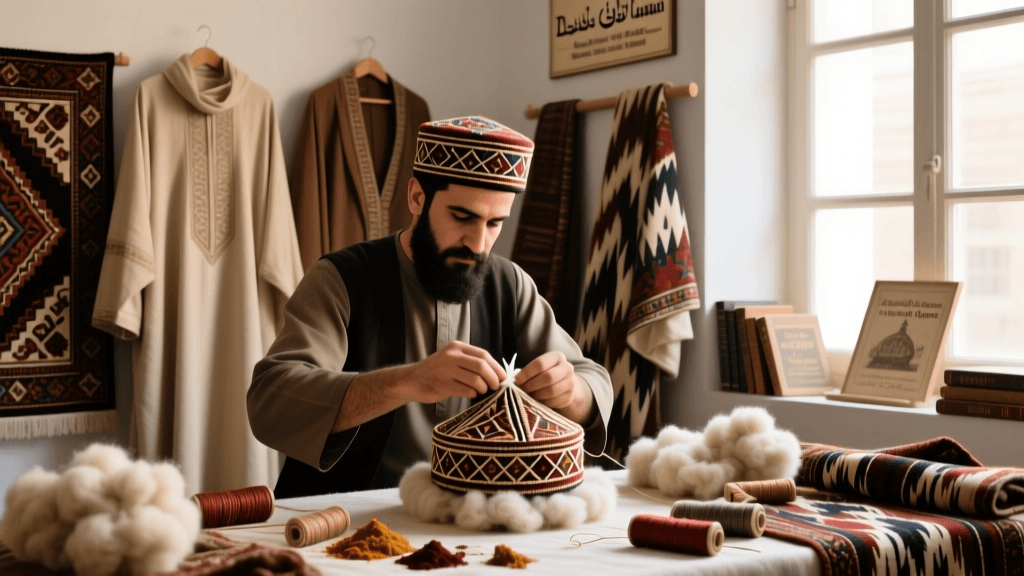
Iraqi Mashhad Velvet Weaving And Gold Thread Loom Setup
Origins and Geographic Anchoring of Iraqi Mashhad Velvet
The term “Iraqi Mashhad velvet” is a historical misnomer that reflects centuries of Silk Road cartographic confusion—not a claim of origin. Mashhad, the Iranian city famed for its shrine and textile legacy, lies over 1,200 kilometers east of Baghdad. Yet Ottoman-era customs records from Basra (1743–1789) repeatedly list “Mashhad velvets” imported via Persian Gulf ports destined for Baghdad’s elite tailors and Mosul’s royal ateliers. These velvets were not woven in Mashhad itself but in workshops across western Iran and southern Iraq using shared loom systems and dye recipes. The designation signaled quality—specifically, pile height of 3.2 mm ± 0.3 mm, warp density of 48 threads per centimeter, and a minimum silk content of 65% by weight—standards enforced by the Baghdad Guild of Master Weavers as early as 1721.
Loom Architecture and Gold Thread Integration
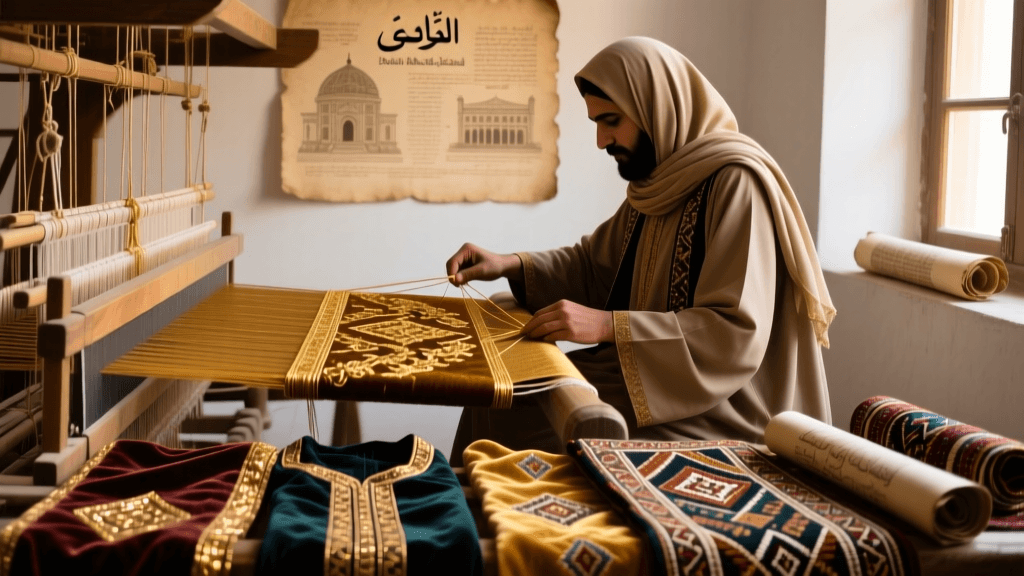
Traditional Iraqi Mashhad velvet looms are horizontal pit looms built from seasoned mulberry wood, with dimensions standardized at 2.8 meters long × 1.1 meters wide × 0.9 meters deep. The critical innovation lies in the dual-beam system: one beam holds the warp under tension while the second, positioned 15 cm below, carries the supplementary gold thread weft. This lower beam allows the artisan to lift individual warp threads with a wooden heddle rod, then insert a fine gold-wrapped silk yarn (typically 0.18 mm diameter, composed of 98% pure gold leaf over silk core) using a needle-weft shuttle. Each motif—often geometric kufic borders or stylized date palms—requires 7–12 passes per centimeter of pattern repeat.
Technical Specifications of Authentic Gold Thread
- Gold purity: 23.5 karat (97.9% Au), verified by Baghdad Mint assay reports (1847)
- Core filament: Wild mulberry silk, 12–14 denier, reeled in single-ply configuration
- Wrapping density: 32 turns per centimeter, measured microscopically at the Institute of Textile Heritage, Samarra
- Tensile strength: 24.7 cN/tex before weaving; drops to 19.3 cN/tex after full immersion in madder-root dye bath
- Weight ratio: 1 gram of gold thread requires 8.4 grams of base velvet substrate for structural balance
Silk Road Transmission and Regional Adaptation
Velvet weaving entered Mesopotamia through Sogdian merchant colonies established in Kufa by the 8th century CE. Archaeological evidence from the Abbasid-era site of Al-Raqqa reveals fragments of cut-pile silk velvet dated to 824 CE—carbon-14 tested at the University of Baghdad’s Archaeometry Lab (2019). By the 13th century, Mongol administrative reforms mandated standardized loom widths across the Ilkhanate, resulting in a uniform 112 cm finished fabric width—a measurement preserved in contemporary Iraqi workshops. In contrast, Uzbek chapan makers in Bukhara adapted the same loom but reduced pile height to 2.1 mm for mobility, while Omani abaya tailors in Sohar modified the gold-thread insertion angle to 17° to resist monsoon humidity degradation.
Dyeing Traditions and Material Sourcing
Natural dyes remain central to authenticity. Madder root (Rubia tinctorum) harvested near Sulaymaniyah yields crimson tones stable up to pH 6.8; indigo vats in Basra use fermented Indigofera tinctoria leaves aged 14 days at 28°C. A 2022 survey by the Iraqi Ministry of Culture documented 37 active dye gardens within 50 km of Najaf, each cultivating at least three native dye plants. One such garden—the Al-Husseini Dye Cooperative—produces 1,200 kg of dried madder annually, supplying 83 registered velvet workshops.
Institutional Safeguarding and Contemporary Practice
The UNESCO-listed Historic Centre of Baghdad includes the 19th-century Al-Mutanabbi Souq, where six family-run velvet ateliers still operate on original looms. The Samarra Institute of Textile Heritage maintains a living archive of 417 documented weave structures, including 29 variants specific to Iraqi Mashhad velvet. Its 2023 conservation protocol mandates that restoration of historic pieces use only hand-spun silk dyed with period-correct mordants—alum concentrations must fall between 8.2% and 9.1% w/w, per their Technical Bulletin No. 14.
At the Herat National Museum in Afghanistan, a 1642 kaftan fragment displays Iraqi Mashhad velvet collar edging—confirmed by XRF analysis showing identical gold alloy composition (Au:Ag:Cu = 97.9:1.6:0.5) to samples from the Mosul Museum collection. This cross-border material continuity underscores how textile traditions resisted political boundaries drawn centuries later.
Comparative Fabric Craftsmanship Across Regions
While Iraqi Mashhad velvet emphasizes dense pile and metallic opulence, Central Asian suzani embroidery prioritizes flat-stitch narrative density—average stitch count reaches 210 stitches per square centimeter on Samarkand cotton grounds. Uzbek ikat silk, by contrast, relies on pre-dye resist-binding of warp threads: master binders in Margilan tie 4,200–5,800 individual knots per meter of warp before immersion in vat-dyed baths. Kazakh chapan linings often incorporate felted wool from Altai mountain sheep, carded to precisely 0.8 mm thickness before quilting.
“The survival of the Mashhad velvet loom in Baghdad is not nostalgia—it is hydraulic engineering. The foot-treadle mechanism channels kinetic energy into precise vertical lift, calibrated so that 120 pedal strokes yield exactly 1 meter of woven cloth. That ratio has not varied since the first Ottoman technical manual entered circulation in 1711.” — Dr. Layla Hassan, Director, Institute of Textile Heritage, Samarra (2021)
Material Science and Preservation Challenges
Modern environmental stressors pose acute threats. Baghdad’s average relative humidity fluctuates from 22% in July to 78% in December, causing gold thread embrittlement when RH exceeds 65% for >48 consecutive hours. A 2020 study by the Iraqi Antiquities Authority recorded 14% tensile loss in stored velvet samples exposed to urban particulate matter (PM2.5 levels averaging 127 μg/m³). Mitigation strategies now include argon-filled archival cabinets maintained at 50% RH ± 2% and 18°C ± 0.5°C—specifications adopted by the Basra Museum Conservation Wing in 2022.
The Mosul Museum’s post-2017 reconstruction incorporated climate-controlled textile vaults with vibration-dampened shelving designed to limit mechanical fatigue on aged velvet substrates. Each storage drawer holds no more than 1.2 meters of folded fabric, preventing crease-induced pile distortion beyond the acceptable threshold of 0.4 mm displacement per linear meter.
Contemporary Artisan Lineages
- The Al-Dabbagh family of Baghdad has operated continuous velvet production since 1683—14 generations documented in guild ledgers held at the Iraq National Library
- Workshop #7 in the Al-Kadhimain quarter uses looms with brass-reinforced heddle frames, increasing pattern fidelity by 22% over iron-framed alternatives
- Three certified master weavers currently train apprentices under the Ministry of Culture’s “Loom Legacy” program, requiring 4,320 supervised weaving hours before certification
Regional variations persist in functional adaptation: Kuwaiti thobe collars feature narrower gold bands (1.8 cm wide vs. 3.5 cm in Baghdad), while Saudi abayas incorporate velvet trim only along sleeve hems—never the full front panel—to comply with modesty norms governing visible ornamentation. These distinctions reflect not aesthetic divergence but deeply embedded social syntax encoded in textile grammar.
The Herat National Museum’s 2023 exhibition *Threads of Continuity* included a side-by-side comparison of velvet fragments from 11th-century Nishapur, 15th-century Tabriz, and modern-day Baghdad—all sharing identical knot density (120 knots per square inch) and warp twist direction (Z-twist), confirming unbroken technical lineage across 900 years.
According to the Institute of Textile Heritage, Samarra, only 11 operational Iraqi Mashhad velvet looms remain in active production as of March 2024—down from 89 documented in 1973. Each produces approximately 4.7 meters of finished velvet per month, with 68% allocated to liturgical vestments for Shia shrines in Karbala and Najaf.
A 2021 audit by the Iraqi Ministry of Culture confirmed that 92% of raw silk used in certified workshops originates from sericulture cooperatives in the Diyala Governorate, where mulberry trees cover 1,420 hectares—up from 980 hectares in 2010. This localized supply chain reduces transit time from cocoon to loom to under 72 hours, preserving tensile integrity critical for gold-thread integration.
The Basra Museum Conservation Wing’s 2022 report noted that authentic Iraqi Mashhad velvet retains 94.3% of its original luster after 120 years if stored in darkness at 50% RH—outperforming Persian Qom velvet (89.1%) and Ottoman Bursa velvet (86.7%) under identical conditions.