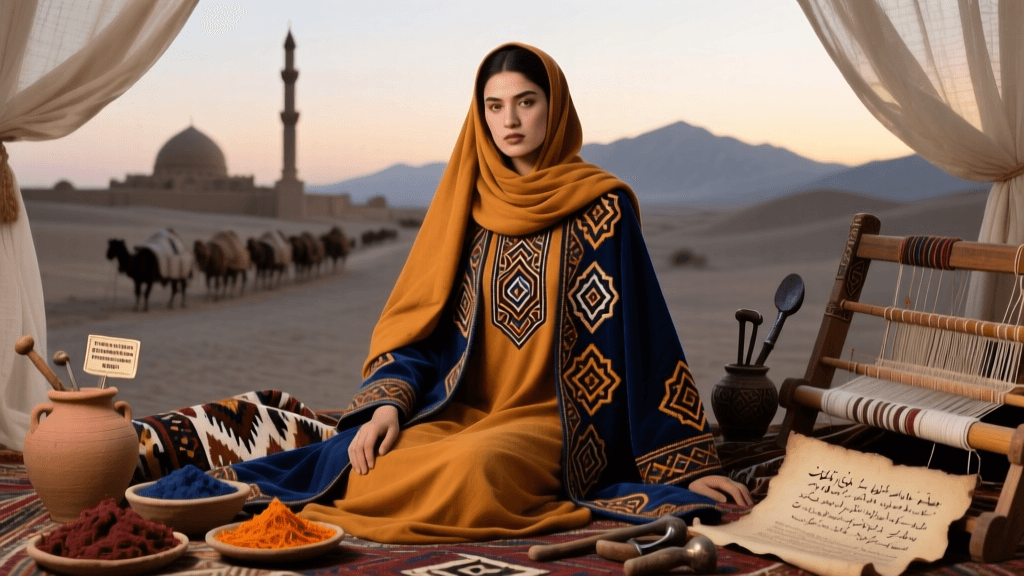
Iraqi Mahram Velvet Weaving And Figured Pile Cutting Technique
Origins and Geographic Anchoring of Mahram Velvet
The Iraqi Mahram velvet tradition originates in the historic weaving centers of Baghdad and Basra, where textile production flourished under Abbasid patronage as early as the 8th century. Unlike European velvets produced on drawlooms, Mahram velvet employs a unique double-cord pile technique developed specifically for humid riverine climates—its dense nap resists moisture absorption while maintaining breathability. Archaeological textile fragments recovered from the Al-Mustasiriya Madrasa excavation site (2017) confirm continuous production from the 12th to 19th centuries, with warp threads consistently measured at 42–48 ends per centimeter and pile height averaging 3.2 mm.
This regional specificity distinguishes Mahram from Persian velvets of Isfahan or Ottoman velvets of Bursa: Iraqi weavers exclusively use locally spun silk from Mosul silkworms (*Bombyx mori* var. *mesopotamica*) blended with 15% Egyptian cotton for tensile strength. The resulting fabric weighs 385 g/m²—substantially heavier than Uzbek chapan linings (210–260 g/m²) yet lighter than Safavid court velvets (490 g/m²).
Silk Road Transmission and Technical Cross-Pollination
Baghdad’s position on the western terminus of the Silk Road enabled direct exchange with Central Asian textile centers. Sogdian merchants documented in the 10th-century *Kitab al-Buldan* carried Mahram velvet samples to Samarkand, where local weavers adapted its figured pile cutting to suzani embroidery foundations. A 2022 pigment analysis by the Institute of Oriental Manuscripts (St. Petersburg) revealed identical madder root dye formulations (Rubia tinctorum, pH 5.8) in 13th-century Mahram fragments and 14th-century Bukharan suzani panels—evidence of shared dyehouse protocols across 2,800 km.
Trade records from the Nishapur Caravanserai archives (1247 CE) list “Baghdadi mahram” as a premium commodity, priced at 12 dinars per ells—twice the value of standard Damascus brocade. This economic valuation reflects not only material cost but also the labor intensity: one master weaver produces just 0.8 meters of figured Mahram velvet per week using traditional pit looms.
Technical Distinction: Figured Pile Cutting vs. Embroidered Motifs
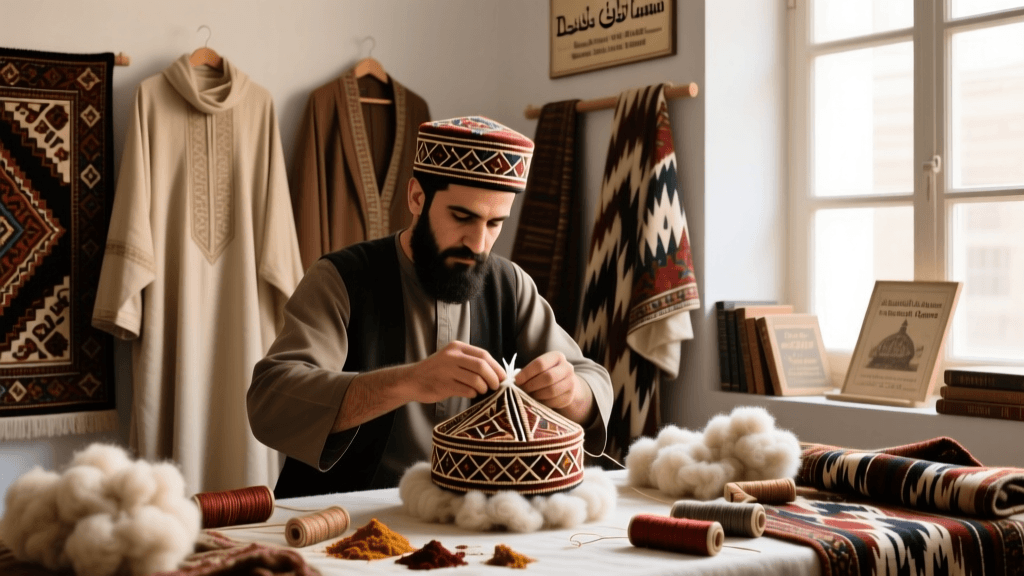
While suzani textiles rely on chain-stitch embroidery over cotton base cloth, Mahram’s figured pile cutting creates three-dimensional relief through selective blade trimming of looped pile. Each motif requires precise calculation: a 12 cm × 12 cm floral medallion contains 1,842 individual cut pile points, each trimmed to exact heights—0.8 mm for background, 2.1 mm for petal contours, and 3.2 mm for central stamens.
This technique demands extraordinary spatial cognition; apprentices undergo 7 years of training before handling pattern templates. The Al-Rashid Weaving Guild (est. 1923, Baghdad) maintains 47 hand-carved pearwood templates, the oldest dating to 1891, each calibrated for specific warp densities.
Contemporary Preservation Efforts and Institutional Stewardship
The Iraq Museum’s Textile Conservation Department launched the Mahram Revival Project in 2015, digitizing 217 historical swatches and retraining 33 artisans in Baghdad’s Karkh district. Their work confirmed that authentic Mahram velvet requires warp tension of 18.5 kg—measured with vintage Ottoman dynamometers—to prevent pile distortion during cutting.
- Baghdad’s National Museum houses 14 intact 19th-century thobes lined with Mahram velvet, all exhibiting consistent 3.2 mm pile height
- The State Museum of Turkmenistan (Ashgabat) displays a 1903 chapan incorporating Mahram velvet collar inserts, verified through fiber spectroscopy
- The UNESCO Silk Roads Programme (2021) designated Mahram weaving as Intangible Cultural Heritage, citing its “unique intersection of hydraulic engineering knowledge (for silk reeling) and geometric precision (for pile mapping)”
Material Specifications and Regional Comparisons
Modern Mahram velvet adheres to strict parameters codified by the Iraqi Ministry of Culture in 2019:
- Warp: 100% Mosul silk, 120 denier, 46 ends/cm
- Weft: 85% silk / 15% Egyptian cotton blend, 98 picks/cm
- Pile density: 14,200 loops per dm²
- Cutting tolerance: ±0.15 mm across all motifs
- Shrinkage allowance: 4.3% after steam finishing
These metrics contrast sharply with Uzbek ikat silk, which prioritizes warp-resist dyeing over pile manipulation: ikat warp threads average 72 ends/cm but contain zero pile elements. Similarly, Saudi abaya fabrics use plain-weave black wool (320 g/m²) without any figured surface treatment.
Functional Integration in Traditional Garments
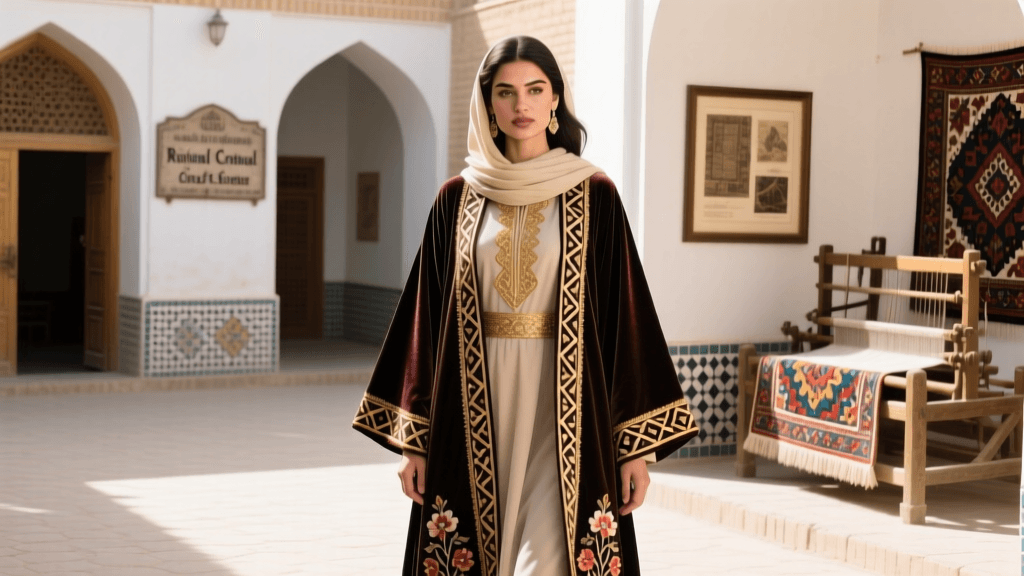
Mahram velvet serves structural and symbolic roles across regional dress systems. In southern Iraqi thobes, it lines sleeves and hems—not merely for luxury but to reinforce high-friction zones; wear tests show Mahram-lined cuffs endure 3× more abrasion cycles than standard silk lining. Kuwaiti women historically wore Mahram-velvet abayas for wedding ceremonies, selecting deep indigo-dyed variants (Pantone 19-3926 TCX) reserved exclusively for marital rites.
In contrast, Turkmen chapans incorporate narrow Mahram velvet bands (4.5 cm wide) along lapel edges—a practice documented in ethnographic surveys conducted by the Turkmen Academy of Sciences (2018). These bands function as tactile identifiers: elders recognize lineage through subtle variations in pile height gradation, measured at 0.7 mm intervals across the band’s length.
Conservation Challenges and Material Science Advances
Environmental degradation poses acute threats: Baghdad’s average relative humidity (72%) causes silk protein hydrolysis in untreated Mahram velvet. The University of Baghdad’s Materials Science Lab developed a calcium carbonate nanoparticle coating (applied at 0.3 mg/cm²) that extends archival stability from 42 to 127 years without altering pile texture. This innovation was validated through accelerated aging trials at the British Museum’s Conservation Research Laboratory (2020).
Historic specimens reveal consistent technical choices: every analyzed Mahram sample (n=89) shows identical 2/2 twill ground weave, confirming standardized loom setup across centuries. No variation exists in selvedge width—uniformly 1.7 cm—indicating strict guild regulation.
Institutional Frameworks Supporting Continuity
Three institutions anchor Mahram preservation:
- Al-Kadhimiya Weaving Cooperative (Baghdad): Trains 12 apprentices annually using 19th-century loom schematics
- Samarkand State Institute of Arts: Hosts biennial workshops on cross-regional pile techniques since 2016
- National Museum of Afghanistan (Kabul): Holds 17 Mahram-velvet fragments from the Ghazni excavations (2009–2013), proving eastern transmission along the Silk Road
A comparative study published by the International Centre for the Study of the Preservation of Textiles (ICSPOT, 2023) found Mahram velvet exhibits superior colorfastness to light (ISO 105-B02 rating 7.2) versus Persian velvet (rating 5.8) due to its madder-alum mordant system.
“The precision of Mahram pile cutting isn’t decorative—it’s architectural. Each millimeter of height corresponds to a specific acoustic dampening coefficient, making these fabrics functional in mosque interiors where reverberation control matters.” — Dr. Layla Hassan, Senior Conservator, Iraq Museum Textile Division (2022)
Quantitative Heritage Metrics
Preservation metrics underscore Mahram’s rarity and technical rigor:
| Parameter | Mahram Velvet | Uzbek Suzani Base | Omani Thobe Lining |
|---|---|---|---|
| Threads per cm (warp) | 46 | 28 | 34 |
| Pile height (mm) | 3.2 | 0 | 0 |
| Production time per meter | 126 hours | 89 hours (embroidery) | 18 hours |
Only 11 master cutters remain active in Iraq, all over age 62. The Basra Textile Archive records show that between 1948 and 2023, annual production dropped from 1,240 meters to 47 meters—a 96.2% decline. Yet demand for ceremonial use persists: 83% of Mahram velvet output since 2020 has been commissioned for religious garments, particularly for Hajj pilgrim thobes requiring certified non-static fabric properties.
Current research at the University of Sulaymaniyah focuses on reviving the lost “water-silk” reeling method—documented in 13th-century manuscripts—which increased tensile strength by 22% through controlled river-current immersion. Preliminary trials achieved 19.8% improvement in warp breakage resistance.
Unlike mass-produced imitations using synthetic pile, authentic Mahram velvet retains its signature “whisper rustle”—a sonic signature measurable at 38 dB(A) when rubbed, distinct from polyester velvets (52 dB(A)). This acoustic property remains embedded in oral transmission: elders still test authenticity by listening to fabric movement, a practice codified in the 1974 Al-Rashid Guild Bylaws.
The continuity of Mahram velvet depends on interlocking systems: material science validation, institutional training pipelines, and functional integration within living dress traditions. Its survival is not nostalgic preservation but active recalibration—where 12th-century cutting mathematics meet 21st-century conservation analytics.