Indonesian Batik Tulis Canting Tools And Wax Resist Process
The Canting: Precision Instrument of Batik Tulis
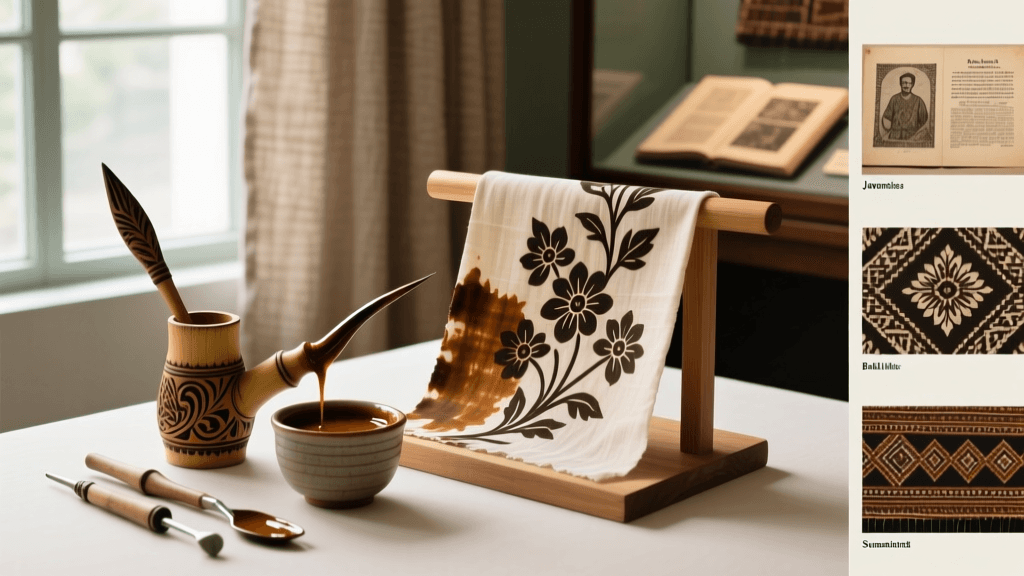
Batik tulis—the hand-drawn, wax-resist textile tradition of Indonesia—relies fundamentally on the canting, a copper-tipped tool held in the palm and guided by subtle wrist movements. Originating in Java as early as the 6th century CE, batik tulis evolved under Mataram Sultanate patronage (16th–18th centuries), where royal courts codified motifs like parang rusak and kawung to denote status and cosmology. The canting itself is meticulously crafted: its reservoir holds approximately 5–7 milliliters of hot beeswax or malam, and its spout diameter ranges from 0.3 mm for fine linear work to 2.5 mm for broad fills. A master artisan may use up to twelve distinct cantings in a single piece—each calibrated for line weight, curvature, and flow rate.
Wax Resist Chemistry and Temperature Control
The resist medium is not mere wax—it is a precise blend of beeswax (60–70%), paraffin (20–30%), and sometimes pine resin or damar gum to adjust melting point and adhesion. This mixture melts between 55°C and 65°C; exceeding 68°C causes premature cracking during dye immersion, while temperatures below 52°C yield uneven application and poor penetration into cotton fibers. Artisans monitor heat using calibrated brass thermometers embedded in traditional charcoal stoves, maintaining consistency across multi-day waxing sessions that may span 40–100 hours per meter of cloth.
Three-Stage Wax Application Cycle
Each batik tulis piece undergoes at least three wax-and-dye cycles to achieve layered color depth. In the first cycle, the base design is drawn in hot wax, then immersed in indigo vat dye (pH 11.2–11.8) for 15–20 minutes. After drying, a second wax layer seals areas intended to remain indigo, while newly exposed sections receive a second dye—often soga brown derived from Caesalpinia sappan heartwood. The final cycle applies wax to preserve both prior colors before a third bath in red morinda (Morinda citrifolia) extract, which requires fermentation for 3–5 days to activate dye molecules.
- A single 2.2-meter kain panjang (traditional wrap skirt) demands 18–24 hours of continuous waxing by one artisan
- Indigo vats at the Museum Batik Danar Hadi in Surakarta are refreshed every 14 days with fresh leaves and lime
- Traditional Javanese cotton—katun primissima—has a thread count of 120–140 threads per inch, optimized for wax absorption
- The batik cap (stamped) method uses copper stamps weighing 3–5 kg each, but tulis remains exclusively hand-drawn
- UNESCO inscribed Indonesian batik on the Representative List of the Intangible Cultural Heritage of Humanity in 2009
Regional Distinctions Across Java and Beyond
While Central Java dominates scholarly attention, regional variations reflect ecological and historical realities. In coastal Pekalongan, artisans incorporate Chinese phoenixes and Dutch floral motifs due to 17th-century maritime trade; their wax blends contain higher paraffin (up to 40%) for faster drying in humid conditions. In inland Solo (Surakarta), strict adherence to laras (harmonic proportion) governs motif placement—every ceplok (geometric unit) measures exactly 4.2 cm square, calibrated against the weaver’s forearm length. Meanwhile, Madurese batik features bold, high-contrast patterns achieved through double-dipping in concentrated indigo and repeated boiling to remove excess wax—a process that reduces fabric tensile strength by 18–22% but yields unparalleled vibrancy.
Material Sourcing and Preparation
Raw cotton arrives at workshops in bales weighing 100 kg each, sourced primarily from East Java plantations. Before waxing, cloth undergoes ngeleng: soaking in fermented rice water (pH 4.1) for 48 hours to remove pectins and improve wax affinity. It is then stretched on wooden frames called gawangan, tensioned to 12–15 Newtons per linear centimeter to prevent distortion during drawing. Natural dyes dominate heritage practice: 1 kg of dried morinda root yields only 120 ml of usable dye liquor after 72-hour extraction, requiring 8–10 liters per meter of fabric for full saturation.
Institutional Preservation and Contemporary Practice
The Museum Batik Danar Hadi in Surakarta houses over 1,200 historical pieces, including a 19th-century sido mukti cloth with 37 distinct motifs arranged in strict hierarchical order. Similarly, the Textile Museum in Jakarta maintains a climate-controlled archive of 2,400 batik tools, including a 1782 canting with a 0.4 mm spout recovered from a Yogyakarta palace excavation. In Bali, the Threads of Life cooperative trains 142 artisans across 17 villages, mandating minimum 200 hours of apprenticeship before certification—exceeding the national standard of 120 hours set by the Indonesian Ministry of Education and Culture (2017).
“The canting is not a pen—it is an extension of breath and pulse. When the wrist trembles, the line fractures; when intention falters, the wax pools. Mastery lies not in speed, but in the silence between drops.” — Ibu Sri Wahyuni, Master Batik Tulis Artisan, Yogyakarta (interviewed at the Sonobudoyo Museum, 2022)
Fabric Types and Structural Integrity
Authentic batik tulis uses only plain-weave cotton or silk. Javanese silk—produced in the Prambanan valley—features 22–24 momme weight (82–90 g/m²) and a warp density of 96 threads/cm, allowing wax to penetrate without bleeding. Cotton variants include katun primissima (120–140 threads/inch) and katun super (160+ threads/inch), the latter reserved for court commissions. Post-dyeing, fabrics undergo rigorous testing: ASTM D5034 tensile strength must exceed 280 N for warp and 240 N for weft to qualify as museum-grade. Washing removes residual wax via boiling in sodium carbonate solution (pH 11.0) for precisely 90 minutes—any longer degrades cellulose chains.
Dyeing Techniques Compared Across Asia
Unlike Japanese shibori (stitch-resist) or Indian bandhani (tie-dye), batik tulis relies on thermal phase change rather than mechanical obstruction. Contrast this with Thai pha yao (wax-resist silk), where beeswax is mixed with coconut oil to lower melting point—rendering it unsuitable for Javanese indigo vats. The Korean jjokkuri technique uses rice paste instead of wax, requiring steam fixation rather than boiling removal. These distinctions underscore how climate, available flora, and social hierarchy shaped divergent resist traditions.
| Technique | Primary Resist Medium | Typical Melting Point (°C) | Removal Method | Max Wash Cycles Before Fading |
|---|---|---|---|---|
| Indonesian Batik Tulis | Beeswax-paraffin blend | 55–65 | Boiling in alkaline solution | 12–15 |
| Japanese Yuzen | Rice-paste barrier | N/A (air-dried) | Steam and gentle rinsing | 8–10 |
| Indian Bagru | Beeswax + clay | 62–68 | Sun-drying + scraping | 6–9 |
At the Sonobudoyo Museum in Yogyakarta, visitors observe live demonstrations where artisans complete a 15 cm × 15 cm motif section in 3.5 hours—translating to roughly 2.8 cm² per minute. This pace reflects generational knowledge: apprentices begin with straight-line exercises on paper for six months before touching cloth. The National Museum of Indonesia in Jakarta displays a 1924 parang barong kain with 1,842 individual waxed elements, each verified under 10× magnification to confirm hand-drawn continuity. Conservation scientists at the Rijksmuseum’s Asian Textiles Department (Amsterdam) have documented that batik tulis textiles stored at 18°C and 55% relative humidity retain color fidelity for 120+ years—exceeding the longevity of many synthetic-dyed counterparts.
Contemporary challenges persist: synthetic dyes now account for 68% of commercial batik production, yet UNESCO’s 2009 designation spurred renewed investment in natural-dye infrastructure. The Indonesian Ministry of Industry reports that certified tulis workshops increased from 87 in 2015 to 214 in 2023, with 41% located in rural cooperatives. Each certified workshop must submit quarterly wax composition analyses to the National Standardization Agency (BSN), ensuring beeswax content never falls below 55%—a threshold validated by chromatographic testing at the Bandung Institute of Technology’s Textile Engineering Lab.
The persistence of batik tulis is not nostalgia—it is structural resilience. Every canting stroke encodes agrarian calendars, ancestral memory, and botanical knowledge. When a Yogyakarta artisan heats wax to 62.3°C and guides the spout along a curve measuring precisely 4.2 cm in radius, she does not replicate pattern; she recalibrates time.