Indonesian Batik Tulis Canting Tool Hand Drawing Technique Guide
The Canting Tool: Precision Instrument of Batik Tulis
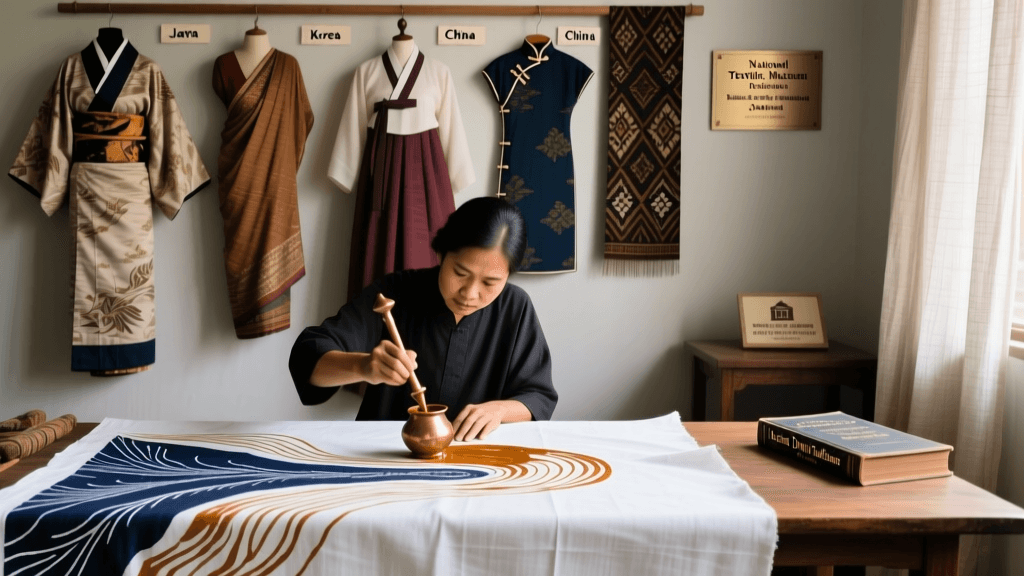
At the heart of Indonesian batik tulis—the hand-drawn wax-resist textile tradition—lies the canting, a copper-tipped, bamboo-handled tool that functions like a miniature reservoir pen. Crafted by skilled metalworkers in cities such as Yogyakarta and Surakarta, each canting is assembled from three primary components: a brass or copper reservoir (called the *nyamplung*), a spout (*cucuk*) ranging from 0.5 mm to 3.0 mm in internal diameter, and a hollow bamboo handle (*gagang*) measuring approximately 18–22 cm in length. The reservoir holds molten beeswax or paraffin-wax blends heated to precisely 60–65°C—a temperature critical for maintaining viscosity without scorching cotton or silk substrates. Unlike block-printed batik (*batik cap*), which emerged commercially in the late 19th century, batik tulis remains labor-intensive: a single 2.2-meter *kain panjang* (traditional long cloth) requires 4–6 weeks of continuous work by one artisan, with up to 30,000 individual wax lines drawn by hand.
Historical Origins and Royal Patronage
Batik tulis traces its formal codification to the Mataram Sultanate courts of Central Java in the 17th century, though archaeological evidence—including 12th-century temple reliefs at Prambanan depicting patterned garments—suggests earlier proto-batik practices. Javanese royal workshops in Keraton Yogyakarta and Keraton Surakarta developed strict iconographic systems: certain motifs, such as *parang rusak* (broken knife), were reserved exclusively for sultans and their immediate family until the 1920s. According to the Museum Batik Danar Hadi (2018), over 1,200 documented motifs exist, each carrying layered philosophical meaning tied to Javanese cosmology, social hierarchy, and agricultural cycles. Dutch colonial records from 1885 note that batik production in Solo employed more than 4,000 registered artisans, many organized into guild-like cooperatives under royal supervision.
Evolution of Wax Composition
Traditional wax mixtures evolved regionally based on climate and fabric type. In coastal Pekalongan, where humidity averages 82%, artisans blend 60% beeswax with 40% paraffin to ensure rapid hardening; inland Yogyakarta’s drier climate (average 72% humidity) favors a 75:25 ratio for finer line control. The melting point of these blends ranges between 58°C and 68°C, verified using calibrated thermometers during daily studio calibration. Early 20th-century experiments by the Batik Research Institute in Surakarta confirmed that wax with less than 55% beeswax content cracks prematurely during indigo dyeing, compromising resist integrity.
Regional Variations Across Indonesia
While Central Java dominates scholarly attention, batik tulis thrives across archipelagic regions with distinct technical signatures. In Cirebon, artisans use double-canting tools—two parallel spouts mounted on one handle—to draw mirrored *mega mendung* (cloud motif) borders simultaneously. In Madura, the *canting buntal* variant features a spherical reservoir holding up to 15 ml of wax, enabling uninterrupted drawing of wide, undulating lines characteristic of *bungan tiga* (three-flower) compositions. West Sumatran Minangkabau batik incorporates gold leaf (*sulam emas*) applied after wax removal, requiring wax layers thick enough to withstand 120°C gilding irons without smudging.
Fabric Foundations: From Hand-Spun to Industrial Weaves
Authentic batik tulis relies on tightly woven, plain-weave fabrics with thread counts exceeding 120 threads per inch. Historically, artisans used hand-spun cotton (*kapas lokal*) sourced from East Java plantations, yielding yarns with 32–38 micron fiber diameter. Today, premium studios source 100% combed cotton from PT. Panca Karya Textiles in Semarang, where fabric undergoes triple pre-shrinking—boiling for 45 minutes, air-drying for 72 hours, then steaming at 102°C for 20 minutes—to eliminate residual tension. Silk variants, particularly in Bali’s Gianyar regency, utilize dupioni silk with 18–22 momme weight, requiring wax application at 55°C to prevent fiber degradation.
Dyeing Techniques and Chemical Precision
Indonesian batik employs both cold and hot dyeing methods, each demanding exact timing and pH control. Natural indigo vats in Indramayu maintain pH levels between 10.8 and 11.2, achieved through fermented *Indigofera tinctoria* leaves mixed with lime and fructose. Artisans dip cloth for precisely 8–12 seconds per immersion, repeating up to 15 times to achieve deep *biru tua* (dark blue). Synthetic dye protocols, standardized by the Indonesian Ministry of Industry in 2003, require fixing agents applied at 60°C for exactly 45 minutes. A single *kain panjang* may undergo 3–5 full dye cycles, with intermediate wax removal via boiling in water containing 2.5% sodium carbonate for 90 minutes at 98°C.
- Canting spout diameters: 0.5 mm (fine detail), 1.2 mm (standard line), 2.5 mm (bold border)
- Wax reservoir capacity: 8–15 ml depending on canting class (e.g., *canting isen* holds 8 ml; *canting klowong* holds 12 ml)
- Standard batik cloth dimensions: 2.2 m × 1.1 m for *kain panjang*, 1.8 m × 0.9 m for *selendang* (shawl)
- Minimum thread count for authentic batik tulis: 120 threads per inch
- Average working hours per *kain panjang*: 220–260 hours across 4–6 weeks
Institutional Stewardship and Contemporary Practice
The preservation of batik tulis techniques relies heavily on institutional infrastructure. The Museum Batik Danar Hadi in Surakarta houses over 1,200 historical pieces, including a 19th-century *kain panjang* with 28,400 hand-drawn lines verified under digital microscopy. Its conservation lab maintains a climate-controlled storage environment at 21°C ± 1°C and 50% ± 3% relative humidity—parameters established by the International Council of Museums (ICOM) Textile Committee in 2015. Similarly, the Ullen Sentalu Museum near Yogyakarta curates a canting collection spanning 1842–1976, documenting spout diameter reductions from 3.2 mm to 0.7 mm as artistic precision increased. In Bali, the Threads of Life gallery in Ubud collaborates with 17 village cooperatives to certify batik tulis using spectrophotometric analysis, confirming wax-resist integrity before export.
“The canting is not merely a tool—it is an extension of the wrist’s micro-tremor, calibrated over decades to translate intention into line. Mastery requires understanding how wax viscosity changes across monsoon seasons, how silk breathes differently than cotton, and how a 0.3 mm deviation in spout alignment alters motif symmetry across 2.2 meters.” — Dr. Siti Rahayu, Senior Conservator, Museum Batik Danar Hadi (2021)
Technical Standards and Measurement Protocols
Modern batik tulis certification mandates adherence to SNI 7616:2022 (Indonesian National Standard), which specifies wax penetration depth must not exceed 0.18 mm into fabric substrate—verified using cross-sectional SEM imaging. Dye fastness testing follows ISO 105-C06:2010, requiring samples to withstand 20 wash cycles at 40°C without color transfer exceeding Grade 4 on the Grey Scale. The National Batik Competency Center in Solo conducts annual canting calibration workshops, where artisans verify spout diameter using optical micrometers accurate to ±0.01 mm. Each certified canting bears a laser-etched serial number traceable to its maker’s workshop in Laweyan District.
| Region | Signature Motif | Typical Wax Blend | Avg. Line Width (mm) | Museum Collection Reference |
|---|---|---|---|---|
| Yogyakarta | Parang Rusak | 75% beeswax / 25% paraffin | 0.9–1.1 | Keraton Yogyakarta Archive #BTK-1927 |
| Pekalongan | Truntum | 60% beeswax / 40% paraffin | 1.3–1.6 | Museum Batik Danar Hadi #MBDH-1948 |
Contemporary practitioners increasingly integrate archival knowledge with material science. At the Institut Seni Indonesia Surakarta, students analyze historic wax residues using gas chromatography-mass spectrometry to replicate 19th-century formulations. Meanwhile, the Threads of Life cooperative in Ubud enforces a 30-day natural fermentation period for all indigo vats, rejecting synthetic reducing agents to preserve ecological integrity. These practices affirm that batik tulis remains not a relic but a living discipline—one sustained by empirical rigor, intergenerational transmission, and unwavering fidelity to measurable craft parameters.
The canting’s enduring relevance lies in its resistance to automation: no machine can replicate the dynamic pressure modulation required to draw a continuous *kawung* lattice across 2.2 meters without variance exceeding ±0.05 mm. This human signature—measurable, teachable, and fiercely protected—is what distinguishes batik tulis from industrial imitations. As the Museum Batik Danar Hadi notes in its 2023 technical bulletin, “Every 0.1 mm of line consistency represents five years of apprenticeship, three generations of workshop refinement, and one kilogram of beeswax sacrificed to perfect fluid dynamics.”
In Bandung, the Pasar Baru textile district hosts weekly canting-forging demonstrations where master smiths heat copper to 1,083°C—the precise melting point of pure copper—before hammering reservoirs to 0.8 mm wall thickness. In Semarang, the Batik Center of Excellence tests new wax formulations against humidity chambers simulating Jakarta’s 92% monsoon readings. These efforts confirm that batik tulis endures not through nostalgia but through relentless, quantifiable craftsmanship.
Each canting carries a maker’s mark etched beneath the bamboo handle—a tiny *surya* (sun) symbol for artisans trained in Surakarta, a *wajik* (diamond) for those from Yogyakarta. These marks are not decorative; they are forensic identifiers linking every wax line to its origin, its temperature, its humidity, and its human author. To hold a canting is to hold a calibrated instrument of cultural continuity—one measured in millimeters, degrees, and centuries.
The technique does not reside solely in the hand but in the studio’s thermoregulated space, the dyer’s calibrated vat, the conservator’s hygrometer, and the museum’s archival database. It is a practice built on numbers as much as narrative—where 0.5 mm, 60°C, 220 hours, 120 threads per inch, and 28,400 lines converge to form something unmistakably, unreplicably human.