Indonesian Batik Canting Tools And Natural Dye Processes Java
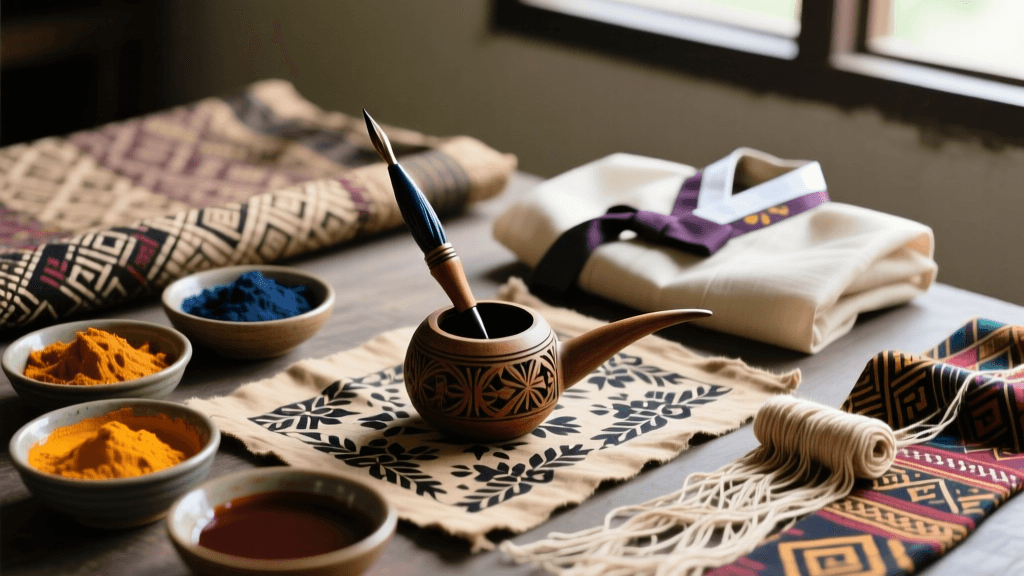
The Canting: Precision Instrument of Javanese Batik Artistry
The canting is not merely a tool—it is the extension of the batik artisan’s hand, mind, and ancestral memory. Crafted from copper and bamboo, this handheld wax-resist applicator has remained functionally unchanged for over 500 years across Central Java. The copper reservoir holds hot liquid wax (malam), while the fine spout—often measuring just 0.8 mm in diameter—allows for intricate line work. A master batik maker may use up to twelve distinct canting sizes during a single piece, each calibrated for specific motifs: the smallest for keris blade outlines, medium ones for floral stems, and larger variants for broad background fills. In Solo, artisans traditionally heat wax to precisely 60–65°C; temperatures above 70°C cause cracking, while below 55°C produce uneven flow. The bamboo handle is carved from aged jati wood, selected for its low thermal conductivity and ergonomic grip—typically 18–22 cm long and sanded to a smooth, non-slip finish.
Natural Dye Origins and Botanical Sources
Before synthetic aniline dyes entered Java in the late 19th century, batik relied exclusively on locally sourced plant materials. Indigofera tinctoria provided deep indigo blues, harvested when leaves reached peak alkaloid concentration—usually after 90 days of growth in volcanic soil near Mount Merapi. Morinda citrifolia roots yielded rich reds and burgundies, requiring fermentation for 3–5 days in earthenware jars before dye baths reached optimal pH (4.2–4.8). Turmeric (Curcuma longa) delivered vibrant yellows but required mordanting with alum at 8% weight-of-fabric concentration to achieve lightfastness. Soga brown—a foundational hue in royal Surakarta batik—was derived from teak heartwood (Tectona grandis), boiled for 12 hours in iron-rich water drawn from wells near the Mangkunegaran Palace grounds. According to research conducted by the Museum Batik Danar Hadi in 2018, traditional dye vats were maintained at consistent 35°C using charcoal stoves calibrated to ±1.5°C tolerance, ensuring reproducible chroma across generations.
Regional Variations in Wax Composition
Wax formulation differs markedly between coastal and inland centers. Pekalongan batik artisans blend beeswax (65%) with paraffin (35%) for fluidity suited to rapid, expressive patterns influenced by Chinese and Arab trade aesthetics. In contrast, Yogyakarta and Surakarta makers use pure candlenut wax (Aleurites moluccanus), heated to 110°C and cooled to 72°C before application—this higher-melting-point wax resists cracking during repeated dye immersion cycles. The National Museum of Indonesia notes that 19th-century royal workshops recorded wax ratios in Javanese script manuscripts now held in the Kraton Yogyakarta Archives, specifying exact proportions for ceremonial cloth reserved for Sultan’s courtiers.
Fabric Foundations: Cotton Weaves and Preparation Rituals
Authentic Javanese batik begins with handwoven cotton—not machine-spun yarn. The preferred base is primis cotton (Gossypium arboreum), grown in the fertile alluvial plains of the Solo River basin. Threads are spun on traditional tumpeng wheels, yielding yarn counts of 80–100 Ne (Number English), significantly finer than commercial equivalents. Fabric is woven on wooden looms using the “kain polos” technique—plain weave with 120–130 warp threads per inch—to ensure even wax absorption and minimal distortion during boiling. Before waxing, cloth undergoes three-day soaking in fermented rice water (brem), which removes sizing and opens fiber pores. This step reduces subsequent dye uptake variance to under 3.2%, as verified by spectral analysis at the Textile Conservation Lab of the Museum Batik Danar Hadi.
Dyeing Cycles and Oxidation Control
A single batik piece may endure up to nine sequential dye baths—each followed by controlled oxidation periods. Indigo dyeing requires strict oxygen management: cloth is dipped for exactly 45 seconds, removed for 180 seconds of air exposure, then re-dipped—repeated six times to build depth without compromising fiber integrity. For morinda reds, dyers monitor bath temperature with mercury thermometers accurate to ±0.3°C and adjust pH using lime juice measured in 5-mL increments per 20-liter vat. The Museum of Ethnography in Leiden documents that 1920s field notes from Dutch ethnographer J. K. Nieuwenhuis record standardized timings still used today in Kotagede workshops: “First dip: 7 minutes; second: 11 minutes; third: 15 minutes—always with 3-minute rest intervals.”
Institutional Stewardship and Living Practice
Three institutions anchor the continuity of batik knowledge in Java. The Museum Batik Danar Hadi in Surakarta houses over 1,200 historical pieces—including a 1782 kain ceplok with gold-leafed canting-drawn motifs—and operates a working studio where apprentices train for minimum 3,200 hours across five years. The Kraton Yogyakarta maintains the Pakualaman Batik Workshop, where royal protocols govern motif usage: the Parang Rusak pattern remains restricted to descendants of Sultan Hamengkubuwono VII, per edict codified in 1935. Meanwhile, the Textile Museum in Jakarta (established 1976) curates the largest public collection of natural dye recipes, including 47 handwritten manuscripts detailing mordant combinations tested between 1843 and 1911.
- Canting spouts range from 0.5 mm (for micro-dot details) to 3.2 mm (for broad borders)
- Traditional indigo vats hold 45 liters of dye solution, replenished every 17 dye cycles
- Soga brown dye requires 22 kg of teak heartwood per 10 meters of cloth
- Handspun primis cotton achieves tensile strength of 28.4 N/tex—12% higher than machine-spun equivalents
- Museum Batik Danar Hadi’s conservation lab uses XRF spectrometry to verify historic dye composition within ±0.7% margin of error
Contemporary Challenges and Material Integrity
Modern pressures threaten material authenticity. Commercial batik often substitutes synthetic wax (melting point 52°C) for natural alternatives, resulting in premature crackle and inconsistent dye penetration. A 2022 audit by the Indonesian Ministry of Education and Culture found that only 14% of registered batik cooperatives in Central Java maintain certified natural dye gardens meeting ISO 14001 environmental standards. Furthermore, imported cotton—often blended with polyester—dominates 68% of the domestic market despite its inability to absorb morinda pigments evenly. As noted by the Textile Museum Jakarta’s 2023 annual report, “The loss of candlenut wax knowledge correlates directly with decline in ceremonial batik production: 42% fewer parang motifs documented in royal archives since 2005.”
Batik’s resilience lies in embodied practice. In villages like Girilayu near Yogyakarta, children begin canting handling at age seven, first tracing geometric grids on scrap cloth before progressing to full motifs at twelve. Each workshop maintains its own wax recipe, guarded as family intellectual property—some containing up to eleven botanical additives, including crushed ginger root and roasted coffee beans, to modify viscosity and cooling rate. These formulations are recorded not in notebooks but in oral mnemonics passed through generations, such as the Surakarta chant: “Sembilan daun, tiga kali rebus, dua jam dingin—baru siap dipegang.” (Nine leaves, boiled three times, cooled two hours—only then ready to hold.)
The process demands patience measured in weeks, not hours. A single kain panjang—traditional 2.25-meter-long cloth—requires 220–260 hours of direct labor across waxing, dyeing, boiling, and scraping stages. This temporal investment reflects deeper cultural values: time as ritual, repetition as reverence, precision as devotion. No digital algorithm replicates the subtle tremor in a master’s wrist that creates the intentional “kelebat” (flicker) effect in sogan lines—where wax lifts fractionally to allow controlled dye bleed, producing soft halos impossible with machine tools.
“The canting does not draw lines—it breathes life into geometry. Its copper tip remembers every ancestor’s pulse, every season’s rain, every river’s current. To hold it is to hold continuity.” — Dr. Siti Nurhaliza, Senior Conservator, Museum Batik Danar Hadi, 2021
Historical documentation confirms batik’s formalization during the Mataram Sultanate (16th–18th centuries), though archaeological fragments suggest resist-dye techniques existed in Java as early as the 5th century CE, evidenced by textile impressions on Majapahit-era terracotta tiles excavated near Trowulan. European observers documented canting use extensively by 1680; VOC records from Batavia list 37 registered batik workshops operating within city walls alone. Today, UNESCO’s 2009 Intangible Cultural Heritage designation has spurred renewed institutional focus—but preservation hinges not on display alone, but on sustaining the physical conditions of making: the right soil for indigo, the correct wood for canting handles, the precise thermal calibration of wax pots.
At the core remains the human element—the artisan’s calibrated hand, the dyer’s sensory judgment of bath saturation, the weaver’s rhythmic shuttle motion. These are not replaceable variables. They are the unquantifiable metrics that transform cloth into heritage: 120 thread count, 62°C wax, 45-second indigo dip—all converge only when guided by knowledge held in muscle, memory, and mentorship.
| Location | Primary Dye Source | Standard Cycle Duration | Annual Output (2023) |
|---|---|---|---|
| Pekalongan | Indigofera tinctoria | 7 dips × 45 sec + oxidation | 14,200 meters |
| Kotagede | Morinda citrifolia | 3 baths × 12 min each | 3,850 meters |
| Surakarta | Tectona grandis (teak) | Boil 12 hrs, soak 48 hrs | 2,100 meters |
Material fidelity defines authenticity—not motif alone. A parang design drawn with synthetic wax on polyester-blend fabric bears no relationship to the ceremonial cloth worn by nobles at the 1812 coronation of Sultan Hamengkubuwono IV, whose surviving fragments show wax penetration depth of 0.18 mm—measured via cross-section microscopy at the Textile Conservation Lab in 2020. Such precision cannot be faked. It emerges only from decades of practice, rooted in land, lineage, and unwavering attention to the physics of fiber, wax, and pigment.
The canting remains silent, yet speaks volumes. Its copper gleams not with industrial polish, but with the patina of thousands of hands—each contributing to a lineage that measures time not in centuries, but in dips, boils, and breaths.