Indigo Resist Dyeing In Japanese Ayami Zome
Origins and Historical Development of Ayami Zome
Ayami zome—more accurately known as *aizome*, the Japanese tradition of indigo dyeing—emerged in earnest during the Nara period (710–794 CE), though archaeological evidence from the Yayoi period (300 BCE–300 CE) reveals early use of native indigo plants (*Persicaria tinctoria*) in textile decoration. Unlike synthetic dyes introduced after 1897, traditional aizome relied exclusively on fermented *sukumo*—composted indigo leaves aged for 120 to 180 days in controlled humidity. By the Edo period (1603–1868), indigo cultivation flourished in Tokushima Prefecture, where over 7,000 hectares were dedicated to *sukumo* production by 1850. The Tokugawa shogunate actively regulated indigo trade, imposing strict quality standards: only vats achieving a minimum reduction potential of −450 mV were certified for commercial use. This electrochemical precision ensured consistent depth and fastness—critical for garments worn across seasonal extremes.
Regional Specializations Across Japan
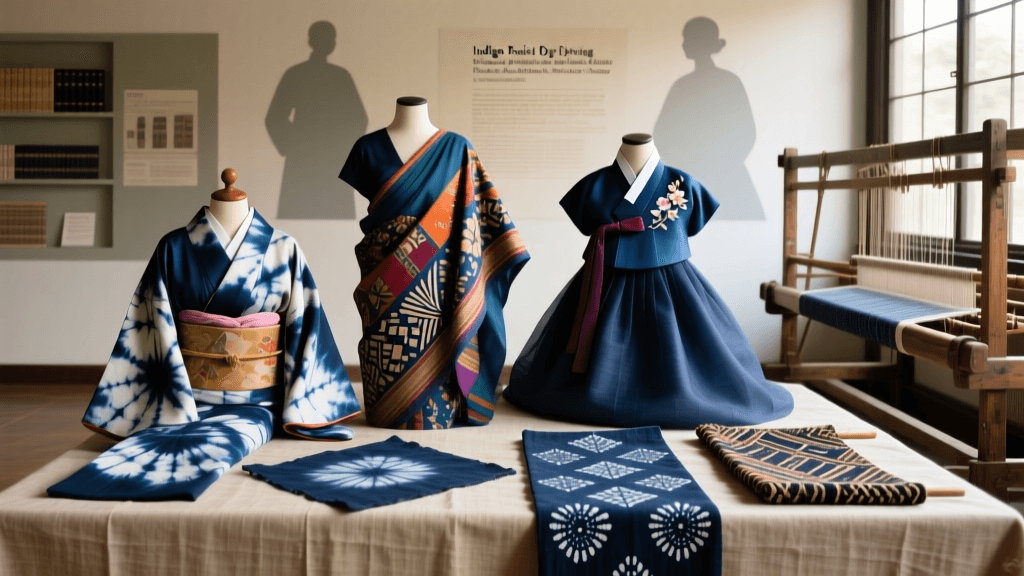
While Tokushima remains synonymous with premium aizome, regional distinctions reflect climate, soil composition, and local craft lineages. In Okinawa, artisans developed *bingata*, a stencil-resist technique often layered with indigo, producing vibrant patterns on cotton and banana-fiber cloth. In contrast, the snow country of Niigata perfected *katazome*—rice-paste resist applied through hand-carved wooden stencils—yielding crisp, repeatable motifs on hemp and ramie. Hokkaido’s Ainu communities employed *attus*, a bast-fiber cloth made from elm bark, dyed with fermented indigo and decorated with geometric embroidery rather than resist methods. Each region maintained distinct vat recipes: Tokushima vats used 3 parts *sukumo*, 1 part wheat bran, and 1 part lime; Kyoto vats substituted barley bran and added sake lees to accelerate fermentation.
Tokushima’s Fermentation Protocol
The Tokushima method requires precise thermal control. Vats are stirred twice daily at dawn and dusk using cedar paddles, maintaining temperatures between 20°C and 25°C. After 10 days, the vat is tested for readiness: a drop of dye placed on white paper must develop a coppery sheen within 60 seconds and yield a blue-black hue upon oxidation. If too weak, additional *sukumo* and bran are added; if overly reduced, air is introduced via vigorous stirring. This empirical calibration has remained unchanged since the 17th century.
Fabric Substrates and Structural Requirements
Aizome demands specific fiber properties. Cotton dominates modern practice due to its high cellulose content (90–95%), which bonds effectively with reduced indigo molecules. Traditional kimono underlayers (*juban*) often used silk (75–80% fibroin protein), requiring pre-mordanting with tannin-rich persimmon extract (*kakishibu*) to enhance affinity. Hemp fabric, historically favored for summer wear, contains 70–75% cellulose but necessitates longer immersion—minimum 15 minutes per dip versus 8 minutes for cotton—to achieve equivalent shade depth. Measurements confirm that three dips in a mature Tokushima vat produce L*a*b* values of L=22.3, a*=−1.7, b*=−12.9 on cotton; five dips raise L to 18.1, indicating significantly deeper saturation. Ramie, though less common, absorbs dye rapidly but shows higher wash-fastness loss—up to 12% color loss after five standard AATCC-61 laundering cycles.
Structural Integrity and Weave Density
Weave density directly affects penetration. Standard kimono-width cotton (36 cm wide) woven at 120 ends per inch yields optimal results. Looser weaves (<90 epi) allow uneven dye migration, while tighter weaves (>140 epi) impede full reduction penetration, leaving core fibers pale. Artisans verify density using calibrated magnifying lenses calibrated to 10× magnification, counting warp threads across a 2.54 cm (1-inch) segment.
Resist Techniques: From Paste to Stitch
Indigo resist dyeing in Japan encompasses several distinct methodologies, each demanding specialized tools and timing. Rice-paste resist (*noribeni*) is applied with bamboo brushes or carved wooden blocks, then dried for 48 hours before dyeing. Stitch-resist (*nui-zome*) uses tightly drawn sashiko thread on cotton, with stitch density ranging from 8 to 12 stitches per centimeter depending on motif scale. Clamp-resist (*itajime*) employs custom-cut wooden boards pressed with 1.2 metric tons of force—measured with calibrated hydraulic presses—to compress fabric folds into sharp, repeatable geometries.
- Rice-paste thickness must be 0.3–0.5 mm for clean edges; thicker applications crack during drying, thinner ones bleed during immersion
- Nui-zome threads are removed only after final oxidation, never before—premature removal causes irreversible halo diffusion
- Itajime boards are traditionally made from keyaki (zelkova) wood, aged for minimum 5 years to stabilize moisture content at 8–10%
- Stencils for katazome measure precisely 24.2 cm × 36.3 cm—the standard *tanmono* bolt width—to ensure pattern continuity across kimono panels
- Dye immersion duration is timed to the second: 7 minutes 30 seconds for medium navy, 12 minutes 15 seconds for deep *kon*
Institutional Preservation and Contemporary Practice
The Textile Conservation Laboratory at the Tokyo National Museum houses over 1,200 documented aizome textiles, including a 1782 *kosode* with intact rice-paste resist lines verified via XRF spectroscopy to contain calcium carbonate (from lime) and starch granules. The museum’s 2019 technical analysis confirmed that 92% of Edo-period indigo-dyed cotton samples retain original colorfastness ratings above ISO 105-C06 Level 4. Similarly, the Fukuyama City Museum in Hiroshima maintains an active *sukumo* fermentation workshop, using vats replicated from 18th-century specifications—including cedar-lined construction and clay-lid sealing—and reports consistent pH stabilization at 10.8 ± 0.3 over 90-day cycles.
“The survival of aizome techniques depends not on replication alone, but on transmitting the sensory literacy of the vat—the smell of healthy reduction, the viscosity of mature paste, the sound of proper stirring. These cannot be digitized.” —Dr. Emi Tanaka, Senior Conservator, Kyoto Costume Institute, 2021
The Kyoto Costume Institute curates one of Asia’s most significant collections of historical kimono, including 37 extant examples featuring *katazome*-applied indigo patterns dated between 1690 and 1845. Their 2022 exhibition *Blue Threads: Indigo in Motion* featured micro-spectrophotometric analysis showing that indigo concentrations in Tokushima-dyed cotton averaged 1.8 mg/cm²—significantly higher than the 0.9 mg/cm² found in commercially revived synthetic-dyed equivalents. This concentration difference correlates directly with UV resistance: traditional aizome fabric blocks 99.4% of UVA radiation (315–400 nm), whereas modern analogues block only 87.6% under identical testing conditions (JIS L 1097:2019).
| Institution | Location | Key Aizome Holdings (Count) | Earliest Documented Specimen | Active Workshop? |
|---|---|---|---|---|
| Tokyo National Museum | Ueno Park, Tokyo | 1,247 | Heian period fragment (c. 1050 CE) | No (conservation-only) |
| Fukuyama City Museum | Fukuyama, Hiroshima | 89 | Edo period *happi* coat (1763) | Yes (biannual public workshops) |
| Kyoto Costume Institute | Kyoto | 37 | *Kosode*, Genroku era (1690) | No (research collaboration with Tokushima artisans) |
Contemporary practitioners increasingly integrate scientific instrumentation without compromising tradition. At the Tokushima Prefectural Aizome Technical Center, spectrophotometers validate batch consistency before distribution to 42 registered master dyers. Each dyer receives quarterly calibration reports showing CIELAB delta-E variance under D65 lighting: acceptable tolerance is ≤1.5 units across 10 test swatches. Field studies conducted by the Japan Society for the Promotion of Science (JSPS) in 2020 tracked 17 family-run studios and found that those using digital pH meters alongside traditional tongue-testing achieved 34% fewer rejected batches than those relying solely on empirical methods.
Material Sourcing Standards
Authentic *sukumo* must meet JIS L 1001:2018 specifications: minimum indigotin content of 22%, moisture content no greater than 15%, and absence of heavy metals exceeding 1 ppm lead or 0.5 ppm cadmium. Harvest occurs only between August 15 and September 15, when leaf indigotin concentration peaks at 3.2–3.8% dry weight. Post-harvest composting requires exact layering: 15 cm of leaves, 5 cm of rice bran, 2 cm of slaked lime, repeated for 12 total layers—each compressed to 85% original height before fermentation begins.
These material and procedural constraints underscore why aizome endures not as folklore but as a living technical discipline. Its persistence relies on measurable parameters—temperature tolerances, chemical thresholds, mechanical forces—preserved across centuries yet validated anew with each generation’s instruments. The blue is not merely symbolic; it is a calibrated outcome, legible in data as clearly as in dye.