DIY Hanfu Sewing: A Guide to Patterns and Fabric Selection
The Renaissance of Hanfu: Why Sew Your Own?
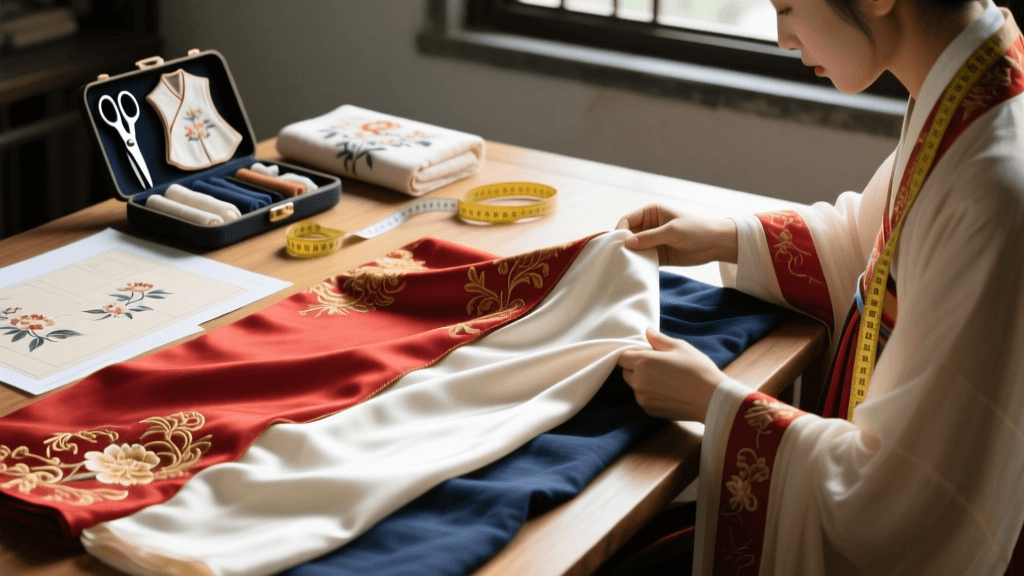
The global Hanfu movement has sparked a profound resurgence of interest in traditional Chinese clothing, transforming historical garments from museum artifacts into vibrant, everyday street fashion. While purchasing ready-to-wear Hanfu is easier than ever, the DIY Hanfu sewing community is thriving among enthusiasts who demand historical accuracy, custom tailoring, and a deeper connection to the craft. Sewing your own Hanfu is not merely about constructing a garment; it is an immersive journey into the philosophy of traditional Chinese aesthetics, flat-pattern drafting, and textile heritage.
Unlike Western tailoring, which relies heavily on darts, curved seams, and complex three-dimensional draping to contour the body, traditional Hanfu construction is rooted in two-dimensional, flat-pattern cutting. The fabric is treated with immense respect, minimizing waste and allowing the natural drape of the textile to dictate the silhouette. This guide will walk you through the essential patterns, fabric selections, and sewing techniques required to create your own authentic Hanfu.
The Philosophy of Flat-Pattern Cutting
When you purchase or draft a Hanfu pattern, you will notice a distinct lack of curved armholes or waist darts. Traditional Chinese garments are constructed using straight lines and geometric panels. The width of the fabric bolt (historically around 50-60 cm, but modern fabrics are usually 110-140 cm) often dictates the proportions of the garment. Sleeves are typically cut as extensions of the bodice, creating a seamless shoulder line that allows the fabric to cascade elegantly over the arms.
The most iconic feature of Hanfu is the Jiaoling Youren (cross-collar, right lapel). This means the left side of the garment crosses over the right side, with the collar edge resting on the wearer's right side.
'The right lapel (Youren) is a defining characteristic of Hanfu and a core tenet of traditional Chinese dress. The left panel crosses over the right, resting on the wearer's right side. In historical Chinese culture, reversing this to a left lapel was strictly reserved for the deceased or specific non-Han ethnic groups, making the direction of the collar a profound cultural signifier.' — Historical Textile and Costume Customs
Selecting the Right Fabric for Your Hanfu
Fabric selection is arguably the most critical step in DIY Hanfu sewing. The wrong fabric can make a historically accurate pattern look like a modern costume, while the right textile will bring the garment to life with authentic movement and drape. As detailed by the Metropolitan Museum of Art's Heilbrunn Timeline of Art History, silk production was a closely guarded imperial secret in ancient China, and it remains the most prestigious and historically accurate fabric for traditional garments. However, modern sewists have a variety of options depending on their budget, climate, and the specific Hanfu style they are recreating.
Fabric Comparison Chart
| Fabric Type | Weight & Drape | Historical Accuracy | Est. Cost per Yard | Best Hanfu Component |
|---|---|---|---|---|
| Mulberry Silk (Charmeuse/Habotai) | Lightweight, fluid, lustrous | High | $25 - $60 | Outer robes, formal Ruqun, Shenyi |
| Raw Silk / Silk Noil | Medium weight, textured, matte | High | $20 - $45 | Winter Ao (jackets), structured skirts |
| Linen & Ramie | Crisp, breathable, stiffens with age | High | $15 - $30 | Summer garments, Zhongyi (undergarments) |
| Cotton Sateen / Poplin | Medium weight, soft, opaque | Medium | $10 - $20 | Everyday Aoqun, Ming Dynasty styles |
| Polyester Chiffon / Organza | Sheer, airy, synthetic sheen | Low (Modern Fantasy) | $5 - $15 | Douyin street fashion, Pibo (shawls) |
Essential Measurements and Yardage Calculations
Because Hanfu relies on flat cutting, standard Western body measurements (bust, waist, hip) are less critical than your overall wingspan and height. The primary measurements you need are:
- Height: Determines the length of the skirt (Qun) and the main robe (Shenyi).
- Arm Span: Measured from wrist to wrist with arms outstretched. This dictates the sleeve length. Traditional wide sleeves (Guangxiu) often extend past the fingertips by 10-20 cm.
- Shoulder Width: Used to calculate the placement of the cross-collar and the width of the back panel.
For a standard Qixiong Ruqun (chest-high skirt and top), you will need approximately 3 to 4 yards of 44-inch wide fabric for the pleated skirt, and 1.5 yards for the top (Shan). For a Ming Dynasty Aoqun (long jacket and horse-face skirt), the pleated Mamianqun (horse-face skirt) requires precise math: typically 4 to 6 yards of medium-weight fabric to achieve the deep, structured pleats and overlapping front panels.
Sewing Techniques: Seams, Hems, and Bias Binding
Sewing Hanfu requires a shift in technique. Because the garments are unlined or lined with contrasting fabrics, the internal finishing must be as beautiful as the exterior. According to Britannica's comprehensive guide on sericulture, the fibroin protein structure of silk gives it a unique triangular prism-like structure that refracts light, but it also makes the fabric notoriously slippery and prone to fraying. Therefore, seam finishing is paramount.
Essential Seams and Edges
- French Seams: The gold standard for Hanfu sewing. Because traditional garments rarely use sergers or overlockers, French seams enclose the raw edges completely, providing a clean, historical finish that is vital when working with sheer silks or ramie.
- Xiang Bian (Bias Binding/Piping): Hanfu collars and edges are rarely faced. Instead, they are finished with bias strips of fabric (often in a contrasting color or pattern). Cutting your own bias tape from silk or cotton and applying it to the neckline and sleeve hems is a mandatory skill.
- Rolled Hems: For the bottom of skirts and the edges of Pibo (draping shawls), a narrow rolled hem (done either by hand or with a specialized presser foot) maintains the fluid drape of the fabric without adding heavy bulk.
Tools of the Trade for the DIY Hanfu Maker
To successfully navigate the slippery nature of silk and the precision required for pleated skirts, your sewing kit must be properly equipped:
- Microtex / Sharp Needles: Standard universal needles will snag silk. Use size 60/8 or 70/10 Microtex needles for a clean pierce.
- Silk Pins: Extra-fine glass head pins that won't leave permanent holes in delicate weaves.
- Rotary Cutter and Mat: Scissors can distort the bias of silk. A rotary cutter ensures perfectly straight geometric panels, which is crucial for the flat-pattern philosophy.
- Pattern Weights: Instead of pinning paper patterns to slippery fabric, use heavy washers or dedicated pattern weights to hold the paper in place while cutting.
Sourcing Patterns and Translating Terminology
For beginners, drafting a Hanfu pattern from scratch can be daunting. Fortunately, the online community offers a wealth of resources. Platforms like Etsy and independent sewing blogs offer PDF patterns drafted for modern fabric widths. If you are sourcing patterns directly from Chinese creators on platforms like Taobao or Weibo, you will encounter specific terminology:
- Cai Jian (裁剪): Cutting layout / Pattern.
- Zhi Sun (褶裙): Pleated skirt.
- Dui Jin (对襟): Center-front opening (symmetrical collar), often used for cardigans or outer jackets.
- Jiao Ling (交领): Cross-collar.
When printing PDF patterns, always verify the scale using the test square provided. Because Hanfu is designed with positive ease (the garment is meant to be larger than the body to allow for wrapping and tying), do not size down the pattern to achieve a 'modern fitted' look, as this will ruin the structural integrity of the cross-collar and the drape of the sleeves.
Finishing Touches: Ties and Fasteners
Hanfu does not use buttons, zippers, or elastic. The entire garment is secured through a system of internal and external ties (Ji Dai). The internal ties (usually placed at the right armpit and left waist) hold the under-layer of the cross-collar securely in place, preventing the garment from gaping open. The external ties are sewn into the side seams and wrapped around the body. These ties must be cut on the bias or straight grain, folded, and topstitched. They should be at least 60 cm long to allow for elegant bows and secure wrapping.
For Ming Dynasty styles, you may incorporate Zi Mu Kou (interlocking metal buttons), which are sewn onto the stand-up collars (Li Ling). These can be sourced from specialty historical sewing suppliers and add a stunning, authentic metallic accent to winter garments.
Conclusion: Embracing the Slow Fashion of Antiquity
DIY Hanfu sewing is an exercise in patience and historical appreciation. By understanding the geometry of flat-pattern cutting, respecting the natural properties of traditional textiles like silk and ramie, and mastering the art of bias binding and French seams, you do more than just make a piece of clothing. You participate in a living tradition, weaving the rich tapestry of Asian heritage into every stitch, pleat, and perfectly aligned cross-collar.