Authenticating Ukrainian Vyshyvanka & Romanian Ie in 2026
The Renaissance of Eastern European Folk Dress in 2026
The landscape of Eastern European and Balkan folk dress has experienced a monumental renaissance by 2026. No longer confined to museum archives or annual heritage festivals, traditional garments like the Ukrainian vyshyvanka and the Romanian ie (pronounced 'ee-eh') have firmly established themselves in the global conscious wardrobe. As consumers increasingly reject fast fashion in favor of slow, meaningful, and culturally rich textiles, the demand for authentic, hand-embroidered Slavic and Balkan garments has reached an all-time high. However, this surge in popularity has also led to a market saturated with machine-made replicas. Understanding the intricate geometry, historical symbolism, and structural anatomy of these garments is essential for any serious collector or cultural enthusiast in 2026.
According to UNESCO's framework for Intangible Cultural Heritage, the preservation of traditional craftsmanship is not merely about saving old clothes; it is about maintaining the living transmission of skills, motifs, and community identity. When you purchase an authentic ie or vyshyvanka, you are investing in a lineage of artisans who have protected these textile codes through centuries of geopolitical upheaval.
Decoding the Vyshyvanka: Ukrainian Embroidery Traditions
The Ukrainian vyshyvanka is far more than a simple embroidered shirt; it is a wearable talisman. Historically, the embroidery was concentrated around the 'openings' of the garment—the neckline, cuffs, and hem—to create a protective barrier against malevolent spirits. In 2026, master artisans continue to utilize over 250 distinct regional stitches, with the cross-stitch (krestik), satin stitch (glad), and the highly complex cutwork (lyshva) being the most prominent.
Hutsul vs. Poltava Motifs: A Regional Breakdown
When sourcing a vyshyvanka, identifying the regional origin is crucial for authentication and styling. The two most sought-after styles in the contemporary market are Hutsul and Poltava.
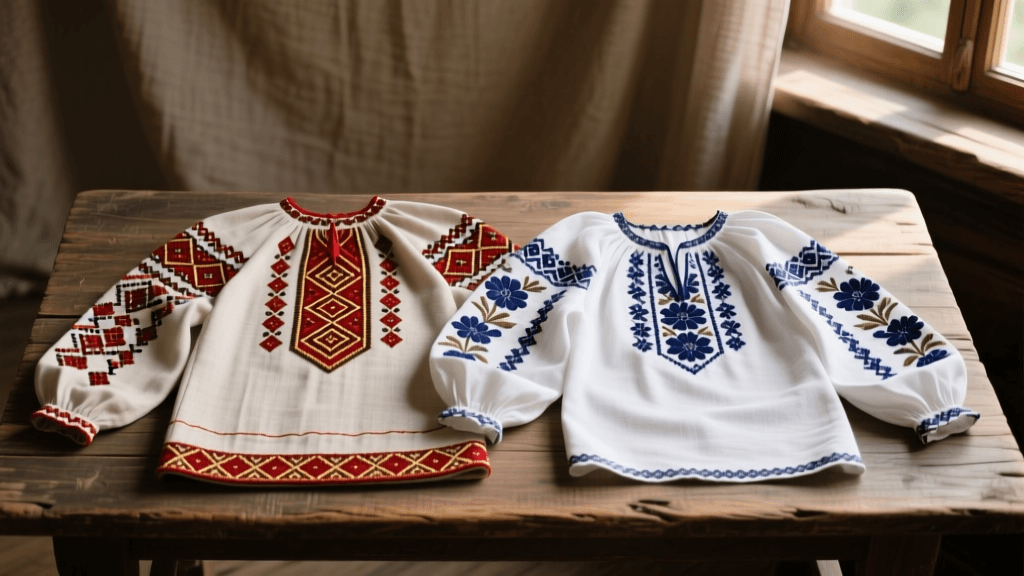
- Hutsul (Carpathian Mountains): Characterized by dense, complex geometric patterns. The color palette traditionally relies heavily on black, deep red, and metallic gold or brass threads. The nyzynka (darning stitch) is used to create a woven, almost kilim-like texture on the fabric. A genuine Hutsul shirt in 2026 requires up to 80 hours of labor, commanding prices between $600 and $1,200 USD.
- Poltava (Central Ukraine): Famous for its ethereal 'white-on-white' embroidery (bila po bilomu). This technique relies on shadow, texture, and intricate cutwork rather than color contrast. It is a hallmark of supreme technical skill, as the artisan must create depth using only the natural shade of unbleached linen and white cotton or silk thread.
The Romanian Ie: Altita, Incret, and Rauri
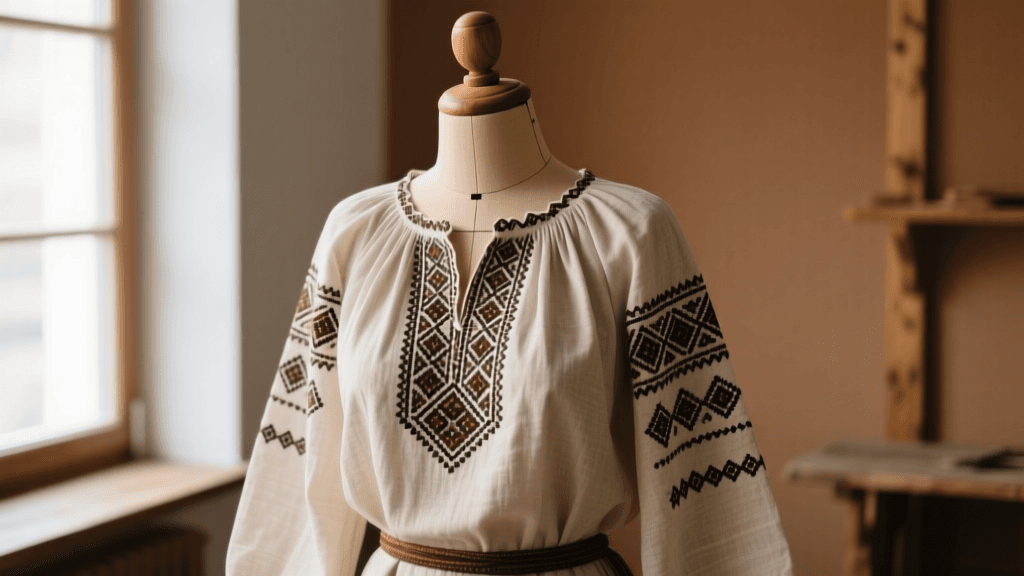
The Romanian ie is the quintessential peasant blouse of the Carpatho-Balkan region, immortalized by Henri Matisse and Yves Saint Laurent, and now experiencing a massive revival among contemporary Balkan designers. The construction of an authentic ie follows a strict, sacred anatomy that mass manufacturers frequently ignore or misunderstand.
The Sacred Anatomy of the Blouse
To authenticate a Romanian ie, you must look for three distinct structural and decorative zones:
- Altița (The Shoulder Epaulette): This is the most important and protected part of the garment. Historically, the altița was never duplicated exactly on any two blouses, as it contained personal protective codes and symbols of the wearer's village, marital status, and family lineage. In 2026, authentic artisans still treat the altița as a unique signature.
- Încreț (The Gather): Located just below the altița, this is a smocked, honeycomb-like gathering of the fabric. It is usually embroidered with a single, contrasting geometric motif, often in yellow or gold thread, symbolizing the sun and agricultural fertility.
- Râuri (The Rivers): These are the vertical or diagonal bands of embroidery that flow down the sleeves and the bodice. They represent the rivers of life and the passage of time. In the Maramureș region, these are stark, black-and-red geometric lines, while in the Olt region, they bloom into vibrant, multicolored floral and avian motifs.
Authentication Guide: Handmade vs. Machine-Made
As the market for Eastern European folk dress expands, so does the prevalence of imported, machine-embroidered knockoffs. Use the following 2026 authentication matrix to evaluate potential purchases, whether you are buying from an artisan cooperative in Cluj-Napoca or an online heritage boutique.
| Feature | Authentic Artisan Handmade (2026) | Mass-Produced Machine Replica |
|---|---|---|
| Reverse Side | Nearly identical to the front; threads are carried neatly or tied off invisibly. | Messy, with long 'jump stitches' connecting disparate motifs, often backed with paper stabilizer. |
| Fabric Base | Hand-woven linen, hemp, or raw silk. Irregularities in the weave are natural and prized. | Uniform poly-blend, thin commercial cotton, or synthetic viscose. |
| Motif Execution | Slight organic variations; tension varies slightly by hand. True cutwork is structurally integrated. | Pixel-perfect, rigid symmetry. 'Cutwork' is often just laser-burned or printed on. |
| Thread Type | Mercerized cotton, hand-spun wool, or natural silk. Colors may have slight lot variations. | High-sheen polyester rayon that catches light unnaturally and snags easily. |
| Average Cost | $450 - $1,500+ USD (depending on region and stitch density). | $35 - $90 USD. |
Sourcing Authentic Garments in 2026
Finding genuine pieces requires looking beyond standard e-commerce platforms. According to the Victoria and Albert Museum's textile archives, the provenance of folk textiles is deeply tied to their geographic and material origins. In 2026, the most reliable method for acquiring authentic garments is through direct-to-artisan cooperatives and specialized cultural NGOs.
For Ukrainian pieces, look for guilds operating out of Lviv and Kyiv that specialize in the revival of pre-industrial loom weaving. For Romanian and Moldovan blouses, the Semne Cusute (Sewn Signs) community and similar digital archives have been instrumental in connecting global buyers with village artisans in Bukovina and Maramureș. When commissioning a piece, expect a lead time of 3 to 6 months. True hand-embroidery cannot be rushed, and artisans in 2026 are increasingly protective of their time and pricing to ensure the economic viability of their craft.
For those seeking vintage or antique pieces (early to mid-20th century), consult the Encyclopedia Britannica's overview of European folk dress to understand the evolution of synthetic dyes. If a 'vintage' piece features neon or highly saturated synthetic colors that were not available until the late 1960s, it is not an early-century antique.
Styling Traditional Garments for the Modern Wardrobe
The beauty of the vyshyvanka and the ie lies in their versatility. In 2026, the styling ethos has shifted away from wearing these pieces as 'costumes' and toward integrating them as statement elements within a minimalist, tailored wardrobe.
Practical Styling Guidelines
- The Monochromatic Contrast: Pair a stark white-on-white Poltava vyshyvanka with wide-leg, charcoal-grey wool trousers and minimalist leather loafers. The texture of the embroidery will pop against the smooth, dark tailoring.
- Layering the Ie: The voluminous sleeves of a Romanian ie make it perfect for layering. Wear it under a structured, sleeveless linen pinafore or a tailored wool vest. Allow the altița and the smocked cuffs to remain visible.
- Footwear and Accessories: Avoid pairing these garments with traditional folk accessories unless you are attending a specific cultural festival. Instead, ground the outfit with contemporary, architectural footwear—such as square-toed leather boots or sleek, minimal sneakers. Keep jewelry limited to raw, unpolished metals or simple amber, which historically complements the warm tones of Balkan embroidery.
'To wear a hand-embroidered garment is to wear a map of a culture's soul. Every stitch is a coordinate, every color a memory. In 2026, we do not just wear these pieces; we steward them.' — Anonymous Artisan, Maramureș Cooperative.
Conclusion: Investing in Living Heritage
As we navigate the fashion landscape of 2026, the Ukrainian vyshyvanka and the Romanian ie stand as testaments to the resilience and profound beauty of Eastern European and Balkan craftsmanship. By learning to authenticate the stitches, understand the regional motifs, and source directly from the artisans who keep these traditions alive, you are doing more than elevating your wardrobe. You are participating in the vital, ongoing preservation of European folk dress, ensuring that these magnificent textile codes continue to be read and revered for generations to come.