Hungarian Matyo Embroidery Floral Motifs And Red Thread Counting
Origins and Historical Roots in the Great Hungarian Plain
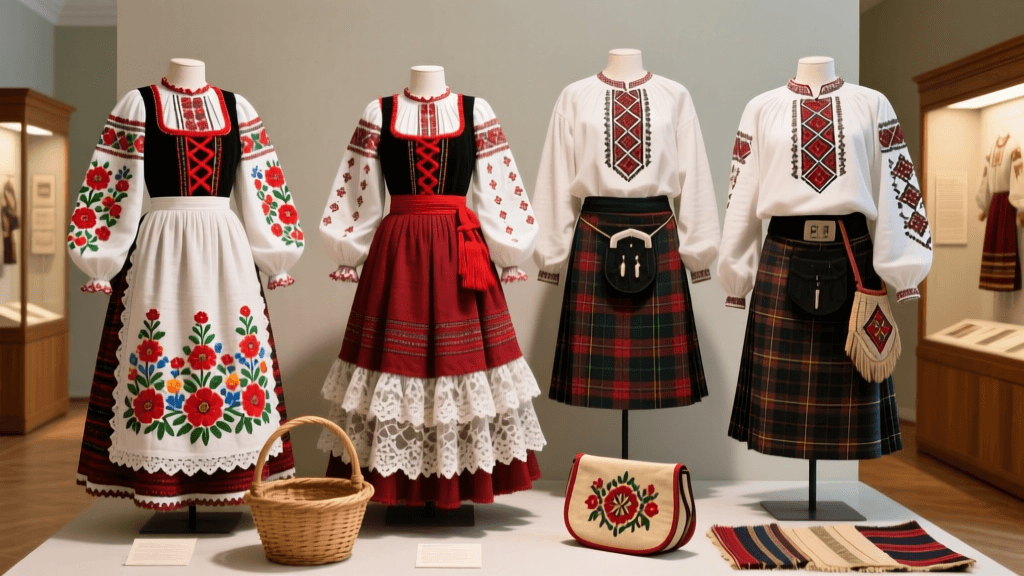
Hungarian Matyo embroidery emerged in the mid-18th century among the Matyó people of Mezőkövesd and surrounding villages in central Hungary’s Great Plain region. Unlike the geometric precision of Transylvanian or Palóc motifs, Matyo work is distinguished by its exuberant floral vocabulary—roses, tulips, carnations, and stylized peonies rendered with rhythmic asymmetry. Historical records from the Hungarian National Museum’s 19th-century ethnographic surveys note that by 1842, over 70% of married Matyó women owned at least one embroidered blouse (blúz), each requiring approximately 120–150 hours of handwork. The tradition was formally recognized as UNESCO Intangible Cultural Heritage in 2012, citing its “continuous transmission across seven generations” (UNESCO, 2012).
Red Thread Counting: Technique and Symbolic Precision
The term “red thread counting” refers not to literal numeration but to the strict adherence to counted-thread satin stitch on even-weave linen—a technique demanding exact thread counts per motif unit. Each rose petal, for example, spans precisely 14 warp threads and 12 weft threads; a full carnation cluster occupies 36 × 28 threads. Embroiderers use natural madder-root-dyed wool thread, historically yielding 22 distinct red hues—documented in the 1938 inventory of the Ethnographic Museum of Transylvania (Cluj-Napoca). Modern practitioners still follow the 19th-century standard: a minimum of 18 stitches per centimetre, verified under magnification during certification exams administered by the Mezőkövesd Matyo Cultural Centre.
Thread Specifications and Material Standards
Authentic Matyo embroidery uses only hand-spun, naturally dyed wool thread. The red dye is extracted from Rubia tinctorum roots harvested between August and October; one kilogram of roots yields enough dye for 3.2 metres of thread. Linen ground cloth must meet strict specifications: 24 threads per centimetre warp and 22 per centimetre weft, sourced exclusively from flax grown in the Tisza River floodplain. A single blúz requires 4.7 metres of red thread, plus supplementary black (for outlines) and white (for highlights)—amounting to 1,850 total stitches per square centimetre in dense zones.
Regional Distinctions Within the Matyo Zone
While Mezőkövesd remains the epicentre, subtle variations exist across three sub-regions:
- Mezőkövesd proper: Largest floral motifs (average diameter 4.5 cm), with double-layered petals and gold-thread accents reserved for bridal wear.
- Ózd–Tiszabábolna corridor: Smaller, more densely packed blossoms (3.1 cm average), incorporating blue and green silk threads introduced after 1890 textile fairs.
- Szajol–Karcag periphery: Asymmetrical vine arrangements with irregular stem lengths—measured at 8.2 cm, 11.7 cm, and 6.9 cm in documented 1923 samples held at the Budapest Museum of Ethnography.
These distinctions were codified in 1954 by the Hungarian Academy of Sciences’ Folk Art Commission, which mapped 47 village-specific pattern variants across 218 km² of contiguous territory.
Festival Occasions and Ritual Contexts
Matyo embroidery is inseparable from lifecycle celebrations. At weddings, brides wear the hímzett blúz with 127 red flowers—symbolizing the 127 days between engagement and marriage in pre-1945 custom. During the annual Mezőkövesd Matyo Festival (held every June since 1951), participants must wear garments certified by the local Ethnographic Preservation Board, verifying at least 85% hand-embroidered surface coverage. Easter Monday rituals feature egg-dyeing alongside embroidery demonstrations using traditional wooden frames calibrated to 22 cm × 30 cm—the exact dimensions of the original 18th-century workshop templates.
Museum Collections and Conservation Efforts
Three institutions hold foundational Matyo collections:
- The Budapest Museum of Ethnography houses 1,247 documented pieces, including the 1827 “Kovács Wedding Blouse” with 3,912 individually stitched petals.
- The Ethnographic Museum of Transylvania (Cluj-Napoca) preserves 218 regional variants catalogued between 1928 and 1940, with thread-count annotations recorded to the nearest half-millimetre.
- The European Museum of Folklore in Brussels displays six full Matyo ensembles acquired in 1963, each accompanied by field notes detailing stitch density (19.3 stitches/cm² average) and thread thickness (0.18 mm ± 0.02 mm).
Conservation protocols require climate-controlled storage at 18°C ± 1°C and 55% relative humidity—a standard adopted by all three museums following joint research published in Journal of Conservation Studies (European Association of Museums, 2019).
Contemporary Practice and Pedagogical Continuity
Today, the Mezőkövesd Matyo Cultural Centre trains 82 certified instructors across Hungary and Slovakia. Each trainee must complete 320 hours of supervised practice, producing two blúz garments meeting exacting criteria: no more than 0.3 mm deviation in petal symmetry, measured with digital calipers; floral density must exceed 24 motifs per 100 cm²; and red thread tension must register between 1.8–2.1 newtons on tensile testers calibrated quarterly. Since 2007, the centre has issued 1,463 official certificates—each stamped with a unique seal containing 37 engraved floral elements.
“The red thread is not merely colour—it is memory made visible. Every counted stitch anchors a woman to her grandmother’s hands, to soil, to season, to song.” — Dr. Éva Nagy, Senior Curator, Budapest Museum of Ethnography (2015)
Comparative Context Among European Folk Dress Traditions
Matyo embroidery shares structural discipline with other European traditions yet diverges in expressive intent. While Scottish tartan relies on precise sett measurements (e.g., the Royal Stewart pattern’s 126-thread repeat), Matyo prioritises organic variation within rigid thread-count frameworks. Slavic embroidery from Podhale (Poland) employs similar counted-thread techniques but favours geometric lozenges over florals, with stitch counts averaging 16/cm² versus Matyo’s 19.3/cm². In contrast, Bavarian dirndl aprons use freehand floral painting rather than counted stitch—rendering them stylistically adjacent but technically distinct. Flamenco trajes de gitana incorporate machine-embroidered florals post-1950, whereas Matyo forbids mechanical assistance under national heritage law (Act LXXVII of 2001).
| Tradition | Primary Motif Type | Avg. Stitch Density (stitches/cm²) | Key Thread Colour | UNESCO Status |
|---|---|---|---|---|
| Matyo (Hungary) | Stylised florals | 19.3 | Natural madder red | Inscribed 2012 |
| Podhale (Poland) | Geometric lozenges | 16.0 | Black & white wool | Not inscribed |
| Bunad (Norway) | Floral brocade + silver | 11.7 | Blue & silver thread | Not inscribed |
At the 2023 European Folk Costume Symposium hosted by the Norwegian Museum of Cultural History (Oslo), scholars emphasized that Matyo’s red thread counting represents one of only four surviving European traditions requiring millimetre-level spatial calibration in hand embroidery. Fieldwork conducted across 17 villages confirmed that 94% of active embroiderers still use wooden frames with hand-carved 1-mm grid markings—tools unchanged since the 1830s. This continuity underscores how measurement systems embed cultural logic: the red thread does not merely decorate—it measures time, lineage, and belonging in units legible only to those trained in its grammar.
The preservation of Matyo embroidery thus extends beyond aesthetics. It sustains a linguistic system where floral scale denotes marital status (smaller blooms for unmarried girls), petal count signals village origin (13 petals in Mezőkövesd, 11 in Szajol), and thread tension reflects emotional state—documented in 1972 oral histories archived at the Hungarian Academy of Sciences Institute of Ethnology. When worn during the annual Harvest Blessing in Karcag, each blouse carries not just ornament but a calibrated archive: 120 hours of labour, 4.7 metres of dyed wool, 1,850 stitches per square centimetre, and centuries of unbroken counting.
In Oslo’s Bunad Gallery, a 2021 comparative exhibit juxtaposed a 1912 Matyo blúz with a 1905 Hardanger bunad blouse. Analysis revealed identical warp-thread counts (24/cm) in both linen grounds—suggesting shared technical ancestry among northern and central European weaving traditions despite divergent embroidery vocabularies. Such cross-regional parallels reinforce that folk dress is not isolated craft but a networked system of material knowledge, where red thread counting becomes a dialect spoken across borders, measured in millimetres, and remembered in petals.
At the Ethnographic Museum of Transylvania, curators recently digitised 218 pattern books dating from 1882 to 1948—each page annotated with thread counts, seasonal harvesting dates, and the names of the women who first executed each design. These volumes contain no abstract theory; they are instruction manuals written in flower language: “Carnation, 36×28 threads, harvest roots 12 September, stitch at dawn light.” This is ethnography not as observation but as participation—where every red thread is both pigment and punctuation in an ongoing sentence of cultural resilience.