Murasaki Shikibu's Legacy: Heian Color Layering for Modern Kimono
Murasaki Shikibu and the Birth of Kasane no Irome
The Heian period (794–1185) of Japan is widely regarded as the pinnacle of classical Japanese art, literature, and courtly refinement. At the very heart of this cultural renaissance was Murasaki Shikibu, the legendary lady-in-waiting and author of 'The Tale of Genji'. While she is globally celebrated for her literary genius, Murasaki Shikibu also left an indelible mark on the history of Asian traditional garments through her meticulous documentation and elevation of 'Kasane no Irome'—the art of layered color combinations. For the modern kimono enthusiast, understanding Murasaki’s fashion legacy is not merely an exercise in historical appreciation; it is a practical masterclass in color theory, seasonal awareness, and sartorial elegance.
The Mechanics of Heian Color Layering
In the Heian court, a person's rank, taste, and emotional state were communicated not through spoken word, but through the subtle interplay of silk layers. The ultimate expression of this was the 'Junihitoe', a twelve-layer robe worn by high-ranking court ladies. Because the sheer volume of silk concealed the body entirely, fashion was distilled to the margins: the edges of the sleeves, the hem of the skirt, and the nape of the neck. As highlighted by the Victoria and Albert Museum's comprehensive exploration of kimono history, the foundation of Japanese sartorial elegance relies heavily on these early courtly aesthetics, where color was treated as a living, breathing language tied to the natural world.
Murasaki Shikibu’s writings reveal a society obsessed with the poetic resonance of color pairings. A mismatched layer was considered a grave social faux pas, indicating a lack of refinement and education. The Kasane no Irome system dictated specific outer and inner color combinations based on the micro-seasons, local flora, and classical poetry. The Kyoto National Museum preserves rare textile fragments and historical scrolls that illustrate the staggering complexity of Heian dyeing techniques, showcasing how artisans used natural plant dyes to achieve the precise, translucent hues required for these layered effects.
Classic Kasane no Irome Seasonal Combinations
| Combination Name | Outer Layer | Inner Layer | Season | Poetic Meaning |
|---|---|---|---|---|
| Kobai (Red Plum) | Deep Crimson | Light Pink | Early Spring | Plum blossoms peeking through snow |
| Yamabuki (Japanese Rose) | Golden Yellow | Pale Green | Late Spring | Bright blooming rose against new leaves |
| Hanatachibana | Orange-Red | Yellow-Green | Early Summer | Wild citrus blossoms in the grove |
| Kikujin | Pale Green | White | Summer | Fresh, translucent summer leaves |
| Momiji (Autumn Leaves) | Crimson | Golden Yellow | Late Autumn | Turning maple leaves in the valley |
| Shinobu | Dark Green | Light Green | Winter | Enduring ferns beneath the frost |
Adapting Historical Layering for the Modern Kimono Wardrobe
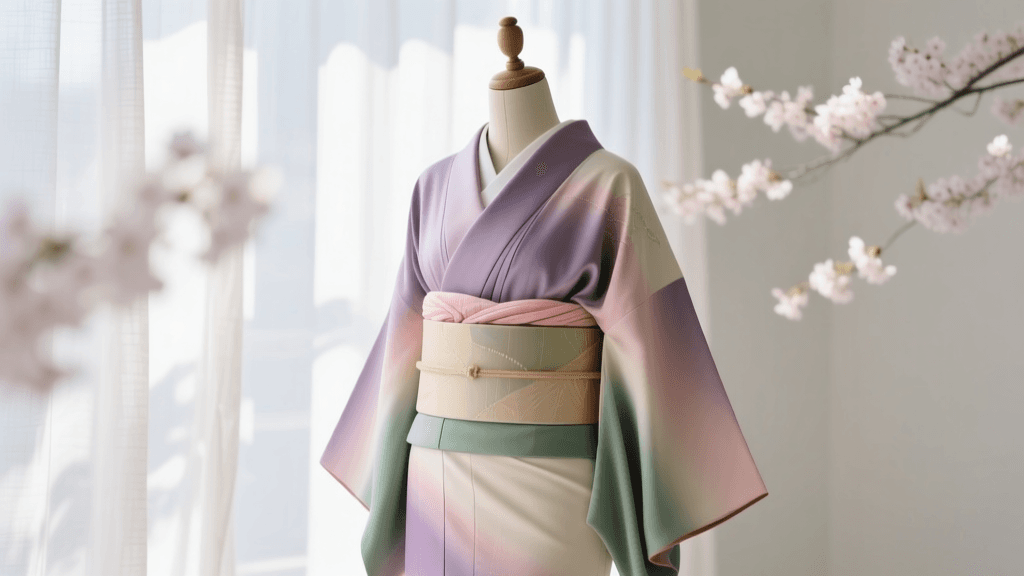
Today, the modern kimono wearer does not don a twelve-layer Junihitoe for daily life or even formal events. However, the foundational principles of Kasane no Irome remain deeply embedded in modern 'kitsuke' (the art of dressing). The legacy of Murasaki Shikibu survives primarily in the coordination of the 'nagajuban' (undergarment), the 'han-eri' (half-collar), and the 'obi' (sash). By utilizing a 'kasane-eri' (a specialized layered collar accessory), modern wearers can replicate the breathtaking depth of Heian layering at the neckline.
Actionable Sourcing and Styling Guide
- Product: Silk Kasane-eri (Layered Collar). This is a pre-sewn, double-layered false collar designed to mimic the look of multiple silk robes.
- Cost: Typically ranges from ¥2,500 to ¥6,000 ($18–$45 USD) for high-quality chirimen silk crepe. Vintage silk options can be found for under ¥2,000 at Kyoto flea markets.
- Measurements: A standard kasane-eri is 110 cm long and 11 cm wide. When pinned to the nagajuban, it must extend exactly 1.5 cm to 2 cm beyond the main collar. This precise measurement replicates the visual effect of multiple silk robes peeking out from beneath a heavier outer garment.
- Timing & Etiquette: Heian color rules are strictly bound to the calendar. The 'Kobai' (Red Plum) combination is reserved exclusively for late January through early February. Wearing it in March, after the plum blossoms have fallen, is considered deeply unrefined. Similarly, 'Momiji' (Autumn Leaves) should only be introduced in late October and retired by early December.
Expanding the Layering Concept to the Obi
The genius of Kasane no Irome is that it can be applied beyond the collar. Modern stylists often apply Heian color pairings to the waist accessories. For instance, pairing a deep crimson 'fukuro obi' with a pale gold 'obijime' (decorative cord) and a light green 'obidome' (cord clasp) creates a three-dimensional layered effect at the waist. This mirrors the sleeve layering of the Heian period, drawing the eye to the intersections of color and texture. When selecting these accessories, always ensure the inner, lighter color represents the 'hidden' layer, while the darker, dominant color represents the 'outer' robe.
Fabric Seasonality and Garment Care
To fully honor the Heian legacy, one must also respect fabric seasonality, which dictates how colors interact with light and texture. From October to May, wear 'awase' (lined silk kimono). In the transitional months of June and September, switch to 'hitoe' (unlined silk). During the humid peak of summer in July and August, traditionalists wear 'ro' or 'sha'—sheer, leno-weave silks that allow the inner layers to be visibly appreciated, much like the translucent Heian robes of Murasaki’s era.
Caring for these layered silk accessories requires diligence. Silk kasane-eri and han-eri must be removed from the juban after every wear. Gently spot-clean the neckline area with a specialized silk detergent, and press with a low-heat iron using a cotton pressing cloth to avoid scorching the delicate dyes. Professional cleaning for heavily soiled silk collars costs approximately ¥1,500 per piece in Japan, a worthwhile investment to preserve the vibrancy of the historical colorways.
Conclusion
Murasaki Shikibu’s fashion legacy is a testament to the idea that clothing is never merely functional; it is a canvas for poetry, nature, and time. By integrating the principles of Kasane no Irome into your modern kimono wardrobe, you do more than just dress well—you participate in a continuous, thousand-year-old dialogue with the natural world. Whether you are sourcing a vintage silk collar in Kyoto or carefully selecting your obijime for a winter tea ceremony, the spirit of the Heian court remains alive in every layered fold.