Sourcing Haudenosaunee Raised Beadwork & Velvet Regalia 2026
The Living Legacy of Haudenosaunee Trade Cloth Regalia
When discussing Indigenous North American dress traditions, the intricate and breathtaking regalia of the Haudenosaunee (commonly known as the Iroquois) stands as a masterclass in cultural adaptation and artistic excellence. Comprising the Six Nations—the Mohawk, Oneida, Onondaga, Cayuga, Seneca, and Tuscarora—the Haudenosaunee Confederacy has a rich sartorial history that beautifully merges pre-contact traditions with European trade goods. As we navigate the 2026 powwow and ceremonial season, the demand for authentic, handcrafted Haudenosaunee velvet garments and raised beadwork has reached new heights, driven by a powerful movement of Indigenous cultural revitalization and contemporary fashion reclamation.
Unlike the Plains tribes, who are globally renowned for their brain-tanned buckskin and elaborate geometric quillwork, the Northeastern Woodlands Haudenosaunee embraced European trade materials in the 18th and 19th centuries. They transformed broadcloth, velvet, and glass seed beads into a distinct visual language. Today, understanding how to source, commission, and care for these garments requires a deep respect for tribal protocols, regional variations, and the specialized materials that define this art form in 2026.
The Anatomy of Raised Beadwork: Techniques and Materials
The hallmark of Haudenosaunee beadwork is the 'raised' or 'embossed' technique. Unlike the flat, lazy-stitch beadwork common in other regions, Haudenosaunee artisans create a three-dimensional effect by layering beads over a raised backing. Historically, this backing was made from birchbark, folded newspaper, or heavy cardboard. The beads are stitched tightly over this padding, creating a lush, textured surface that catches the light and gives floral and avian motifs a lifelike, sculptural quality.
According to the Iroquois Indian Museum, this embossed style flourished during the Victorian era as Haudenosaunee women created 'whimsies' and pincushions for the tourist trade, which in turn funded their communities and preserved their beadworking skills for ceremonial regalia. Today, the same meticulous techniques are applied to velvet skirts, sashes, moccasins, and the iconic Gustoweh (traditional headdress) bases.
Sourcing Authentic Glass Beads in 2026
To achieve the fine, raised detailing required for authentic Haudenosaunee floral patterns, artisans rely on incredibly small seed beads. In 2026, the industry standard remains the size 13/0 and 14/0 Charlotte cut beads, primarily manufactured by Preciosa in the Czech Republic. The 'Charlotte' cut features a single flat facet that reflects light brilliantly, mimicking the shimmer of steel beads used in historical garments.
- Size 13/0 & 14/0 Charlotte Cuts: Essential for the tight curves of floral vines and leaf edges. Expect to pay between $8 and $12 per hank (approximately 12 inches of strung beads) from specialized Indigenous trading posts or premium bead suppliers in 2026.
- Opaque Colors: Traditional palettes rely heavily on opaque white, turquoise, red, and yellow. Due to global glass manufacturing shifts, sourcing consistent batches of opaque turquoise has become a premium endeavor this year, often requiring artisans to pre-order directly from European distributors.
- Thread and Needles: Nymo or Silamide beading thread in size B or D is preferred for its tensile strength. Artisans must use specialized beading needles (size 12 or 13) to pass through the tiny 14/0 beads multiple times when securing the raised layers.
Selecting the Right Velvet and Broadcloth
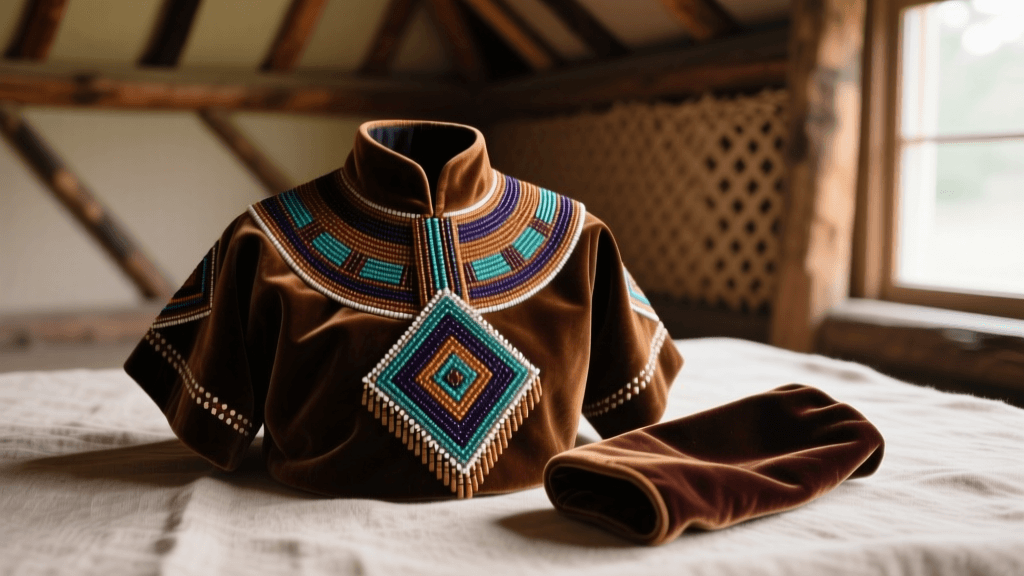
The foundation of Haudenosaunee women's regalia is the velvet skirt, often paired with a matching yoke or sash. In 2026, master beadworkers and seamstresses strongly advise against synthetic 'crushed' or 'panne' velvets, which lack the historical drape, matte finish, and structural integrity needed to support heavy, raised beadwork. Instead, 100% cotton velvet or high-grade upholstery-weight velvet is the standard. These fabrics provide a sturdy pile that grips the beadwork and prevents the heavy glass from sagging over time. High-quality cotton velvet currently retails between $45 and $65 per yard, requiring an investment of roughly $150 to $200 just for the base fabric of a full traditional skirt.
Floral vs. Geometric: Six Nations Regional Variations
While the raised technique is shared across the Confederacy, the motifs and colorways often signal a maker's specific tribal affiliation or regional influence. The Smithsonian National Museum of the American Indian houses extensive collections that highlight these distinct evolutionary paths.
- Mohawk and Seneca Floral Styles: These nations are renowned for their highly symmetrical, dense, and intricate floral motifs. The 'Mohawk strawberry' and elaborate climbing vines are central themes, often utilizing a vibrant, high-contrast color palette against deep navy or black velvet.
- Tuscarora Influences: As the sixth nation to join the Confederacy (having migrated from the Carolinas in the 18th century), Tuscarora beadwork sometimes incorporates distinct southern floral influences or unique geometric borders that differentiate it from the New York-based nations.
- Contemporary Adaptations: In 2026, younger Haudenosaunee designers are blending traditional raised beadwork with modern silhouettes, incorporating sustainable, locally sourced broadcloth and experimenting with metallic threads alongside traditional glass beads, pushing the boundaries of Woodlands fashion while maintaining strict adherence to ancestral techniques.
2026 Artisan Commission and Material Cost Guide
Commissioning a piece of Haudenosaunee regalia is an investment in a master artisan's time, cultural knowledge, and physical endurance. Raised beadwork is incredibly taxing on the hands and eyes. A single velvet skirt with a fully beaded hem and apron can take over 300 hours to complete. Below is the 2026 market rate guide for commissioning authentic pieces from established Haudenosaunee artisans.
| Garment / Item | Materials Required | 2026 Artisan Commission Rate | Estimated Lead Time |
|---|---|---|---|
| Beaded Skullcap (Gustoweh Base) | Velvet, satin lining, size 13/0 beads | $350 - $550 | 2 - 3 Months |
| Women's Traditional Velvet Skirt | 3-4 yards cotton velvet, broadcloth trim, extensive floral beadwork | $1,400 - $2,200 | 6 - 9 Months |
| Beaded Sash / Belt | Wool broadcloth, heavy interfacing, size 13/0 beads | $450 - $700 | 3 - 4 Months |
| Center-Seam Moccasins | Brain-tanned deer hide, smoked finish, raised beadwork vamp | $650 - $950 | 4 - 5 Months |
| Men's Velvet Yoke / Cape | Heavy velvet, satin lining, symmetrical chest beadwork | $800 - $1,300 | 4 - 6 Months |
Note: Prices reflect direct commissions from Indigenous artists. Purchasing from non-Native middlemen or mass-produced overseas imitations is strongly discouraged by the Haudenosaunee Confederacy and violates the Indian Arts and Crafts Act.
Preservation and Archival Care for Heirloom Garments
Haudenosaunee regalia is not merely clothing; it is a living heirloom meant to be passed down through generations. Proper care is essential to preserve both the delicate velvet pile and the structural integrity of the raised beadwork.
Storage Protocols
Never fold a beaded velvet garment. Folding creates permanent creases in the velvet pile and places immense stress on the beading threads, which can snap under the weight of the glass beads over time. In 2026, museum conservators recommend storing velvet skirts on wide, padded hangers covered in unbleached cotton muslin. The garments should be kept in a climate-controlled environment, away from direct sunlight, which can fade the vibrant opaque beads and degrade the cotton velvet fibers.
Cleaning and Maintenance
Water and commercial fabric cleaners are the enemies of raised beadwork. Moisture can cause the internal cardboard or birchbark backing to warp, melt, or develop mold, ruining the 3D embossed effect. If a velvet skirt becomes dusty, use a soft-bristled natural hair brush to gently sweep the fabric in the direction of the pile. For the beadwork itself, a dry, soft microfiber cloth can be used to gently buff the Charlotte cut beads and restore their shine. If a bead breaks or a thread snaps, the garment must be taken to a skilled Indigenous beadworker for repair; attempting to patch raised beadwork without understanding the underlying padding structure will result in further damage.
Conclusion
The creation and wearing of Haudenosaunee raised beadwork and velvet regalia in 2026 is a profound act of cultural sovereignty. By understanding the specific material requirements, respecting the regional variations among the Six Nations, and investing ethically in Indigenous master artisans, collectors and community members alike can ensure that this breathtaking Northeastern Woodlands tradition continues to thrive for generations to come.