Hardangerbunad Bodice & Skirt Pattern Drafting Guide 2026
The 2026 Revival of Hardangerbunad Construction
The Hardangerbunad, originating from the Hardanger region in Norway, stands as one of the most iconic and meticulously constructed examples of European folk dress. As we navigate the tailoring landscape of 2026, there is a profound resurgence in heritage garment construction. Artisans and hobbyists alike are moving away from mass-produced festival wear, opting instead to draft, cut, and sew these garments using historically accurate patterns augmented by modern precision tools. This comprehensive guide details the exact construction patterns and techniques required to build a traditional Hardangerbunad bodice and skirt in 2026, blending centuries-old Norwegian tailoring wisdom with contemporary digital pattern drafting.
According to archives preserved by DigitaltMuseum, the original 19th-century garments were constructed using geometric, straight-grain pattern pieces to minimize fabric waste. Today, understanding these foundational geometry principles is essential before applying modern fitting adjustments. The construction of the Hardangerbunad requires a deep understanding of structural tailoring, particularly in the heavily boned bodice and the mathematically precise box-pleated skirt.
Essential Materials and 2026 Sourcing Costs
Before drafting your patterns, securing the correct textiles is paramount. The year 2026 has seen fluctuations in the European textile market, particularly for heritage-grade worsted wools and high-count linens. When sourcing materials, always consult certified regional distributors such as Husfliden to ensure your materials meet the strict Bunad and Folk Costume Council guidelines.
| Material | Specification | 2026 Estimated Cost (per meter) | Construction Purpose |
|---|---|---|---|
| Worsted Wool (Black/Navy) | 140cm width, 280g/m² | €65 - €85 | Skirt and Bodice outer shell |
| Heavyweight Linen | 150cm width, 220g/m² | €30 - €45 | Bodice lining and structural interlining |
| Silk Embroidery Thread | Multistrand, high-sheen | €12 per skein | Traditional Hardanger whitework and floral motifs |
| Flat Steel Boning | 6mm width, spiral/flat mix | €4.50 per meter | Bodice structural support and posture alignment |
| Wool Flannel (Red/Green) | 100% wool, medium weight | €40 - €55 | Skirt hem facing and appliqué base |
Drafting the Hardangerbunad Bodice Pattern
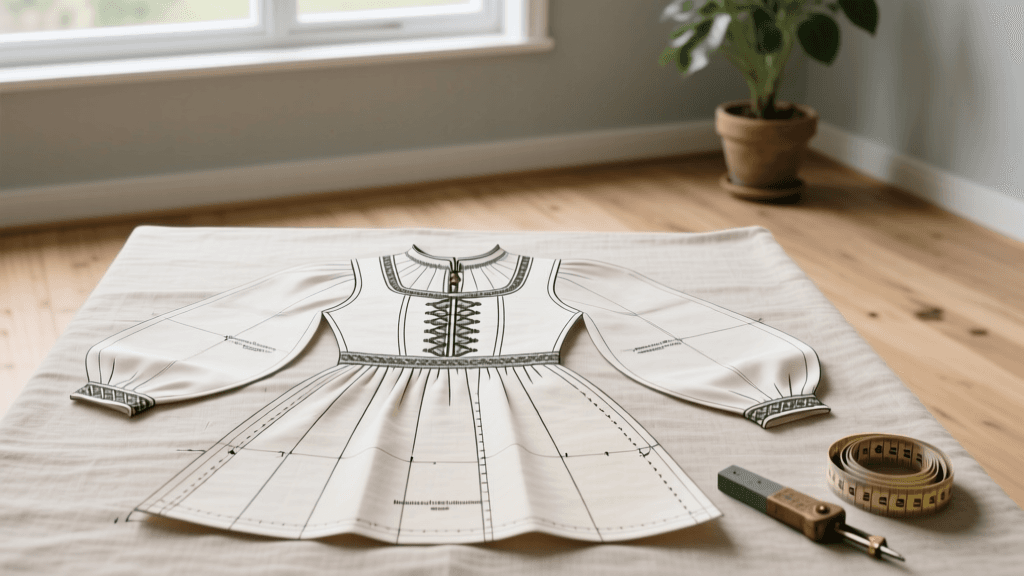
The bodice of the Hardangerbunad is a masterclass in structural tailoring. Unlike modern fashion bodices that rely on stretch fabrics and darts, the traditional bunad bodice uses princess seams and heavy interlining to create a rigid, conical silhouette that supports the back and elevates the posture. In 2026, many independent tailors utilize open-source software like Seamly2D to parametrically draft the base block before printing it at a 1:1 scale.
Step 1: The Base Block and Princess Seams
Begin by drafting a close-fitting, sleeveless block based on the wearer's exact bust, waist, and back-width measurements. The Hardangerbunad bodice features a deep, squared neckline in the front and a scooped back. Divide the front and back pattern pieces using princess seams that originate from the armhole and curve down to the waist. These seams are not merely decorative; they house the primary boning channels. Ensure you add a 1.5cm seam allowance to all structural seams, as the thick wool and linen layers will consume more ease than standard cotton.
Step 2: Interlining and Boning Channels
The secret to the bodice's longevity lies in the interlining. Cut the interlining pieces from heavyweight linen. Before assembling the outer wool shell, construct the inner corset. Create boning channels by sewing parallel lines of stitching 8mm apart along the princess seams and center back. Insert flat steel boning into these channels. In 2026, tailors increasingly use silicone-tipped bone casing to prevent the steel from fraying the linen over decades of wear. The front center panel often features a wooden busk or a heavy-duty steel bone to maintain a perfectly flat front profile beneath the intricate embroidery.
Step 3: Neckline and Armhole Finishing
The edges of the bodice are traditionally finished with a narrow wool braid or a silk binding. When drafting the pattern, do not add extra ease to the neckline; the structural interlining will prevent stretching. Bind the edges using a 2cm wide bias strip of silk or fine wool, slip-stitched by hand to the inner linen lining to ensure no machine stitches are visible on the garment's exterior.
Fitting Adjustments for Historical Accuracy
When fitting the Hardangerbunad bodice in 2026, modern tailors must resist the urge to apply contemporary fashion ease. Historical folk dress was designed to be worn tightly, acting almost as a supportive corset that redistributes the weight of the heavy wool skirt and silver belt accessories. During the first muslin fitting, ensure the armholes are cut exceptionally high and close to the armpit. This historical tailoring trick prevents the fabric from bunching when the wearer moves their arms and provides greater overall mobility. The shoulder seams should sit slightly back from the natural shoulder line, pulling the garment taut across the upper back. Furthermore, the waistline of the bodice must align precisely with the wearer's natural waist, not the modern dropped waist, to properly support the skirt's waistband and the heavy silver soljer (brooches) that will be pinned to the front panel.
Skirt Construction and Box Pleating Techniques
The Hardangerbunad skirt is renowned for its rich, deep folds and heavy drape. It is constructed from a single, continuous length of worsted wool, gathered into precise box pleats at the waistband. The mathematical precision required for this step is where many novice tailors struggle.
Calculating the Pleat Ratio
The traditional ratio for a bunad skirt is 3:1, meaning you need three meters of fabric for every one meter of the wearer's waist circumference. For a waist measurement of 75cm (plus 2cm for ease), the finished waistband will be 77cm. Therefore, you will need 231cm of fabric width dedicated solely to the pleated section. Because standard wool is 140cm wide, the skirt must be constructed from multiple panels, joined using flat-felled seams to ensure durability and a clean interior finish.
Setting the Box Pleats
- Marking: Use tailor's chalk and a meter ruler to mark the pleat lines on the wrong side of the fabric. A standard box pleat for the bunad consists of a 6cm visible face and a 12cm hidden underlay.
- Pressing: Traditional tailors use a heavy iron with a pressing cloth and a solution of water and white vinegar to set the wool pleats permanently. The acetic acid in the vinegar relaxes the wool fibers, allowing them to be molded into sharp, lasting creases.
- Basting: Hand-baste the pleats 2cm from the top edge before attaching the waistband. Machine stitching at this stage can cause the thick layers of wool to shift, resulting in uneven folds.
The Hem Facing
To protect the worsted wool from mud and wear, the bottom 10cm of the skirt is faced with a contrasting wool flannel, typically in deep red or forest green. This facing is applied to the inside of the hem and secured with a blind catch stitch. The added weight of the flannel facing also acts as a structural anchor, ensuring the skirt swings beautifully and maintains its conical shape when the wearer is in motion.
Integrating Embroidery into the Construction Workflow
The Hardangerbunad is heavily adorned with regional embroidery, particularly the intricate whitework (Hardangersøm) on the linen apron and shirt, and the colorful floral wool embroidery on the bodice and skirt pockets. A critical mistake in 2026 pattern drafting is failing to account for the embroidery hoop's requirements. When drafting the bodice front panels, you must extend the pattern pieces by at least 5cm on all sides to allow for hoop tension. The embroidery must be completed entirely before the interlining is applied and the princess seams are sewn. Attempting to embroider through the heavy linen interlining will ruin the tension of the silk threads and distort the historical motifs.
Modern Digital Tools for the 2026 Tailor
While the physical construction remains deeply rooted in hand-sewing and traditional tailoring, the preliminary stages have been revolutionized. Software such as CLO 3D allows artisans to input their 2D Seamly2D patterns and simulate the drape of the heavy worsted wool virtually. This 3D prototyping is invaluable for testing the 3:1 pleat ratio and visualizing how the box pleats will sit on the wearer's specific hip-to-waist ratio before cutting into €85-per-meter heritage textiles. By marrying the ancestral knowledge documented by institutions like DigitaltMuseum with modern parametric design, the 2026 tailor ensures that the Hardangerbunad remains a living, breathing masterpiece of European folk dress.
By adhering to these stringent fitting protocols and utilizing precise parametric drafting tools, contemporary artisans can produce garments that honor the deep cultural heritage of the Hardanger region. The intersection of ancestral techniques and modern technology ensures that the European folk dress tradition will continue to thrive and evolve throughout 2026 and beyond.