The Hanfu Retail Revolution: From Silk Markets to E-Commerce
The Historical Marketplace: Silk Routes and Imperial Weavers
For millennia, acquiring traditional Chinese garments was not a matter of browsing a digital catalog or clicking 'add to cart.' The procurement of Hanfu and other historical Chinese clothing was deeply intertwined with the agricultural calendar, regional trade routes, and the strict sumptuary laws of imperial dynasties. In ancient and pre-modern China, textiles were a form of currency and a marker of social status. According to the Metropolitan Museum of Art, the complexity of Chinese silk weaving and the vast trade networks of the Silk Road meant that high-quality fabrics like brocade, damask, and gauze were heavily regulated luxury goods.
Consumers in historical markets—such as the bustling silk hubs of Suzhou and Hangzhou—did not buy ready-to-wear garments. Instead, they purchased raw textiles by the bolt. A buyer would select a fabric based on their social rank and the season, then take the material to a local tailor or rely on the women of the household to cut, sew, and embroider the garment at home. The UNESCO Intangible Cultural Heritage archives note that sericulture and silk craftsmanship were deeply embedded in rural life, meaning the 'supply chain' of historical Hanfu began in the mulberry fields and ended at the family loom.
The 2003 Revival: From Niche Forums to Bespoke Tailors
The modern Hanfu movement traces its public genesis to 2003, when a man named Wang Letian walked the streets of Zhengzhou wearing a self-made, traditional Han-style robe. In these early days, there was no 'Hanfu market' to speak of. Enthusiasts relied on niche internet forums like Hanminzu (Han Chinese Network) to share historical research, debate garment structures, and exchange sewing patterns.
If early adopters wanted to wear Hanfu, they had to commission bespoke tailors who were often unfamiliar with historical cutting techniques like the pingmian caizhi (flat-pattern cutting) or the signature cross-collar (jiaoling youren). Costs were high, lead times were unpredictable, and the quality varied wildly. The transition from a DIY subculture to a viable commercial industry required a massive shift in both manufacturing capabilities and consumer platforms.
The E-Commerce Explosion: Taobao and the Hanfu Boom
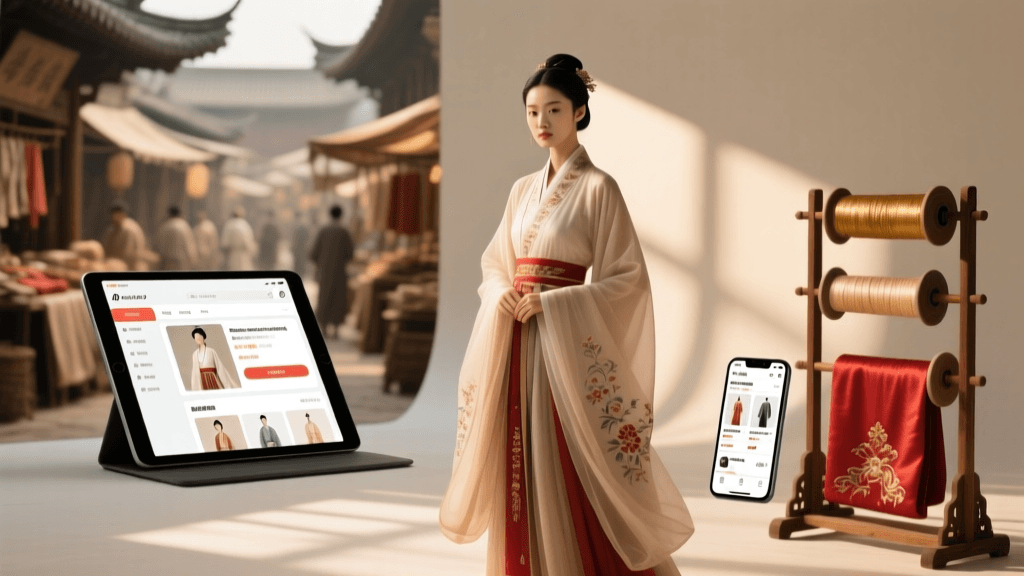
The true commercialization of Hanfu began with the rise of China's e-commerce giants, primarily Alibaba's Taobao and Tmall. By the mid-2010s, platforms like Taobao allowed small, passionate studios to bypass traditional retail gatekeepers and reach a national audience. Brands like Shisan Yu (Thirteen余) and Zhong Ling (钟灵记) emerged from these digital storefronts, transforming Hanfu from a niche hobby into a multi-billion-RMB industry.
As reported by Sixth Tone, the Hanfu market has experienced explosive growth, driven by Gen Z consumers, the proliferation of short-video platforms like Douyin (TikTok), and a broader cultural movement known as Guochao (national trend). Today, e-commerce platforms offer everything from historically accurate museum replicas to modernized, daily-wear Hanfu elements like the wildly popular Mamianqun (horse-face skirt). The digital marketplace has democratized access, but it has also introduced a complex ecosystem of pre-orders, fabric grading, and quality control that modern buyers must navigate.
Practical Buyer's Guide: Navigating Modern Hanfu E-Commerce
Buying Hanfu online requires a different approach than purchasing modern Western fashion. Here is actionable advice for navigating the modern e-commerce landscape, whether you are buying domestically in China or ordering internationally.
1. Understanding the Pre-Order System (Yushou vs. Xianhuo)
Unlike fast fashion, high-quality Hanfu is frequently produced on a pre-order basis to minimize inventory waste for small studios.
- Xianhuo (现货 - In Stock): Ready to ship within 48 hours. Usually limited to basic designs, popular sizes, or older collections.
- Yushou (预售 - Pre-Order): The standard for new releases. You pay a deposit (dingjin) or the full amount upfront, and the studio manufactures the batch. Actionable Tip: Expect wait times of 30 to 60 days. Always check the estimated shipping date on the product page, as delays are common.
2. Essential Measurements for the Perfect Fit
Hanfu sizing is generally more forgiving than modern tailored clothing due to its flat-cut construction and reliance on tying rather than zippers. However, you must know your measurements in centimeters (cm):
- Chest/Bust (胸围): Crucial for tops (Shan, Ao, Ru). Because Hanfu wraps across the chest, you need a minimum of 10-15 cm of ease beyond your actual bust measurement to ensure the cross-collar lies flat without gaping.
- Waist (腰围): Essential for skirts (Qun) and trousers. Measure where you intend to tie the skirt (usually the natural waist or slightly above the hips for a Mamianqun).
- Height and Arm Span: Hanfu sleeves can be exceptionally long (e.g., Pipa sleeves or ground-dragging Guangxiu). Check the garment's length chart to ensure the hem hits your desired point (ankle vs. floor).
3. Cost Breakdown and Budgeting
Prices vary drastically based on fabric, embroidery technique, and brand prestige. Here is a realistic budget guide (prices in USD for international reference):
- Entry-Level ($25 - $60): Usually made of polyester chiffon, digital prints, and machine embroidery. Great for beginners, travel, or hot summer weather. Brands like Lan Ruoshi often have entry-level options.
- Mid-Tier ($70 - $180): The sweet spot for most enthusiasts. Features jacquard woven fabrics, metallic yarn weaving, and intricate multi-thread machine embroidery. This tier offers the best balance of historical drape and durability.
- High-End & Bespoke ($250 - $1,000+): Genuine silk, real gold-thread weaving, and hand-embroidery (such as Su embroidery). These are investment pieces, often sold by heritage brands like Minghuatang.
Channel Comparison: Where Should You Buy?
Choosing the right platform depends on your location, budget, and tolerance for shipping logistics. Below is a comparison of the primary purchasing channels.
| Purchasing Channel | Price Range (USD) | Lead Time | Pros | Cons |
|---|---|---|---|---|
| Taobao / Tmall (Direct) | $30 - $500+ | 3 - 60 days | Largest selection, direct from studios, authentic guarantees on Tmall. | Requires a Chinese payment method (Alipay) or a shopping agent (like Superbuy/Pandabuy). |
| Global E-commerce (AliExpress / YesStyle) | $40 - $150 | 10 - 20 days | Easy checkout, English interfaces, direct international shipping. | Limited selection, higher markups, risk of 'Shanzhai' (knockoffs). |
| Physical Hanfu Stores (Chengdu / Xi'an) | $80 - $400 | Immediate | Try before you buy, includes styling, hair, and makeup services. | Only accessible if traveling in China, limited to in-stock sizes. |
Navigating Quality and the 'Shanzhai' Market
As the Hanfu market boomed, so did the proliferation of Shanzhai (knockoff) stores. These shops steal the original digital patterns and embroidery files from independent designers and mass-produce them using inferior, stiff fabrics that ruin the historical drape of the garment.
Actionable Advice for Authenticity:
- Look for the 'Zheng' (正) Character: Authentic Hanfu communities and buyers use the character 正 (Zheng, meaning authentic/original) to denote legitimate studios. Knockoffs are labeled as 山 (Shan, meaning fake).
- Check the Fabric Composition: Authentic historical drape requires specific weaves. Avoid cheap, shiny satin polyester. Look for terms like Qiangjin (metallic woven), Tihua (jacquard), or Lu (gauze/ramie) in the product details.
- Verify the Store's Credentials: On Taobao, check if the store is an official flagship (旗舰店) or if they have a long-standing reputation on community forums like Weibo's Hanfu super-topics.
Conclusion
The journey of Chinese traditional garments from the imperial silk markets of antiquity to the algorithmic storefronts of modern e-commerce is a testament to the enduring power of cultural heritage. Today's consumers have unprecedented access to centuries of sartorial history, provided they know how to navigate the digital marketplace. By understanding historical construction, mastering the nuances of pre-order logistics, and knowing how to identify quality textiles, modern buyers can build a Hanfu wardrobe that honors the past while embracing the conveniences of the digital age.