The Hanfu Retail Revolution: From Local Markets to E-Commerce
The Origins: Niche Forums and Brick-and-Mortar Tailors
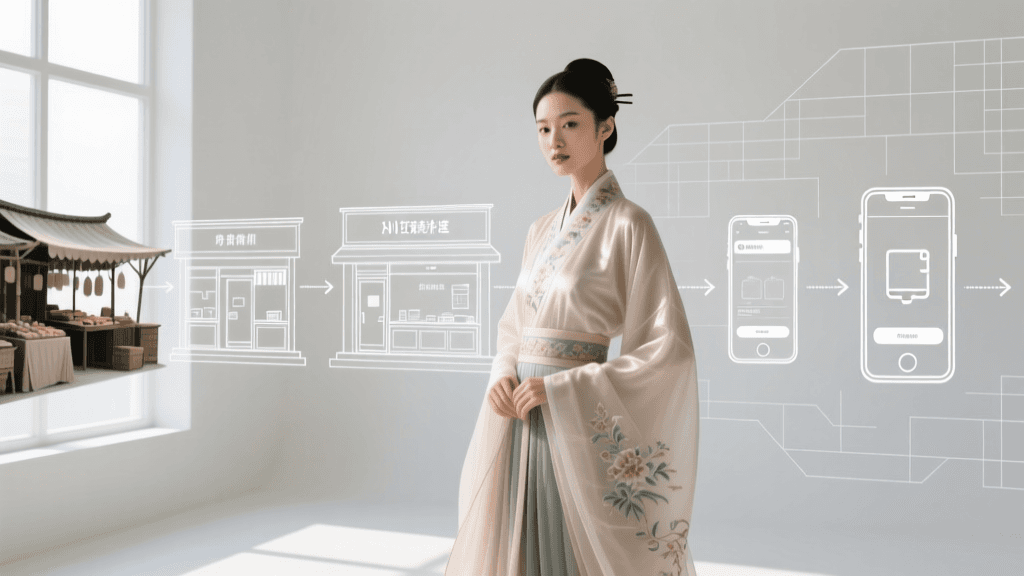
Before the advent of modern e-commerce platforms, acquiring traditional Chinese clothing—specifically Hanfu—was a labor-intensive endeavor restricted to dedicated cultural enthusiasts. In the early 2000s, the Hanfu revival movement was largely grassroots. Enthusiasts relied on niche internet forums like Baidu Tieba to share historical patterns, discuss textile research, and coordinate with local tailors. Physical retail options were virtually nonexistent outside of specialized theatrical costume shops or high-end bespoke tailors in cultural hubs like Xi'an and Chengdu.
For those who could access physical markets near historical sites, such as the Datang Everbright City in Xi'an, the experience was heavily reliant on in-person negotiations. Garments were often made from synthetic stage materials, and historically accurate textiles like silk gauze or damask were prohibitively expensive and difficult to source. A single, tailored set could cost upwards of $300 USD, with lead times stretching into several months. This high barrier to entry kept Hanfu confined to a small, dedicated subculture rather than a mainstream fashion movement.
The E-Commerce Catalyst: Taobao and the Hanfu Boom
The true democratization of Hanfu occurred alongside the explosive growth of China's domestic e-commerce giant, Taobao. By the mid-2010s, Taobao allowed independent designers and small workshops to bypass traditional retail gatekeepers, connecting directly with a national audience. According to BBC Culture, this digital infrastructure transformed Hanfu from a niche historical hobby into a multi-billion-dollar mainstream fashion industry.
E-commerce enabled the rise of specialized Hanfu brands that balanced historical accuracy with modern manufacturing efficiencies. Brands like Shisan Yu, Zhongling, and Ming Huatang emerged as digital-first powerhouses. They utilized high-quality product photography, detailed historical citations in their listings, and sophisticated supply chains to offer historically inspired garments at accessible price points. Today, the online Hanfu market is a sophisticated ecosystem where consumers can purchase everything from budget-friendly daily wear to museum-grade, hand-woven silk replicas.
Purchasing Channels Compared
For modern consumers, understanding where to buy is just as important as knowing what to buy. The retail landscape has fragmented into distinct channels, each catering to different buyer needs, budgets, and patience levels.
| Purchasing Channel | Price Range (USD) | Lead Time | Sizing Accuracy | Best For |
|---|---|---|---|---|
| Brick-and-Mortar Boutiques (Xi'an/Chengdu) | $80 - $400+ | Immediate | High (Tailored) | Tourists, urgent event needs, luxury buyers |
| Taobao / Tmall (Domestic China) | $30 - $250 | 7 - 90 days | Medium (Standardized) | Enthusiasts, variety seekers, domestic buyers |
| Global E-Commerce (AliExpress / Indie Sites) | $40 - $150 | 15 - 45 days | Low-Medium | International buyers, beginners, casual wear |
| Bespoke Artisan Workshops (WeChat/Direct) | $300 - $1,500+ | 3 - 8 months | Very High (Custom) | Collectors, historians, luxury patrons |
Actionable Guide: Navigating the Digital Hanfu Market
Buying Hanfu online requires a different approach than purchasing modern Western clothing. The structural complexity of traditional garments—featuring wrap skirts, cross-collars, and wide sleeves—demands precise attention to detail. Here is a practical guide to sourcing authentic garments online.
Sizing and Measurements
Unlike modern fashion, Hanfu sizing is rarely based on standard S/M/L charts. Most reputable Taobao shops require your exact measurements in centimeters. You will need to provide your height, bust, waist, and sometimes your arm span. Because traditional garments are designed with a generous drape, the crucial metric is often the 'garment length' rather than body-hugging proportions. Always add 2 to 4 centimeters of ease to your bust and waist measurements when consulting a shop's size chart to ensure the cross-collar wraps comfortably without gaping.
Navigating Pre-Sales (Yushou)
One of the most unique aspects of the Hanfu e-commerce market is the prevalence of Yushou (pre-sales). Because high-quality Hanfu requires specialized weaving, embroidery, and pleating, top-tier shops do not hold large inventories. Instead, they release digital renders or prototype photos, open a pre-order window for 7 to 15 days, and then manufacture the garments based on demand. If you are buying from premium shops like Ming Huatang or Ting Yue Ju, expect to wait anywhere from 45 days to 6 months for your garment to ship. Always check the listing for the estimated 'shipping date' (发货时间) before purchasing.
Identifying Quality and 'Orthodox' Garments
The online market is flooded with cheap, costume-like imitations. To ensure you are buying culturally respectful and structurally accurate clothing, look for the term Zhengtu (orthodox/correct form). Orthodox garments adhere strictly to historical cutting methods, such as the absence of shoulder seams and the use of traditional fabric widths. Avoid listings that use excessive zippers, modern darts, or synthetic lace. Reputable sellers will often provide diagrams of the garment's flat pattern and cite the specific historical dynasty or artifact that inspired the design.
Social Commerce and the Future of Hanfu Retail
The evolution of Hanfu retail did not stop at traditional e-commerce search bars; it has deeply integrated with social commerce. Platforms like Douyin (the Chinese counterpart to TikTok) and Xiaohongshu (Little Red Book) have become primary discovery engines. Live-streaming hosts now showcase the drape, texture, and movement of silk garments in real-time, answering buyer questions about fabric weight and opacity on the spot. This visual medium is particularly crucial for Hanfu, as the aesthetic value of the garment is heavily dependent on how the fabric moves and layers in natural light.
For international buyers, platforms like TikTok and Instagram have spurred the growth of independent global Hanfu retailers. These businesses act as curators and personal shoppers, bridging the language and logistics gap between Chinese Taobao workshops and Western consumers, often handling the complex international freight and customs processes.
Preserving Intangible Heritage in a Digital Age
While mass-market e-commerce has driven volume, the digital space has also become a lifeline for traditional artisans. The creation of authentic Hanfu relies heavily on intangible cultural heritage crafts, such as Song brocade weaving, Yunjin silk production, and traditional plant dyeing. As noted by UNESCO, the sericulture and silk craftsmanship of China are vital cultural practices that require continuous transmission to survive.
E-commerce allows these master artisans to reach a global audience of willing patrons. High-end buyers are increasingly using digital platforms to commission bespoke garments woven on traditional wooden looms. Furthermore, institutions like The Metropolitan Museum of Art have extensively documented the historical significance of Chinese silk and textile structures, providing the digital archives that modern e-commerce designers use to accurately recreate historical weaves and embroidery motifs for the contemporary market.
Conclusion
The journey of Hanfu from obscure physical markets to a dominant force in global e-commerce is a testament to the power of digital retail in revitalizing cultural heritage. What was once an inaccessible, hyper-local endeavor is now a thriving, globalized industry. By understanding the nuances of online purchasing—from navigating pre-sales and precise measurements to identifying orthodox construction—modern consumers can actively participate in the preservation and celebration of traditional Chinese sartorial arts. As e-commerce continues to evolve, it promises to keep the threads of history woven seamlessly into the fabric of modern life.