Imperial Hanfu Color Codes and Mandarin Squares Guide
The Language of Silk: Color and Rank in Imperial China
Traditional Chinese clothing, particularly the Hanfu worn during the Ming and Qing dynasties, was never merely about aesthetics or warmth. It was a complex, wearable text governed by the strict sumptuary laws of Li (rites and propriety). Every thread, dye, and embroidered motif served as a visual identifier of the wearer's social status, political rank, and cosmological alignment. For modern Hanfu enthusiasts, historians, and textile collectors, understanding these historical color codes and rank badges—known as Buzi or Mandarin Squares—is essential for achieving true historical accuracy in formal wear, cosplay, and cultural exhibitions.
According to the Metropolitan Museum of Art's Heilbrunn Timeline of Art History, the Ming dynasty (1368–1644) solidified a highly structured sartorial hierarchy that dictated exactly which colors and patterns were permissible for different tiers of society. Violating these codes was not considered a mere fashion faux pas; it was an act of treason punishable by severe penalties. Today, as the Hanfu revival movement grows globally, practitioners are increasingly looking to these historical codes to curate authentic, respectful, and deeply meaningful wardrobes.
Decoding the Imperial Color Hierarchy
In imperial China, color was intrinsically linked to the Wu Xing (Five Elements) theory and the social hierarchy. The dyes used to achieve these colors were often incredibly expensive, derived from rare botanicals, minerals, and insects, which naturally restricted their use to the elite.
- Bright Yellow (Ming Huang): Reserved exclusively for the Emperor. This color represented the center of the universe and the element of earth. The crown prince was permitted to wear a slightly muted apricot yellow, while imperial consorts wore golden yellow. Actionable Advice: Modern Hanfu wearers should strictly avoid bright yellow for formal historical recreations to maintain cultural respect and historical accuracy.
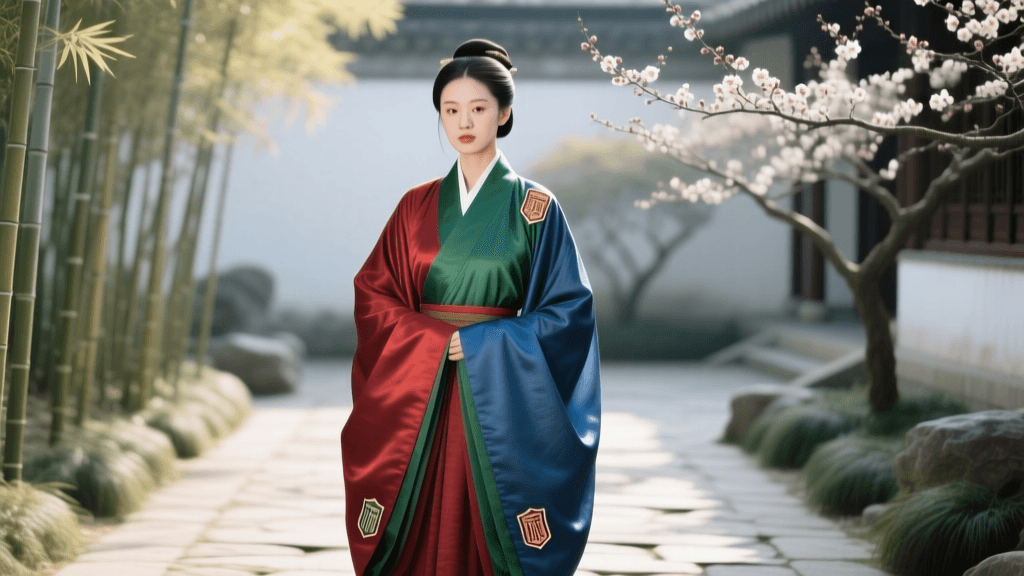
- Crimson and Red (Da Hong): The color of fire, joy, and high authority. During the Ming dynasty, crimson was the designated color for high-ranking civil and military officials (Ranks 1 through 4). It remains the most popular and culturally auspicious color for modern traditional Chinese weddings.
- Deep Blue and Azure (Qing/Lan): Associated with the element of wood and the scholarly class. Mid-tier officials (Ranks 5 through 7) often wore robes in varying shades of blue. Indigo dye was more accessible, making blue a staple for the educated gentry and scholars.
- Green (Lv): Generally assigned to lower-ranking officials (Ranks 8 and 9) and sometimes worn by scholars or musicians. Green was also heavily utilized in the intricate embroidery of collars and cuffs to provide contrast against darker silk grounds.
Buzi (Mandarin Squares): The Ultimate Rank Identifier
While color indicated broad social tiers, the Buzi (Mandarin Square) was the ultimate identifier of a specific official's exact rank. Introduced during the Ming dynasty and heavily codified during the Qing dynasty, these intricately embroidered squares were affixed to the front and back of the official's surcoat. As noted by the Victoria and Albert Museum's Asian Collections, the craftsmanship of a Buzi often reflected not just the wearer's rank, but their personal wealth, as higher-quality silk and gold-wrapped threads were frequently commissioned by the officials themselves.
Civil officials were represented by birds, symbolizing elegance, literary prowess, and grace. Military officials were represented by beasts, symbolizing courage, strength, and martial prowess. The Encyclopedia Britannica highlights that the Buzi system was one of the most rigid and universally recognized visual languages in pre-modern Asia.
Civil and Military Rank Motifs (Ming & Qing Dynasties)
| Rank | Civil Motif (Bird) | Military Motif (Beast) | Symbolic Meaning |
|---|---|---|---|
| 1st Rank | Crane | Qilin (Mythical Chimera) | Supreme wisdom and divine martial power |
| 2nd Rank | Golden Pheasant | Lion | Royal authority and undisputed bravery |
| 3rd Rank | Peacock | Leopard | Cultural refinement and strategic agility |
| 4th Rank | Wild Goose | Tiger | Loyalty, discipline, and raw strength |
| 5th Rank | Silver Pheasant | Bear | Integrity and steadfast resilience |
| 6th Rank | Egret | Panther | Purity of thought and swift justice |
| 7th Rank | Mandarin Duck | Rhinoceros | Fidelity and impenetrable defense |
| 8th Rank | Quail | Rhinoceros | Bravery and groundedness |
| 9th Rank | Paradise Flycatcher | Sea Horse (Mythical) | Vigilance and naval/maritime prowess |
Actionable Guide: Sourcing and Wearing Authentic Buzi Today
For modern Hanfu practitioners looking to incorporate Buzi into their formal attire (such as the Yuanlingpao round-collar robe or the Dahu sleeveless vest), sourcing historically accurate pieces requires an understanding of textile markets, measurements, and embroidery techniques.
Sizing, Costs, and Placement
- Measurements: Authentic Ming dynasty Buzi typically measure approximately 35cm x 35cm (14 x 14 inches) and were woven or embroidered as a single, continuous square. Qing dynasty badges were slightly smaller (approx. 30cm x 30cm) and were split down the middle to accommodate the front-opening surcoats. When buying modern reproductions, ensure you are purchasing the correct style for your specific garment's dynasty.
- Cost Tiers:
- Machine-Embroidered Replicas ($15 - $40 USD): Made with synthetic or blended threads. Suitable for casual cosplay, stage performances, or photography. Lead time is usually immediate from online retailers.
- Hand-Embroidered Silk ($150 - $600 USD): Created using traditional Suzhou embroidery techniques with real silk floss and sometimes metallic gold threads. Ideal for serious collectors and formal cultural events. Expect a lead time of 2 to 4 months if custom-ordered.
- Kesi (Silk Tapestry) & Antiques ($1,500 - $10,000+ USD): Museum-quality pieces. Antique Qing badges can be sourced from specialized auction houses, while modern Kesi weavers take 6 to 12 months to complete a single badge.
- Placement: For a Ming-style Yuanlingpao, the front badge should be centered on the chest, and the back badge centered between the shoulder blades. Use a blind-stitch hemming technique with silk thread to attach the badge so the stitches remain invisible on the interior lining.
Rules for Modern Hanfu Formal Wear
When attending modern formal events, such as traditional Hanfu weddings, ancestral rites, or cultural festivals, applying historical color codes adds a layer of profound respect to your attire. If you are the central figure (e.g., the bride or groom), crimson and deep red are highly appropriate and auspicious. If you are a guest, opt for deep blues, emerald greens, or subtle earth tones to avoid upstaging the principals of the event.
Furthermore, avoid mixing dynastic codes. Wearing a Ming-style round-collar robe with a Qing-style split Mandarin square creates a historical dissonance that experienced enthusiasts will immediately notice. Consistency in your era-specific styling demonstrates a deep, actionable understanding of Chinese sartorial history.
'The Mandarin square was not merely decorative; it was a rigid semiotic system. To wear the crane was to claim the literary pinnacle of the empire; to wear the tiger was to project martial invincibility. Today, when we recreate these garments, we are not just wearing silk—we are wearing the ambitions and philosophies of the past.'
By understanding the intricate symbolism of imperial color codes and the Buzi rank system, modern wearers can transform their Hanfu from a simple costume into a living, breathing homage to one of Asia's most sophisticated textile traditions. Whether you are investing in a hand-embroidered crane badge or carefully selecting a deep azure robe for a formal gathering, you are participating in a centuries-old dialogue of art, rank, and cultural pride.