Celestial Silks: Styling Hanfu Inspired by Chinese Mythology
Dressing the Divine: Hanfu and Chinese Mythology
The modern Hanfu revival movement (Hanfu Yundong) has transcended mere historical reenactment, evolving into a vibrant canvas for cultural storytelling. Among the most captivating niches within this community is the interpretation of traditional clothing through the lens of Chinese mythology and legends. Drawing inspiration from ancient texts like the Classic of Mountains and Seas (Shan Hai Jing) and the epic Journey to the West, enthusiasts and designers are translating the wardrobes of celestial deities, earth-bound creators, and mythical spirits into wearable, breathtaking ensembles.
According to the Encyclopædia Britannica's overview of Chinese mythology, the Chinese pantheon is deeply intertwined with natural elements, cosmological forces, and moral archetypes. When we dress as these figures, we are not just wearing clothes; we are embodying the moon, the earth, and the heavens. This guide provides actionable, practical advice on how to curate, tailor, and style mythological Hanfu for conventions, photoshoots, and cultural festivals.
Chang’e (The Moon Goddess): Ethereal Elegance
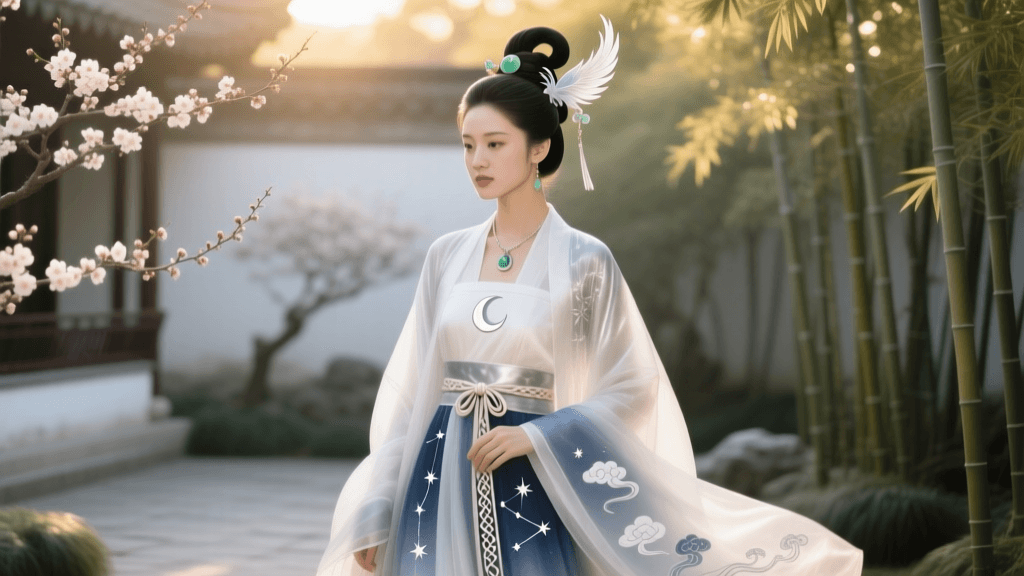
Chang’e, the goddess who ascended to the moon after consuming the elixir of immortality, represents ethereal grace, melancholy, and celestial beauty. Her mythological depictions emphasize weightlessness and lunar luminescence.
Garment Structure: The Qixiong Ruqun
The most historically resonant and visually accurate choice for Chang’e is the Qixiong Ruqun (chest-high skirt), popular during the Tang Dynasty. This silhouette features a high waistband that ties above the bust, creating an elongated, flowing lower half that mimics the trailing clouds of the heavens.
- Top (Shangyi): Opt for a Daxiushan (large-sleeve shirt) made of 8mm or 10mm silk chiffon. The sleeves should span at least 150cm from cuff to cuff to create a dramatic, wing-like effect when moving.
- Skirt (Qun): Use a multi-layered approach. A base layer of 16 momme silk charmeuse provides opacity and a subtle sheen, while an outer layer of silver-foiled organza adds lunar texture.
- The Pibo (Shawl): Essential for the Chang’e silhouette. Drape a 3-meter-long, 40cm-wide silk organza shawl around the arms. To keep it in place during outdoor shoots, use hidden magnetic clasps at the shoulders.
Color Palette and Accessories
The Smithsonian Asian Art Museum notes that colors in Chinese culture carry profound cosmological weight. For Chang’e, avoid stark, pure whites which can look flat in photography. Instead, use moonlight silver, pale celadon, and icy azure. Accessorize with a buyao (step-shake hairpin) featuring dangling jade rabbit motifs and freshwater pearl strands that catch the light with every movement.
Nuwa (The Creator Goddess): Earthly Power and Majesty
Nuwa is the mother goddess of Chinese mythology, famous for creating humanity from yellow earth and mending the broken heavens with five-colored stones. As Britannica's entry on Nuwa details, she is a figure of immense power, often depicted with a serpent or dragon lower half. In human Hanfu styling, this translates to grounded, majestic, and structurally complex garments.
Garment Structure: The Mamianqun and Aoqun
To capture Nuwa’s earthly authority, the Mamianqun (horse-face skirt) paired with a structured Ao (jacket) from the Ming Dynasty is ideal. The architectural pleats of the Mamianqun evoke the tectonic forces of the earth.
- Skirt Construction: Select a Mamianqun with flat front and back panels (the 'horse faces') and 6 to 8 pairs of deep side pleats. For a commanding presence, the skirt should be tailored to a 130cm length, grazing the floor when worn with traditional cloud-toe shoes.
- Fabric Choice: Heavy silk brocade or jacquard weave (minimum 25 momme). Look for woven motifs of swirling clouds, mountains, or the five elements.
- Jacket (Ao): A standing-collar (liling) or round-collar jacket with wide,琵琶 (pipa-shaped) sleeves provides a regal, structured upper body that balances the heavy skirt.
Color Palette and Accessories
Nuwa’s palette is rooted in the earth and the five-colored stones she used to mend the sky. Incorporate terracotta, deep ochre, jade green, and crimson. The most crucial accessory is the yaopei (waist chain). Create a custom waist chain using polished agate, turquoise, lapis lazuli, jade, and amber beads to represent the mythical five-color stones, anchoring the ensemble with a heavy silk tassel.
Longwang (The Dragon King): Sovereign of the Seas
For masculine or gender-neutral styling, the Dragon Kings of the Four Seas offer a blueprint for opulent, authoritative dress. The Dragon King commands the waters, requiring garments that reflect fluidity, wealth, and imperial power.
Garment Structure: The Yuanlingpao
The Yuanlingpao (round-collar robe) is the quintessential garment for this deity. Often worn by officials and royalty, it can be elevated to divine status through fabric manipulation and motif selection.
- Collar and Fit: The round collar must sit flush against the base of the neck. Tailoring requires precise neck circumference measurements (typically 38-42cm for adults) to prevent gaping. The robe should feature side slits for ease of movement.
- Sleeves: Opt for zhixiu (narrow sleeves) with leather or embroidered bracers for a martial water-deity look, or guangxiu (wide sleeves) for a scholarly, celestial bureaucrat aesthetic.
- Layering: Wear a white zhongyi (inner garment) with a slightly higher collar beneath the robe to create a crisp, layered neckline.
Color Palette and Accessories
Deep azure, midnight black, and imperial gold are mandatory. The fabric should feature woven water-wave (haishui jiangya) motifs. Accessorize with a guan (topknot crown) carved from dark wood or jade, and a leather belt featuring brass or gold-alloy plaques depicting coiling dragons.
Deity Styling Comparison Chart
| Deity | Core Garment | Primary Fabric | Color Palette | Est. Cost (USD) |
|---|---|---|---|---|
| Chang’e | Qixiong Ruqun & Pibo | Silk Chiffon & Organza | Icy Blue, Silver, Celadon | $120 - $250 |
| Nuwa | Mamianqun & Liling Ao | Heavy Brocade & Jacquard | Terracotta, Ochre, Jade | $180 - $350 |
| Longwang | Yuanlingpao | Silk Damask & Brocade | Deep Azure, Gold, Black | $150 - $300 |
Practical Guide to Sourcing and Tailoring
Bringing a mythological vision to life requires careful planning, especially when dealing with specialized fabrics and custom tailoring. Here is a practical roadmap for sourcing your divine wardrobe.
Measurements for Mythological Hanfu
Unlike modern Western clothing, Hanfu relies heavily on modular measurements and generous ease. When ordering custom pieces, provide the following to your tailor:
- Hollow to Hem: Crucial for Qixiong Ruqun. Measure from the underbust directly down to the ankle bone. For a 165cm tall wearer, this is typically 110-115cm.
- Arm Span: For Daxiushan (large sleeves), measure from the center of the back of the neck, over the shoulder, down to the wrist, and multiply by two. Add 10-15cm for the dramatic 'water sleeve' drape.
- Skirt Waist/Underbust: Measure the exact circumference where the skirt will sit, then add 3-5cm for overlap and tying ease.
Timing and Budgeting
If you are commissioning a custom mythological Hanfu for a specific event like the Mid-Autumn Festival (for Chang’e) or Lunar New Year, you must account for the production time of specialized brocades.
Pro-Tip: Commission custom-woven jacquard or brocade Mamianqun at least 8 to 10 weeks in advance. Ready-to-wear pieces from platforms like Taobao or independent Etsy artisans typically cost between $80 and $150, but custom-tailored sets with genuine silk and hand-embroidered motifs will range from $250 to over $500.
Conclusion
Styling Hanfu inspired by Chinese mythology is a profound way to engage with ancient narratives, transforming abstract legends into tangible, wearable art. Whether you are channeling the lunar sorrow of Chang’e, the earthly majesty of Nuwa, or the aquatic authority of the Dragon King, the key lies in understanding the intersection of historical garment structure and mythological symbolism. By carefully selecting fabrics, respecting traditional silhouettes, and incorporating symbolic accessories, you can step out of the mundane world and into the pages of the Classic of Mountains and Seas.