Hanbok Jeogori Construction: Zero-Waste Pattern Drafting in 2026
The Philosophy of Zero-Waste Asian Garment Construction
Asian garment construction stands in stark contrast to Western tailoring. Where Western garments rely on complex darts, princess seams, and bias cuts to sculpt the fabric to the body's curves, traditional Asian dress—such as the Japanese kimono, Chinese hanfu, and Korean hanbok—relies on geometric, flat-pattern construction. In 2026, as the global fashion industry grapples with sustainability and textile waste, the zero-waste philosophy inherent in these traditional techniques is experiencing a massive renaissance. According to the Victoria and Albert Museum's Asian collections, the structural integrity and elegance of historical East Asian garments rely heavily on the drape of the fabric rather than rigid tailoring. This article delves deep into the construction of the jeogori, the iconic upper garment of the Korean hanbok, exploring its masterful zero-waste geometry, curved seaming techniques, and how modern makers are adapting these methods in 2026.
Anatomy of the Jeogori: A Masterclass in Geometry
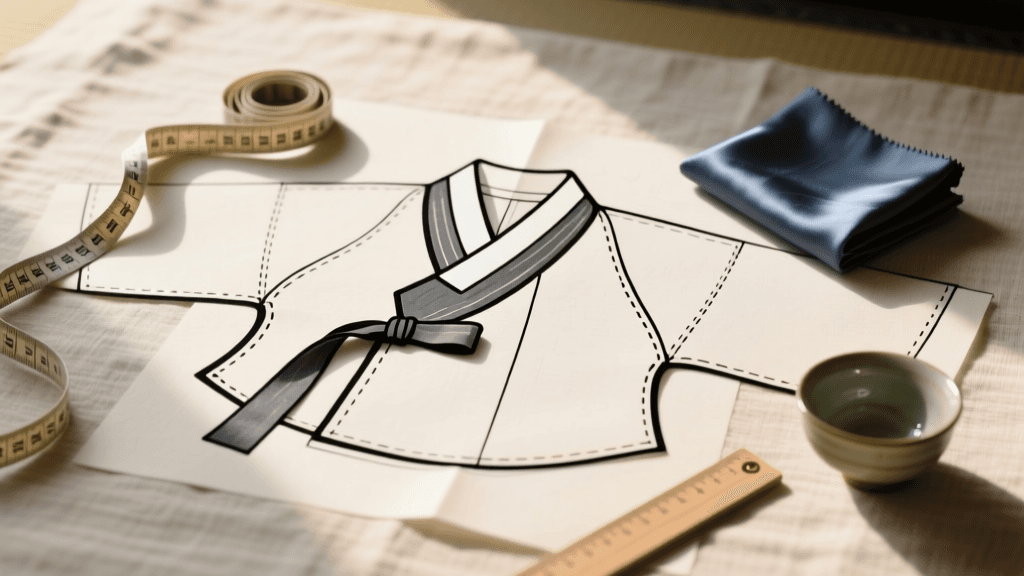
To understand the construction, one must first understand the anatomy of the jeogori. Unlike a Western jacket, which is heavily structured with interfacing and padding, the jeogori is soft, unlined or lightly lined, and flows naturally. The primary components include the gil (the front and back body panels), the somae (the sleeves), the git (the collar band), the seop (the front overlap that creates the V-neckline), and the dongjeong (the removable, stiff white paper or fabric collar that sits atop the git). As highlighted by the Metropolitan Museum of Art's Asian Art department, the elegant simplicity of the Joseon dynasty jeogori masks an incredibly complex system of proportional geometry designed to accommodate the human form without restricting movement.
Traditional Loom Widths and the Rectilinear Pattern
Historically, traditional Korean looms produced narrow fabric widths, typically around 45 to 50 centimeters. This loom limitation birthed the zero-waste rectilinear pattern. The gil and somae were essentially cut as long rectangles. To create the necessary volume and shaping without wasting a single scrap of precious silk or ramie, makers utilized strategic folding, gussets, and curved seams. The beauty of this system is that if a garment was worn out or needed to be cleaned, the seams could be entirely unpicked, the fabric panels washed and stretched, and the garment re-sewn. In 2026, modern textile artists are returning to this narrow-width mindset, utilizing sustainable, small-batch woven silks to honor the historical zero-waste ethos while minimizing modern cutting room floor waste.
Step-by-Step Construction Techniques
1. Shimjil: The Art of Basting
The absolute foundation of hanbok construction is shimjil, or basting. Because traditional silk and ramie are incredibly slippery and prone to shifting, long, temporary running basting stitches are applied before any permanent seaming. This ensures the geometric panels align perfectly. In the modern 2026 atelier, makers often use water-soluble basting threads or Teflon-coated synthetic basting yarns that glide through delicate peace silks without snagging or leaving residue, significantly speeding up the preparation phase while maintaining traditional accuracy.
2. Ssamjimjil: Flat-Felled Seaming
Once basted, the straight seams of the gil are joined using ssamjimjil, a traditional flat-felled seam. This technique encloses all raw edges within the seam itself, eliminating the need for overlocking or serging. The seam allowance is typically 1.5 centimeters. One edge is trimmed, the other is folded over it, and then stitched down flat. This creates a remarkably clean interior, allowing the jeogori to be fully reversible if constructed without a separate lining, a highly sought-after feature in modern sustainable fashion.
3. Sculpting the Baerae: The Sleeve Curve
The most complex and visually striking element of the jeogori is the baerae, the curved bottom edge of the sleeve. While the top of the sleeve attaches to the straight shoulder of the gil, the underarm and bottom hem sweep downward in a gentle, crescent-like curve. To sew this without puckering, the seam allowance on the inner curve must be meticulously clipped or notched. Traditional makers use a darrimi (a heavy, flat iron) to press the curve into submission. In 2026, studios utilize precision steam-wand pressing stations with custom-curved wooden bucks to achieve a flawless, pucker-free baerae that perfectly mimics the historical silhouette.
4. Attaching the Git: The Collar Intersection
Attaching the git (collar) to the gil and seop requires immense precision. The intersection where the collar meets the front overlap must form a sharp, perfect V-shape when worn. The seop is cut on a slight curve or bias to allow the fabric to wrap smoothly across the chest. Makers use a technique called gapseam (enclosed seam) to attach the collar, ensuring no raw edges are visible. The removable dongjeong is then tacked lightly to the git, providing a stark white contrast that frames the face and draws the eye upward.
Traditional Hand-Sewing vs. 2026 Digital Adaptations
While the soul of the hanbok remains in its hand-sewn origins, the 2026 atelier blends ancestral wisdom with cutting-edge technology to improve efficiency and accessibility without compromising the garment's integrity.
| Construction Phase | Traditional Hand Method | 2026 Modern Adaptation | Impact on Production |
|---|---|---|---|
| Pattern Drafting | Chalk marking directly on fabric based on body measurements. | CLO3D parametric zero-waste nesting optimized for modern wider fabrics. | Reduces silk waste by up to 18% while maintaining traditional drape. |
| Cutting | Heavy fabric shears; high risk of fraying on silk gauze. | Ultrasonic cutting blades that seal edges via heat friction. | Eliminates fraying, removes need for chemical sealants on sheer fabrics. |
| Basting (Shimjil) | Long running stitches with cotton thread. | Water-soluble PVA basting threads applied via low-tension machines. | Saves 2-3 hours per garment; dissolves completely in the first wash. |
| Seaming (Ssamjimjil) | Hand-stitched flat-felled seams using silk thread. | Specialized flat-felling presser feet on computerized straight-stitch machines. | Increases seam durability and uniformity for everyday modern wear. |
| Collar Shaping | Starch and heavy iron pressing. | 3D-printed flexible collar inserts and ergonomic steam-bucks. | Ensures the perfect V-neck angle regardless of the wearer's posture. |
Essential Tools for the 2026 Hanbok Atelier
For contemporary designers and hobbyists looking to construct a jeogori in 2026, the toolkit has evolved. While a good pair of fabric shears and silk pins remain essential, modern makers should invest in an ultrasonic fabric cutter. This tool uses high-frequency vibrations to cut and seal synthetic and blended organzas simultaneously, which is crucial when working with modern sustainable alternatives to traditional silk gauze (sa). Additionally, digital fabric relaxers are now standard in professional studios; these machines gently steam and unroll bolt silk, removing the tension and creases caused by shipping, ensuring that the rectilinear panels of the gil do not warp after the garment is completed.
Furthermore, 3D body scanning technology has revolutionized the fitting of the git. Historically, the collar was drafted to fit a standardized posture. Today, scanning allows makers to adjust the angle of the seop overlap to accommodate modern ergonomic habits, such as the forward-leaning posture associated with computer work, ensuring the V-neck remains perfectly centered and does not gape.
Preserving the Legacy in a Modern Era
The construction of the jeogori is more than just a method of assembling fabric; it is a profound expression of respect for materials, geometry, and the human body. The preservation of these intricate sewing methods is vital, a sentiment echoed by the UNESCO Intangible Cultural Heritage initiatives, which continually emphasize the importance of safeguarding traditional craftsmanship in a rapidly digitizing world. By understanding and adapting the zero-waste, flat-pattern techniques of the hanbok, the 2026 fashion community not only honors Korean heritage but also pioneers a sustainable path forward for global garment construction. Whether you are drafting by hand with chalk or nesting patterns via AI-driven software, the fundamental philosophy remains unchanged: every thread, every curve, and every seam serves a deliberate, harmonious purpose.